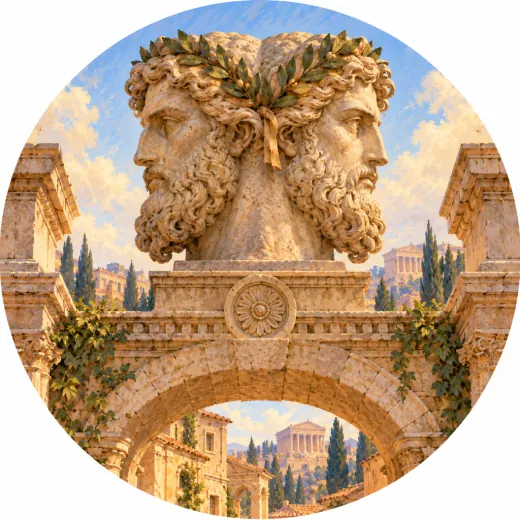
Janus
Ianus, in Latin
not scary at all
Janus is a purely Roman god, one the Greeks did not have. He has two faces, one looking forward and one looking back, because he is the god of doors, passages and beginnings. He was prayed to first, before any other god, whenever something new was starting. In Rome the doors of his temple stood open when the city was at war and closed when there was peace: the historian Livy tells that, from Numa down to his own day, they were closed only three times.
Did you know? January, the month that opens the year, takes its name from him: Ianuarius, the month of Janus.
The story
On the first day of the year, in Rome, nobody quarrels.
That was the custom. You got up at dawn, you greeted people with kind words even if you didn't like them, and for breakfast you ate sweet things: dates, dried figs, honey. Anyone who owed money was left in peace. Anyone who had an enemy wished him, under their breath, a happy new year. People believed that the first day set the tune for all the others.
And in Rome, the first day belonged to one god alone.
The poet Ovid was writing the calendar in verse. All he needed was a lamp and a writing tablet. It was already the dead of night when he heard a noise in the room, like the creak of a hinge, and a light that was not the lamp's lit up his desk.
He looked up. In front of him stood a man with two faces.
One face looked at him. The other looked back over the man's shoulder, towards the wall, and towards everything in the wall that could not be seen. One was younger and one was older. Both were smiling, with the smile of someone who has already seen too much. In his right hand the man held a key, and in his left a long staff.
“Don't be afraid, poet,” said one mouth. The other, at the same moment, finished the sentence. “You're writing about me. You might as well ask me.”
“Who are you?” asked Ovid, who knew perfectly well.
“Janus.”
And Ovid, who by now had forgotten his fear and found his curiosity again, asked the first question that came into his head.
“Why do you have two faces?”
“Because a door has two sides,” answered Janus. “No one has ever gone into a place without first coming out of another. I look forwards and backwards, because that is how thresholds are guarded. I keep the sky: I am the doorkeeper of the gates the sun passes through. That is why I have the key and the staff: the key to open, the staff to keep away those who must not pass.”
Ovid wrote it down. Then he asked another.
“Why are you prayed to first? Before Jupiter, before everyone?”
“Because every prayer, to reach the gods, has to go through a door,” said Janus. “And I am the door. If you want something from someone, you knock on mine first. The first month of the year is mine, the first day is mine, the first step of everything is mine. January bears my name: the month of Janus. And I have two other names as well, Patulcius and Clusius, because I am the one who opens and the one who closes. A door always needs both.”
“And once they called you something else.”
“Once,” said Janus, with an expression very like a sigh, “they called me Chaos. When the world was a shapeless mass, with no sky and no earth, and everything was jumbled together. Then that great muddle came apart: fire rose up, earth sank down, the sea settled in between. I remained, hanging between one thing and another, and the shape I had then I still keep today. Two faces, because I was no longer one single thing.”
Ovid looked at him with respect. Then a more practical question occurred to him.
“At New Year, Romans give each other presents. Dates, figs, honey. Why?”
“Because people want the year to begin with sweetness. And some give bronze coins, too. On one side is my double head, and on the other the prow of a ship.”
“A ship?”
“The god Saturn came by sea, and I welcomed him. That is why my coin has a ship on it.”
Then Ovid asked the thing he had always wanted to know.
“Your temple, down in the Forum. Why are its doors open in wartime and closed in peacetime?”
Janus grew serious. Both his faces did.
“Because once, long ago, the city was in danger.”
He told how, after the Sabine women were carried off, the Sabines had come to Rome in arms, with their king, Titus Tatius. The citadel was guarded by a girl called Tarpeia, who out of greed had opened the gate to them, and the enemy was already getting into the city. The streets were empty, and the Forum still undefended. The Sabines were climbing towards the Forum.
“So I did something,” said Janus. “I opened a spring. From the ground beneath their feet I made boiling water gush out, stinking of sulphur. The Sabines stopped. Some ran away, others stood rooted to the spot. When the Romans came back, they found the way clear.”
“And that's why the doors stay open?”
“They stay open in war, so that those who leave the city can always come back. They are closed in peace, so that peace stays inside and does not get out.”
The poet sat with his stylus in mid-air.
The story does not end there. The historian Livy, in his books, says that it was King Numa, the second king of Rome, who built that temple and closed its doors for the first time. After that, for centuries, they stayed open. Rome was always at war with someone. Up to his own day, Livy counted only two other times when they were closed: after the first war against Carthage, and after the Battle of Actium, when the civil war ended and Augustus brought peace.
Three times, from Numa down to Livy's own day.
When Ovid looked up again, the man with two faces was gone. The lamp had almost gone out, the cockerel was crowing, and the first light of a new year was coming in through the window.
The poet smiled. He picked up his tablet, pinched out the lamp with two fingers and opened his front door. Outside, the street was grey and silent. At the far end someone was throwing open their shutters; further along, a woman was coming out with a basket of figs.
Ovid waved to her.
“Happy new year,” he said.
And he was the first to speak in the whole city.
Relatives around the world
Listen / Read next
- Music to read by: Cinematic JourneyEpic film-style music, no lyrics, by Ciro Simone IrmiciSpotifyYouTube Music
Sources
- Ovid, Fasti, Book I
- Livy, History of Rome, Book I
