Heimdall
Heimdallr, in Old Norse
not scary at all
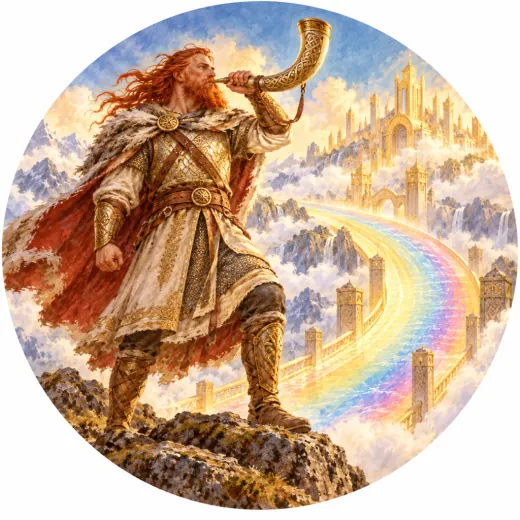
Heimdall is the watchman of the gods. He lives beside Bifröst, the rainbow bridge that links the world of humans to Asgard, and keeps watch day and night. He needs less sleep than a bird, he can see a hundred leagues away by day or by night, and his hearing is so sharp that he can hear grass growing and wool growing on sheep's backs. He has a horn, the Gjallarhorn: he will blow it only once, when Ragnarök comes, to wake all the gods.
Did you know? According to Snorri his teeth were made of gold, so one of his nicknames was “gold-tooth”.
The story
Heimdall did not sleep.
Or rather: he slept less than a bird, which is not much to begin with. He would close his eyes for the space of a single breath, open them again, and the world would still be there, with its stars, its rivers and its sounds.
He lived in a house called Himinbjörg, at the very edge of the sky, right where the bridge began. The bridge was the rainbow. It was called Bifröst, and it was the road the gods took every day to come down from the sky to the earth. From far away you could see seven colours. Close up, you could see that the red was real fire, burning and never going out, so that the giants would never be tempted to climb up to the city of the gods.
But all that would not have been enough. Someone had to stand guard, night and day, without ever getting distracted.
Heimdall stood guard. People said he had been born of nine mothers, nine sisters, at the edge of the world, and that as a child he had been fed on the strength of the earth and the cold water of the sea. Perhaps that was why he had never needed to sleep.
He had golden teeth, and when he smiled, which did not happen often, it was like a lantern lighting up in the dark. He had a horse with a golden mane, but he rarely rode it. He spent his time sitting on the threshold, his chin resting on his hand, listening.
He could see a hundred leagues away, by day and by night, and to him there was no difference. He could hear the grass growing on the earth: a faint, steady rustle, like breathing. He could even hear the wool growing on the backs of sheep in some faraway valley, where nobody would ever have guessed they were being listened to.
That night, like every other night, he was listening.
He heard a fox cross a meadow. He heard the wind stir the branches of an ash tree. He heard the sea, very far away, repeating the same sentence it always says. He heard frost settling on the leaves, and a spider tying off its thread between two twigs. He heard a child turn over in its sleep, a door closing, a raven settling its feathers. And then, at a distance nobody else could have measured, he heard a footstep.
A light footstep, the step of someone who does not want to be heard. It was coming towards the bridge.
Heimdall did not get up. He waited, and when the figure was close enough to be seen, he raised his eyes.
“Good evening, Loki.”
Loki stopped on the first step of the bridge, wearing a look of innocence that did not suit him at all.
“How did you know it was me?”
“I've heard you since you left the woods.”
“I've been out and about.”
“I know where you've been.”
Loki scratched his neck. The two of them had known each other a long time, and they did not like each other. There had been a time, so people said, when Loki stole a necklace from a goddess, and Heimdall chased him, and the two of them fought on the seashore in the shape of seals. Heimdall won and brought the necklace back. It was not a story for telling children. But neither of them had forgotten it.
“May I pass?” said Loki.
“It's your bridge.”
“Then I'll pass.”
“Pass.”
Loki climbed up, brushing the handrail of light with his fingers, and vanished towards the city of the gods. The red fire brushed against his cloak and did not burn it.
Heimdall followed him with his eyes for as long as there was any point. Then he looked at the red fire of the bridge and thought that, when it came down to it, he and Loki had one thing in common: both of them knew how it would all end, and both of them carried on anyway.
He went back to listening.
Below him, on the earth, a farmer was lighting a fire for the night. A shepherd was counting his sheep. A child was asking its mother why the sky was so full of little dots.
There was one thing, though, that Heimdall never listened to. He kept it far at the back, the way you keep a thought you would rather not have: his horn.
The Gjallarhorn was an enormous horn, silvery and ageless. It was not in his house and not at his belt. According to some translations of the old poem, it was hidden under a root of the greatest tree in the world, in a place only Heimdall knew. No one had ever blown it. When someone did, the sound would be heard in every world, above and below, from the ice to the land of the dead.
That would be the day.
He did not know when. He only knew it was coming. One winter longer than the others, then another, and another still with no summer in between. Brothers who would kill each other. A wolf that would swallow the sun. And then, from the south, the sons of Muspell, the realm of fire, would ride onto the bridge with blazing swords, and beneath them the bridge would break.
Then Heimdall would rise to his feet, take the horn and blow it with all the breath he had. A sound no god could ignore, one that would reach all the way to Valhalla, to the halls where the heroes slept, to Odin, who would hurry off to seek advice from the head of wise Mímir. All the gods would wake, take up their weapons and go down onto the plain for the last battle.
He would face Loki, and each would kill the other.
He knew it. He had always known it, the way you know your own name.
But it was not that night.
That night there was the rustling of the grass, and the sheep, and the sea, and the child who had fallen asleep with its forehead against the windowpane. And there was the bridge, beautiful, red and blue and gold in the moonlight, waiting to be crossed.
Heimdall yawned, just for a moment. Then he sat up straight, rested his chin on his hand and listened once more.
Because someone had to do it. And the night, after all, was long.
Relatives around the world
Listen / Read next
- Music to read by: Cinematic JourneyEpic film-style music, no lyrics, by Ciro Simone IrmiciSpotifyYouTube Music
Sources
- Snorri Sturluson, Prose Edda, Gylfaginning and Skáldskaparmál
- Poetic Edda, Völuspá and Hyndluljóð
