Yggdrasil, the World Tree
Yggdrasill, in Old Norse
not scary at all
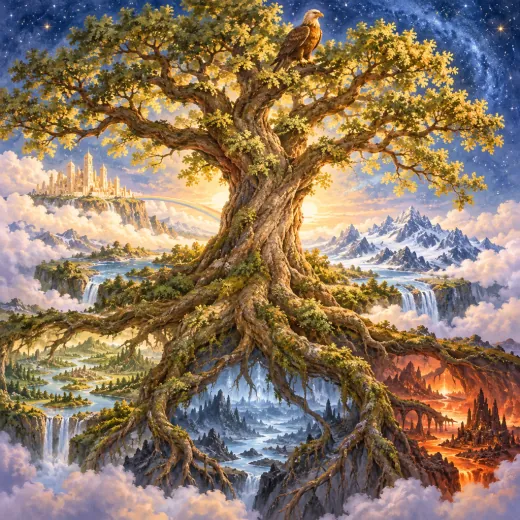
For the peoples of the North, the whole world was held up by a gigantic ash tree, Yggdrasil. Its branches spread out above the sky and its three roots reach different places: the home of the gods, the land of the frost giants and the kingdom of the dead. Among the branches and roots lie nine worlds, including ours, Midgard. An eagle lives at the top, a dragon gnaws the roots underneath, and a squirrel runs up and down carrying insulting messages between the two.
Did you know? Every day three women called the Norns water the roots of the tree from a spring, so that it does not dry out.
The story
Nobody has ever seen the top of Yggdrasil, and nobody has ever seen its roots. All anyone knows is that it is there.
It is an ash tree, the biggest, the tallest, the finest of all trees. Its branches spread out above the sky. Its trunk holds up the nine worlds, and each world sits in a different place: the world of the gods, the world of the frost giants, the world of the dead, and in the middle, small and brave, the world of humans.
The tree is never alone. At the very top lives an eagle who knows many things, and between its eyes sits a hawk, Veðrfölnir. Down below, among the roots, slithers the dragon Níðhöggr, who has been gnawing at them for ever, with a crowd of serpents beside him. Four stags run among the leaves, nibbling at them. And up and down the trunk, all day long, never stopping, runs a squirrel, Ratatoskr, who carries words from the eagle to the dragon and from the dragon to the eagle. They are never kind words. The squirrel remembers them precisely, and when he repeats them he makes them a little bit worse.
And yet the tree does not wither.
Under one of the roots there is a well, the well of Urðr, and three ancient women live there, called the Norns: Urðr, Verðandi, Skuld. What was, what is, what shall be. Every day they draw water from the spring, along with a little white clay, and pour it over the roots so the branches stay green. That water is so pure that anything that enters the well turns as white as an eggshell. Two swans swim in the well, and from them come all the swans in the world. And now and then a dew as sweet as honey drips from the tree, and the bees feed on it.
Every morning the gods ride across the rainbow bridge, all of them on horseback except Thor, who prefers to wade through the rivers on foot, and they come to sit beside the well and give judgement. That is where fate is decided.
Under another root, in a cold and silent place, lies Mímir's well. Mímir drinks from it every morning, and that is why he knows more than anyone else. Whoever drinks that water becomes wiser than anyone.
The third root reaches down into the mist, into the realm of the dead, where a spring called Hvergelmir bubbles and boils. That is where the rivers are born. And there, among the serpents, the dragon spends his days gnawing, and he never gets bored.
One day, a very long time ago, Odin decided to go and see Mímir. He walked along the root that ran down towards the frost, where once, before there was a world, there had been nothing but emptiness. The wind carried needles of hoarfrost. Behind him the sounds of the sky faded little by little, and ahead of him a silence of water grew.
Mímir was waiting for him, because he always knew who was about to arrive.
“I want to drink,” said Odin.
“All knowledge has its price,” Mímir replied. “What will you give me?”
Odin did not hesitate. He raised his hand to his face, took out one of his eyes and left it at the bottom of the well. When he drank, he saw in that water things he had never seen, far away and close by. But he wanted more.
He wanted the runes.
The runes were the signs used to write the oldest words of all: words that healed and words that bound, words that opened a door and words that barred it. Nobody owned them. They were in the tree, or under the tree, or perhaps in its silence, and there was only one way to reach them.
So Odin climbed Yggdrasil.
He did not climb it to rest. For nine nights he hung from a branch battered by the wind, with a wound in his side from a spear, given to Odin, himself to himself. Nobody offered him bread. Nobody offered him a horn to drink from. Below him gaped a bottomless emptiness, and above him was the noise of the branches, a rustling that sounded like a choir.
On the first night he was cold. On the second he was thirsty. On the third he stopped feeling his arms. The fourth and fifth he spent counting sounds, because it was the only way to stay awake. On the sixth he began to forget his own name. The squirrel came down to have a look, eyed him rather suspiciously and dashed back up to tell the eagle that the father of the gods was hanging from the trunk. The eagle did not reply. Little by little the wind became a voice, and the voice became a language. He thought he could hear what the leaves were saying. Then the sound of the squirrel running along the trunk, and the dragon's mutterings in the dark, and the Norns murmuring far below, and the water of the well.
By the eighth night there was nothing left of him that was not listening.
At dawn on the ninth, he looked down. On the ground, among the roots, he saw signs. They had always been there, and nobody had ever seen them. He seized them with a scream, and the scream flew out of his mouth like a bird and hung in the air. Then he fell.
When he hit the ground he felt no pain. He felt only a strange lightness. He realised he had begun to understand. Words gave birth to other words, deeds to other deeds, and he felt himself growing like a young tree, full of sap.
“I have learned,” he said. And he stood up again.
From that day on, Odin was the wisest of all the gods.
One day, they say, all of this will end. When Ragnarök comes, the end of the world, the ash tree will tremble in every branch, and its old trunk will groan, and the wolf and the giants will break free. But, they say, it will stay standing.
Until that day comes, every morning a squirrel runs up and down an enormous ash tree, carrying a nasty message from one end to the other. Who knows whether the eagle and the dragon would ever have insulted each other without him.
Relatives around the world
Listen / Read next
- Music to read by: Cinematic JourneyEpic film-style music, no lyrics, by Ciro Simone IrmiciSpotifyYouTube Music
Sources
- Poetic Edda, Völuspá and Grímnismál
- Snorri Sturluson, Prose Edda
