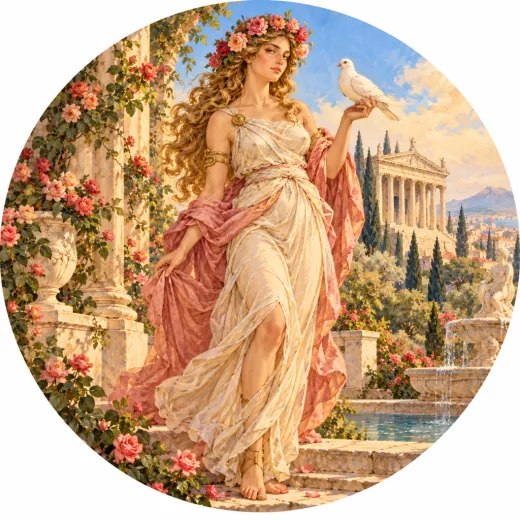
Venus
Venus, in Latin
not scary at all
Venus was the goddess of love and beauty, the same goddess the Greeks called Aphrodite. For the Romans she was extremely important because she was the mother of Aeneas, the Trojan hero from whom Romulus and Remus descended. Julius Caesar's family claimed to descend from her, through Iulus, the son of Aeneas. In the Aeneid, Venus protects her son throughout the voyage from Troy to Italy, and once she appears to him disguised as a huntress to give him advice.
Did you know? The second planet from the Sun, the brightest in the night sky after the Moon, is named after her.
The story
A Roman poet, Lucretius, began his great poem with a prayer.
“Mother of Aeneas' people, delight of men and gods, life-giving Venus,” he wrote. He said that when she comes, the winds drop, the clouds go away, the earth spreads out its flowers, the sea laughs and the sky grows bright. The birds sense her coming and their hearts leap in their chests. And he prayed: you alone can give the Romans peace.
That is what Venus was for the Romans. But she was something else as well: she was a mother.
Her son's name was Aeneas. He had escaped from burning Troy with his father on his shoulders and his son by the hand, and had set out to sea with a handful of survivors, looking for a land where they could start again. Seven years of wandering. One evening, off the coast of Sicily, a storm caught them.
The wind heaved the waves up like mountains. The ships crashed into one another, broke apart, vanished into the dark. Aeneas, clinging to the helm, raised his hands to the sky and said it would have been better to die at Troy.
Up above, someone was watching.
Venus sat in the palace of the gods with tears in her eyes. Meanwhile the god of the sea, Neptune, had heard the uproar and lifted his head from the waves: with a single word he calmed the winds, and the surviving ships were able to reach a shore. Aeneas landed with a few companions on the coast of Africa, worn out, with the wind cutting into his skin. With him was Achates, his most loyal friend. They hunted seven deer and shared them among all the sailors. That evening Aeneas spoke to comfort the others, but inside his heart was heavy. He did not know what had become of the other ships. He did not even know where he was.
Venus, however, had not calmed down. She went straight to Jupiter, who sat on his throne with his grey beard and his kingly gaze.
“Father,” she said. “You who rule over all things. What has my son done wrong? You promised me that from his blood the Romans would be born, and that they would rule the world. Have you changed your mind? Why did you let him nearly drown?”
Jupiter smiled. He kissed her on the lips, the way a father kisses his daughter, and said gently: “Don't be afraid. Fate has not changed. You will see the walls of Lavinium, and you will raise Aeneas up to the stars. Little Ascanius will found Alba Longa, and his kingdom will last three hundred years. Then a boy will be born, Romulus, raised by a she-wolf, and he will found a city. To those Romans I set no boundaries and no limits of time: I will give them an empire without end.”
And he foretold, too, that from that people a Caesar would be born, who would take his name from Iulus, Aeneas' son, and that the world would then know peace.
Then Jupiter sent Mercury to Carthage, to make the people there ready to welcome the shipwrecked strangers.
The next morning, as Aeneas and Achates were walking through the woods, they met a girl.
She came towards them with a light step. She had a bow slung over her shoulder, her hair loose on her shoulders, and her dress hitched up and knotted at the knee, like the huntresses of Sparta. She looked like a creature of the forest.
“Young strangers,” she said. “Have you by any chance seen one of my sisters? She was hunting a wild boar, with a quiver and a cloak of lynx skin.”
“No,” answered Aeneas. “But you… you cannot be a mortal. Are you Apollo's sister, perhaps? Or a nymph? Whoever you are, help us. Tell us where we are. The waves and the wind have driven us here.”
“I'm no goddess,” she replied with a smile. “The girls of Tyre always carry a quiver and wear purple boots. You are in the land of the Punic people. The city you can see rising is called Carthage, and it is ruled by a queen, Dido.”
She told him Dido's story. Dido had fled from Tyre after her brother Pygmalion, out of greed, had murdered her husband, Sychaeus. She had loaded her treasure and her friends onto ships and landed on this coast. There she had bought as much land as an ox hide could cover, and had cut the hide into very thin strips, to make the boundary as big as possible.
Then she asked: “And who are you? Where do you come from?”
Aeneas sighed. “If I told you all our misfortunes, night would fall before I finished. I am Aeneas, called the dutiful. I carry with me my gods, saved from Troy. I am looking for Italy. I set out with twenty ships, and seven are left, or perhaps not even those. I wander alone through the wilderness, without a home.”
The girl gently interrupted him.
“Don't complain. I believe the gods have not abandoned you.” And she pointed to the sky. Twelve swans, brilliant white, were flying in neat lines. A little earlier an eagle had scattered them, but now they were coming down to land, one after another. “You see? Your companions are safe. They have found a harbour. Go on along this road.”
She turned to leave. And as she turned, the back of her neck glowed rosy pink. Her hair breathed out a fragrance not of this world. Her dress fell down to her feet. Now, just from the way she walked, anyone could tell who she was.
Aeneas recognised her.
“Mother!” he cried. “Why do you trick me? Why do you hide your face from me, so that I cannot touch your hand, or speak to you as a son speaks to his mother?”
But the goddess did not turn back. She brought down a thick mist over the two men, hiding them from everyone, so that no one could touch them or ask them what they were doing there. Then she rose back up into the sky, towards Paphos, where she had a temple and a fragrant altar.
The two men climbed the hill in the mist, and from the top they saw Carthage being born. They could see masons building walls, workers digging the harbour, people unloading stones. And beneath the mist, unseen by anyone, Aeneas thought for the first time in a long while that perhaps there was a future after all.
But Venus did not trust them. She did not trust the Carthaginians, or that queen. So she sent her son Cupid, the little god of love, wearing Ascanius' face, to sit on Dido's lap.
But that is another story.
Relatives around the world
Listen / Read next
- Music to read by: Cinematic JourneyEpic film-style music, no lyrics, by Ciro Simone IrmiciSpotifyYouTube Music
Sources
- Virgil, Aeneid, Book I
- Lucretius, On the Nature of Things, Book I
