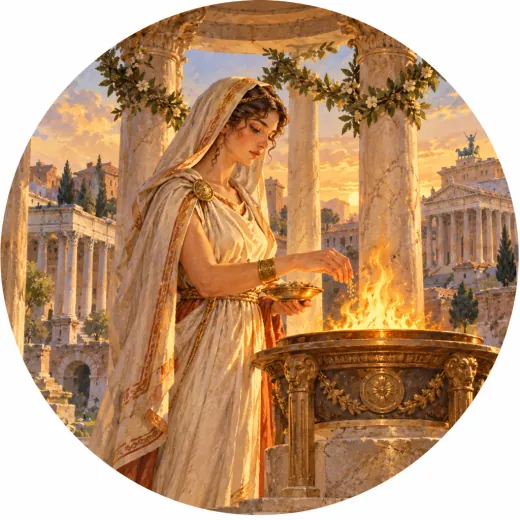
Vesta and the Sacred Fire
Vesta, in Latin
not scary at all
Vesta was the goddess of the hearth, the fire at the centre of the home, and of all Rome, which was like one big home. In her small round temple in the Forum burned a fire that must never go out: if it did, it was a very bad sign for the city. It was looked after by the Vestals, priestesses chosen as little girls, who served the goddess for thirty years. They were greatly respected: they could even save a condemned prisoner by meeting him in the street.
Did you know? according to the ancient sources, if Vesta's fire went out, it could be lit again only with the rays of the sun.
The story
The Romans never saw Vesta.
There was no statue of her in her temple, not even a painted picture. In the Forum, at the foot of the Palatine Hill, stood a small round building with a domed roof and a low doorway. Inside, right in the middle, was a hearth. And on the hearth burned a fire.
“That is her,” the Romans said. Vesta was the fire. Ovid, in his Fasti, tells us he searched for a long time for a statue, and then discovered that the goddess and the flame are the same thing: one is simply the other. That is why no images are needed. All you have to do is never let her go out.
Ovid explains that Vesta and the Earth are the same goddess: the Earth is the hearth of the world, and the hearth at home is a little earth. In every Roman house, in front of the fire, people offered the goddess a piece of their own supper. The fire in the Forum was everyone's hearth. And Plutarch adds that Numa wanted it in a round temple, in the image of the world.
Because that fire must never go out. Not by day, not by night, not in winter, not in summer. If the flame died, the Romans said, Rome itself was in danger.
That is what the Vestals were for.
It was King Numa, one of the very first kings, who set them to guard the fire. At first there were two, then four, then six. They were chosen as little girls, from the best families, and they left their parents' homes to live in a house beside the temple, with a garden and a portico.
Imagine one of them, on her first night.
She is eight years old, or a little more. They have cut her hair and given her a white robe and a veil. For the first time in her life she is awake in the dead of night, and the little temple is silent. An older Vestal sits beside her and shows her how it is done. A piece of wood now and then. A gentle breath if the embers sink low. That is all. It looks easy, and yet it is the hardest job in Rome.
The girl watches the flame bend and straighten again. She feels the heat on her face. She hears the roof creak, and outside, in the Forum, the footsteps of a guard. She keeps telling herself: I mustn't fall asleep, I mustn't fall asleep.
The Vestals served for thirty years. Plutarch says these were divided into three parts: for ten years they learned, for the next ten they did the work, and for the last ten they taught the newcomers. They were deeply respected. When they went out into the city, an officer called a lictor walked ahead to clear the way, and nobody dared to touch them. And there was one privilege that amazed even the proudest Romans: if a man condemned to death, while being led to his execution, met a Vestal by chance, he was spared. As long as she swore that the meeting had not been planned.
But every gift had its price. If a Vestal let the fire go out, she was punished severely. So at night they took turns. Never alone, never far from the flame.
And if, for some reason, the flame really did die? It could not be lit again from another fire. Someone had to take a hollow metal bowl and hold it up to the sun. The rays gathered into a single point, until a spark was born from that point. It had to be the sun that gave Vesta back her fire.
Ovid also tells a story that makes people smile.
One day, after a feast of the gods, the goddess fell asleep on the grass. A mischievous god, Priapus, saw his chance and crept up on her. But close by, a donkey was grazing. The donkey spotted him and started to bray at the top of its lungs, a noise loud enough to wake the dead. Vesta leapt to her feet, everyone came running, and the mischievous god fled amid roars of laughter.
Ever since, on the day of her festival, the Romans crowned donkeys with necklaces of bread. It was their way of saying thank you.
Another time the danger was real. It was the age when Rome was at war with Carthage. One night, after a day of heat and wind, a cry went up from the Forum: the temple of Vesta was burning.
Flames poured out of the roof, and fire, real fire, the very thing that was meant to protect them, was devouring the place that kept it. The Vestals ran back and forth with their veils undone, crying that someone had to save the sacred objects. Inside the temple were kept things so ancient that no Roman had ever seen them: among them the little statue of Pallas, the Palladium, brought from Troy, the city Aeneas had come from. Not one Vestal dared go in among the flames.
That was when a man pushed his way through the crowd. It was the chief priest, Metellus. He said nothing, or perhaps only this: “If Rome must lose its sacred treasures, I will not stand here and watch.” And he threw himself into the temple.
He came out a few moments later, his arms full, wrapped in smoke. He had saved the sacred things. But the fire had burned his eyes, and from that day on Metellus never saw again.
Ovid writes that he had no regrets: faced with that danger, he says, he had not given a thought to his eyes.
And Vesta's fire? That night it began again. A flame came back, small and trembling, in the middle of the still-smoking temple. The Vestals cupped their hands around it, the way you shield a candle from the wind, and stayed awake until morning, watching it grow.
At the end of her service, after thirty years, a Vestal was free. She could leave the temple and go back to ordinary life. But many stayed. They had spent so many years beside a flame that they could no longer imagine a home without one. And when, on some winter evening, the wind crept in through the low door and the flame bent, even the oldest of them would jump up, just like on that first night, halfway between sleep and fear.
Relatives around the world
Listen / Read next
- Music to read by: Cinematic JourneyEpic film-style music, no lyrics, by Ciro Simone IrmiciSpotifyYouTube Music
Sources
- Ovid, Fasti, Book VI
- Plutarch, Life of Numa
