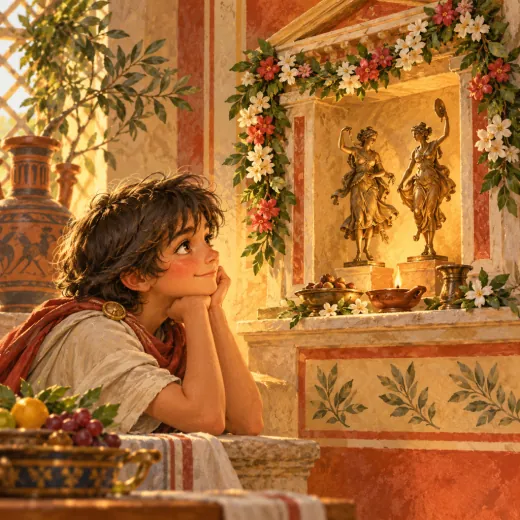
The Lares and Penates
Lares and Penates, in Latin
not scary at all
In every Roman home there was a small altar, the lararium, where the family's gods lived. The Lares protected the house and the people in it; the Penates were other gods of the family. Every day they were offered a little food, a few flowers or a drop of wine, and on feast days they were decorated with garlands. In the Aeneid, Aeneas flees Troy carrying with him the Penates of his own city.
Did you know? According to an ancient explanation, the name of the Penates recalled the Latin word “penus”, meaning “pantry”.
The story
At the end of supper, when the plates were nearly empty, Grandmother would get up and take a bowl.
Into it she put a little of everything that had been on the table: a slice of flatbread, two olives, a bit of cheese, a drop of wine. Then she crossed the atrium and went to the corner where, in a painted niche, stood the bronze statuettes.
They were small, no taller than a hand. Two young men in short tunics, who seemed to be dancing, and a little dog at their feet, because, the old folk said, the Lares are like dogs: they stand guard and watch over those who sleep.
The boy watched her from the doorway.
“Why are you feeding bits of bronze?” he asked.
Grandmother did not get cross. She set the bowl down, straightened a garland that had slipped a little, and answered softly:
“They're not bits of bronze. They're the ones who stay awake in the house while we sleep. They're called the Lares. And with them are the Penates, who live even deeper inside, where the food is kept and where a family is truly a family.”
“And what do they do?”
“They're here. Does that seem like nothing to you?”
It was the evening of the Caristia, in February. The day before, the city had thought about the dead: people had gone to the tombs and left flowers and a little bread. After that, said the poet Ovid, it is good to turn back towards the living. So on that day relatives came together, even the ones who rarely saw each other, even the ones there had been a quarrel with. They sat at the same table, and part of the food went to the Lares, because the peace of a house is their business too.
The boy sat down on the floor, near the brazier.
“Tell me about the Penates,” he said. “The really old ones.”
Grandmother smiled, because that was the story everyone in Rome knew.
“Then listen. There was a city called Troy, and one night, after ten years of war, the enemy came in through the gates. A man named Aeneas was asleep in his house. He dreamed of Hector, the greatest warrior of Troy, who had been dead for some time. His face was grimy with dust, his feet were swollen, his wounds were open. He did not speak gentle words. He said: ‘Run, son of a goddess. The walls are falling. Troy entrusts you with her sacred things and her Penates. Find walls for them too.’”
“And then?”
“And then Hector placed in his hands the sacred ribbons, the statue of Vesta and the fire that must never go out. Aeneas woke with a start. From the roof he saw the sky glowing red, and he heard the screams, and the crackling of the houses, like fire racing through a field of ripe wheat.”
The boy hugged his knees.
“Did he run away?”
“Not straight away. His father, Anchises, was old, and he said he would not move: he had lived long enough, and he would stay and die with his city. Aeneas begged, wept, and tried to take up his weapons and go back to the fighting. And then, on the head of his little son, Iulus, a thin flame appeared. It did not burn his hair. It licked at his skin and glimmered, harmless. Then came a sharp clap of thunder on the left, and a star shot across the sky, leaving a trail of light.”
“A sign.”
“A sign. Anchises raised his hands to the sky and said: ‘There's no more waiting. I'll follow you, gods of my house.’ So Aeneas lifted his father onto his shoulders, over a lion skin, took his son by the hand, and told his wife, Creusa, to follow behind, a few steps back.”
Grandmother paused. In the atrium the only sound was the lamp's flame.
“And the Penates?” the boy asked.
“Now comes the part I like. Aeneas said to his father: ‘You take the sacred things and the Penates of our homeland in your hands. I've just come from a battle, and I'm not allowed to touch them until I've washed in running water.’ And so the little gods of Troy crossed the burning city in an old man's lap, and he held them tight, the way you hold something alive.”
“That's lovely.”
“Yes. But it doesn't end well, at least not at first. When they were almost at the gates, Anchises cried out that he had heard footsteps, that he had seen weapons gleaming. Aeneas ran off through the darkest streets, and when he stopped to count who was with him, Creusa was gone.”
The boy said nothing.
“He went back. He searched the whole city, calling her name, and he called it so many times that his voice broke. At last a ghost appeared to him, taller than in life, and the ghost spoke to him kindly. She told him not to cry. She told him that nothing happened without the will of the gods, that he would have to cross the sea, and that he would come to a faraway land called Hesperia, where the Tiber flows gently through the farmers' fields. There he would have a kingdom, and a new bride. ‘Love our son,’ she said. Aeneas tried to hold her, once, twice, three times. His arms closed on a breath, light as the wind, like a dream slipping away.”
The fire in the brazier sank low. Grandmother added two pieces of wood.
“At dawn, at the foot of Mount Ida, a crowd had already gathered. All the people who had escaped. Aeneas took up his father again, took his son's hand again, and carried the Penates with him. He sailed for years. And one day, they say, he saw the mouth of the Tiber.”
“The one that flows past here?”
“The one that flows past here.”
The boy looked at the niche, at the two dancing statuettes, at the little dog with its ears pricked up.
“Are they the same ones?”
“The same ones from Troy? I don't know,” said Grandmother. “Nobody knows. What I know is that in Rome, in every house, someone gets up after supper and carries a dish to this corner. People have done it for centuries. And if one day we stopped, maybe nobody would notice. But the house would.”
He took an olive from the bowl. Grandmother took it out of his hand, laughing, and put it back in its place.
“That one's theirs.”
Then she put out the big lamp and left only a small light burning in front of the niche. In the atrium the two bronze young men seemed to move ever so slightly, as if in a very slow dance, while the house fell asleep around them.
Relatives around the world
In the trails
Listen / Read next
- Music to read by: Cinematic JourneyEpic film-style music, no lyrics, by Ciro Simone IrmiciSpotifyYouTube Music
Sources
- Ovid, Fasti, Books II and V
- Virgil, Aeneid, Book II
