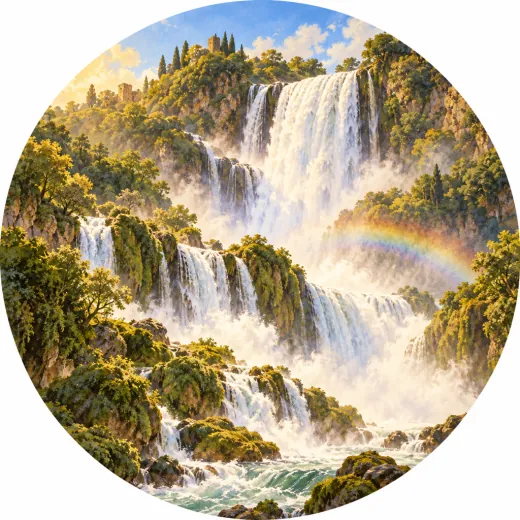
Nera and Velino, the Cascata delle Marmore
the nymph Nera and the shepherd Velino
not scary at all
The nymph Nera fell in love with a shepherd, Velino. But the goddess Juno did not want that love, and to part them she turned Nera into a river flowing at the bottom of the valley. Velino, desperate because he thought she had drowned, leapt from the cliff to reach her. In one version Jupiter, moved, turned him into water too: so the Velino falls for ever into the arms of the Nera, and the waterfall was born. The real story is different: the falls, the Cascata delle Marmore, were made by the Romans, with a canal that carries the Velino to the edge of the cliff.
Did you know? In 271 BC the consul Manius Curius Dentatus had the Cavo Curiano dug, a canal that drained the still waters of Lake Velino down the cliff: that is how the falls were born. Since 1929 the same water has driven the Galleto power plant.
The story
The valley of the Nera, in Umbria, is so green that it seems painted. Among the rocks runs a river that shines even when the sky is grey, and at a certain point, at Marmore, the water throws itself down from a cliff, in the Cascata delle Marmore (the Marmore Falls), with a roar that can be heard from far away.
The old people of the place say that the sound is a story. And it is a love story.
At the beginning, where the falls are today, there was no drop. There was a place of meadows and rocks, and there lived a nymph called Nera. Nymphs are creatures of the waters and woods: they do not grow old, they are not afraid of the dark, and they live longer than any mountain.
One day, on the plateau above the valley, Nera saw a shepherd.
His name was Velino. He took his flock where the grass was tallest and had nothing special about him: a worn cloak, a hazel staff, a voice a little out of tune when he sang. But Nera looked at him, and understood that from that moment her place was beside him.
It was not something that could be done. Nera was a nymph, Velino a human being: they belonged to two different, distant worlds. But they, who did not care about rules, met all the same. They saw each other in secret, among the rocks, at the hour when the flocks return to the fold.
The secret did not last long.
Juno, the queen of the gods, learned of the love between the nymph and the shepherd. And Juno was very angry. A nymph who falls in love with a man, for her, was a nymph who had broken the rules. And whoever breaks the rules is punished.
The punishment was terrible and silent. Juno turned Nera into a river.
One moment she was a girl with hair wet with dew. The next she was water, a long ribbon of water sliding down, to the bottom of the valley, faster and faster, further and further from the place where she was born.
Velino reached the cliff and did not find her.
He looked down. He saw a river that had never been there, and on the river a sparkle he knew well, like somebody's laughter. He did not understand at first. Then he understood. He thought she had fallen, that the water was carrying her away, that she was drowning.
He did not think of Juno, he did not think of the gods. He thought of only one thing: I must reach her.
And he threw himself from the Marmore cliff.
It was a very high jump. The wind whistled in his ears, the valley spun around him, and the river down there came to meet him, closer and closer, stronger and stronger.
But from up there, in the sky, someone had seen.
Jupiter, the most powerful of the gods, had watched the young shepherd hurl himself into the void for love of a nymph. And he was struck by his courage. It was an act of madmen, of lovers, of heroes. Jupiter could not undo what his wife Juno had done, but he could do something else.
He turned Velino into water too.
So, before touching the rocks, the shepherd's body melted into a spray and a roar, and fell below like a waterfall. It fell straight into the river, into Nera's arms.
Since then the two have never been parted. The Velino comes from above, the Nera waits at the bottom, and every time the water crashes onto the rocks and rises in a cloud of droplets, the sun draws a rainbow there, and it seems that the two lovers are embracing.
This is the story they tell at Marmore.
But there is another story too, more down to earth. And scholars tell it with the same passion.
The river Velino flows on the plateau around Rieti. Its waters, though, had no way down towards Terni: they lay still in marshes and in a lake, Lake Velino, which the Romans called Lacus Velinus. The water stagnated, and that still water made the people living nearby ill.
In 271 BC the Romans decided to act. The consul Manius Curius Dentatus had a canal dug, the Cavo Curiano, which carried the still waters of the Velino towards the drop at Marmore, so that they would plunge into the Nera, which in turn flows into the Tiber. An enormous undertaking.
Before then the Velino never reached that point: the cliff was there, but the water was not. So the falls were made by the Romans, with that canal which carries the river to the edge and lets it drop. They are among the tallest man-made waterfalls in the world.
The problems, however, did not end. When the Velino was in flood, the water of the Nera threatened Terni, and the quarrel between Terni and Rieti went all the way to the Senate in Rome. After the fall of the empire, nobody looked after the canal any more, and the plain of Rieti turned back into a marsh. Further works were done in 1422, 1545, 1598 and 1787, each time to make the water flow better. In 1787, on the orders of Pope Pius VI, the architect Andrea Vici worked on the drops and gave the falls the appearance they have today. And since 1929 that water has also turned the turbines of a hydroelectric plant, the one at Galleto: that is why, at certain hours, the falls are "switched off" and then turned on again.
Which is the true story? Perhaps both.
One has mud on its shoes, and the other has tears. But when you are under the falls, with droplets on your face, it is hard not to believe the one with the tears.
Relatives around the world
Listen / Read next
- Music to read by: Cinematic JourneyEpic film-style music, no lyrics, by Ciro Simone IrmiciSpotifyYouTube Music
