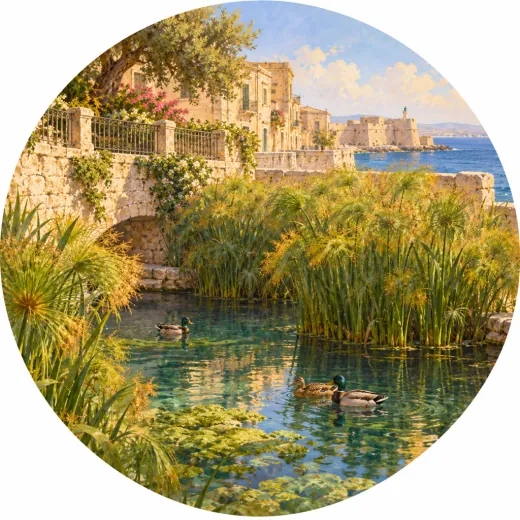
Arethusa and Alpheus
the spring of Syracuse
not scary at all
Arethusa was a nymph who followed the goddess Artemis through the woods of Greece. One day, while she was bathing in a river, the god of that river, Alpheus, fell in love with her and began to follow her, but she wanted nothing to do with him. To help her, Artemis hid her in a cloud; the nymph, in her anguish, dissolved into water, and the goddess opened the earth so that she could flow under the sea, all the way to the island of Ortygia, in Sicily. But Alpheus did not give up: he too crossed the sea beneath the waves to join his waters with those of the spring. Ovid tells the story.
Did you know? The Arethusa Spring, a few metres from the sea, now has brackish water because of seepage from the sea, and its basin is rich in papyrus.
The story
When the goddess Ceres found her daughter again, after searching so long, she wanted to know one thing. She had seen a spring that came from very far away, and water that was like no other.
"Why did you become a sacred spring?" she asked Arethusa.
It was almost evening, and around them the world had grown quiet again. From the depths of the waters, the nymph raised her head. She wiped her green hair with her hands. And she began her tale.
"I was a nymph of Achaea," she said. "I was a huntress. I roamed the woods with nets stretched between the paths. There was one thing I never boasted of: my beauty. It seemed a trifle to me. It even seemed almost a fault that people looked at me.
One day I was coming back from the wood of Stymphalus, tired and hot, and I found a stream. It was clear, so clear that you could count the stones on the bottom. On the banks were silvery willows and poplars, and the shade was cool. I tested the water with one foot. Then with the other. Then I went in up to my knees. I hung my dress on a willow and plunged in.
The water was cool on my tired skin. For a while I thought of nothing. I swam, I moved, I played with the water, when, in the middle of the current, I heard a murmur.
My blood ran cold. There was nobody there, but the water itself seemed to have a voice. I ran towards the bank.
And a hoarse voice rose from the waves. 'Where are you running?' it asked. And then again: 'Where are you running?'
It was Alpheus, the river god. He was there, under the water, and he had seen me.
I fled. I did not have my dress with me, it had stayed on the other bank, and there was no time to go back. He chased me, even faster. I ran like a dove fleeing from the hawk. He flew like the hawk after the dove.
I ran past Orchomenus, past Psophis, past Cyllene. I ran over the mountains of Maenalus, over icy Erymanthus, all the way to Elis. He was stronger than me, and my breath grew shorter and shorter. My legs grew heavy, my heart pounded in my ears, the stones cut my feet. I could not go on much longer.
The sun was going down. I saw a shadow in front of my feet. It was his. I heard his steps behind me. I felt his breath on my hair, warm.
Then I called on Diana.
'Help me,' I said, 'or I am lost.'
The goddess heard me. She wrapped me in a thick, dark cloud.
Alpheus stopped. He circled the cloud twice, looking for me. He called: 'Arethusa! Arethusa, hey!' I was there, inside, as still as a lamb that senses the wolves nearby, like a hare hidden in the bushes while the hounds circle round. I did not dare move. I did not dare breathe. Around me the cloud was damp and silent, and outside I heard his footsteps going round and round.
And he stayed there, watching the cloud. He did not leave.
A cold sweat took hold of my limbs. My body was no longer mine. Drops fell from my hair, little pools formed at my feet. It was a sweet and terrible thing at once. Before I even realised it, my body began to melt. I turned into water. I became a stream.
Alpheus recognised that water. He recognised it, and he loved it. So he gave up the shape of a man and went back to what he was, a river, to mingle his waters with mine.
But Diana heard us once more. She opened the earth. I plunged into the opening and went down, through caverns without light, to an island dear to my goddess: Ortygia. Below me was darkness, above me the sea, and I went on and on, with no name and no fear any more. And there, at last, I rose up into the air. There you see me."
So Arethusa spoke to Ceres. The goddess listened to the end, without interrupting her.
And the story says nothing more. It says only that since then, in Syracuse, on the island of Ortygia, a spring gushes out right by the sea. They say that the water of Alpheus, the river of Greece, reaches her beneath the waves, to join with her.
If you go to Ortygia, the fountain is there, on Via Castello Maniace, facing the sea, in the heart of the city. The semicircular basin dates from around 1843, and in the middle grow papyrus plants, which Sicilians call pàpere. Once the water was sweet and pure. Today it is brackish, because the sea gets in. Near the spring there is a statue by Biagio Poidomani showing Alpheus and Arethusa together. In the surroundings, three ancient tanneries have come back to light, where from the eighteenth century that water was used to treat hides. And at sunset, they say, you can see from there one of the loveliest views of the city.
You sit on the edge. The sea is a few steps away, and on either side of the water the voices of the city arrive muffled. The water moves gently, and the papyrus plants bow just a little. You think of that river in Greece, so far away, and of that nymph who, so as not to be caught, became water.
There are also those who tell the scene another way, and set it in the river Alpheus, in the Peloponnese. But the story, in both versions, ends at the same point: two distant waters that seek each other, and an island where they meet again.
Perhaps that is what makes the difference in a spring: not so much where it comes from, as where it arrives.
Relatives around the world
Listen / Read next
- Music to read by: Cinematic JourneyEpic film-style music, no lyrics, by Ciro Simone IrmiciSpotifyYouTube Music
- The words of the dialect: SicilianNonnese, the dictionary of Italian dialects
Sources
- Ovidio, «Metamorfosi», libro V
- ENIT, italia.it, «Fonte Aretusa»
