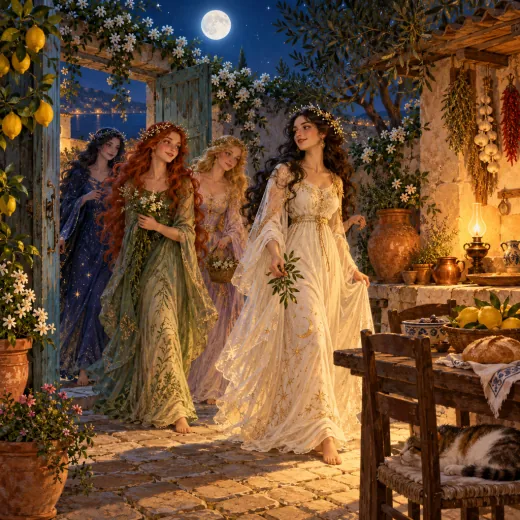
The Donne di Fora
“donni di fora”, the ladies from outside
a little scary
In Sicily people told of creatures, half fairies and half witches, who went round houses at night, thirty-three creatures led by a Great Mother: the donne di fora. Out of respect people called them “the Beautiful Ladies”. If they found the house tidy and were welcomed kindly, they brought luck; if they were offended, they caused trouble. People also believed that some women left their sleeping bodies at night to join them. Traces of these beliefs remain in the records of the Inquisition too.
Did you know? The great scholar Giuseppe Pitrè, in the nineteenth century, collected from people's own voices many popular Sicilian stories like these.
The story
In the houses of Palermo, once upon a time, there was one evening of the week when the lady of the house left nothing to chance.
She told nobody. She swept the rooms, one by one, even the corners where nobody ever looked. She scrubbed the copper in the kitchen, the big pots, the coffee pot, the basin, until it became a mirror. She took out the whitest sheets, the linen ones, which smelled of soap and sun, and made the bed again, smoothing the folds with her hands. The cushions she plumped one by one, with her fists, until they became tall and soft as clouds.
Her husband watched her from his chair, not understanding. "Why all this work? Nobody is coming."
She smiled, without answering.
Because somebody was coming, in fact. Everyone knew it, even if nobody admitted it. It was said that on certain nights, on a Tuesday, a Thursday or a Saturday, they passed through the streets and the houses. The donne di fora, the women from outside.
Nobody ever saw their faces. They did not walk. They arrived, the way coolness arrives after a hot day. There were thirty-three of them, people said. Thirty-three creatures, all under one great mother, the Mamma Maggiore, whom they called the Savia Sibilla, the matron, the teacher. Some called them the beautiful ladies, or the beautiful gentlemen, or the mistresses of the house. Speaking of them out loud was not wise. Better to do it with respect, and in a low voice.
Who were they? Neither fairies nor witches, scholars say. By day, it was said, if someone discovered them they turned into toads, and stayed that way until the following night. For this reason, in Palermo, nobody ever harmed a toad. You never know.
By night, instead, they became themselves again.
And what happened then was the strangest part. They did not come in through the door. In a certain sense, they did not come in with their bodies at all. Some women, the ones who had the gift, lay down in the evening like everyone else. The body stayed there, in the bed, motionless, breathing softly. But the spirit went out, light, and joined the donne di fora. They passed through the keyholes like a thread of wind, and wandered through the houses.
What did they do? They looked. They weighed everything. If the house was in order, if the copper was bright and the bed white and the rooms swept, it was as if someone said: here people live well. And whoever had done that work, with a whole day's effort, was rewarded. If instead they found dust and disorder, or someone who treated them rudely, then the visit did not end sweetly.
That evening, while the lady of the house was sweeping the kitchen, a tiny noise was heard outside, on the landing. It could have been the wind. It could have been a cat. But she stopped, with the broom in mid-air.
Then she went on.
That night, after supper, she put a little incense on the fire, two bay leaves and a sprig of rosemary. She did it before midnight, as they say it must be done. The scent filled the room, sweet and dark. Her husband looked at her and said nothing. She laid a hand on his shoulder.
"Tonight," she said softly, "if you see me sleeping, do not touch me. Do not wake me, whatever happens. Promise."
He promised. He was not a man for many questions. And besides, deep down, he had been expecting it for a long time.
The house went quiet. The bed was white and fragrant. She lay down between the sheets and closed her eyes.
An hour later, or perhaps two, in the deepest silence, the husband heard something at the keyhole. A rustle, a whisper, like many faraway voices speaking together. He did not open his eyes. He did not move. Beside him, his wife was breathing very gently, but there was something different in her breath. It seemed that she was no longer completely there.
For a moment the room filled with a scent that was neither incense nor rosemary. A long shadow moved on the wall, and he had the feeling of not being alone.
He thought of all the things people told. He thought of Ventotene, where it was said that the thirty-three met three times a week, in council, to decide about evil eyes and spells to be undone, and also about household matters. He thought of the tower of the old Ballarò market, where seven women received at night the men and women they had drawn there, with dances and music, and brought them home before dawn. And he thought of the Courtyard of the Seven Fairies, in Albergheria, which on certain evenings seemed darker than the rest of the street.
He had promised. He stayed still, with his eyes closed and his heart beating.
Then the whisper moved away. The lock clicked, softly, like a finger being withdrawn. The shadow on the wall vanished.
Silence returned to the room.
In the morning, the light came through the shutters, white and soft. His wife was still asleep, peaceful, with pink cheeks and a faint smile. When she opened her eyes she looked at him, and understood that he had kept his promise.
"Did everything go well?" he asked.
"Well," she said. She added nothing else.
The copper, in the kitchen, shone more than before. But nobody could have said whether it was thanks to her or to someone else.
Perhaps, some say, the secret of the donne di fora was above all this: when a man could not believe that his wife was so good, so capable, so always one step ahead, the easiest explanation was to think that she had invisible friends.
But at night, in Palermo, there are still people who leave the house in order, just in case.
Relatives around the world
Listen / Read next
- Music to read by: Cinematic JourneyEpic film-style music, no lyrics, by Ciro Simone IrmiciSpotifyYouTube Music
- The words of the dialect: SicilianNonnese, the dictionary of Italian dialects
Sources
- Giuseppe Pitrè, «Usi e costumi, credenze e pregiudizi del popolo siciliano», vol. IV (1889)
- Claudia Geremia, «Religions» (2024), articolo sulle donne di fora nei documenti dell'Inquisizione
