The Janas
“the fairies”, in Sardinian
not scary at all
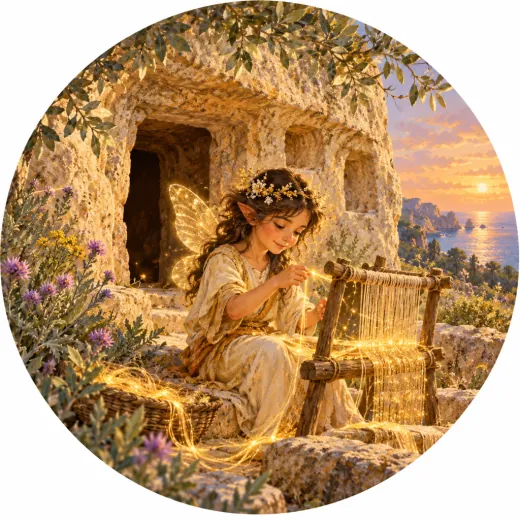
They are tiny fairies who live in the “domus de janas”, the fairy houses carved into the rock thousands of years ago. By day they stay in their rock houses weaving cloth of gold on golden looms. They can be generous with those who respect them and spiteful with those who enter their homes without permission. In Sardinia almost every village has its own janas story. The fairies are a legend, but their houses are real: they are prehistoric tombs, often carved like homes, with doors and pillars.
Did you know? More than 2,400 domus de janas have been found in Sardinia, and since July 2025 seventeen sites with these tombs have been UNESCO World Heritage Sites.
The story
In Sardinia there are houses that nobody ever built. No mason laid one brick on top of another. They were dug into the rock, one blow after another, when the grandparents of the grandparents of the grandparents could not yet write.
They have a door, and sometimes also a false door, drawn on the stone to deceive whoever looks. They have a gabled roof, like the houses of the living. They have columns, a hearth in the middle of the room, stone beds, and on the walls a little red, ochre, and the horns of a bull.
The Sardinians call them domus de janas. Houses of the fairies.
Once, in a village that anyone can choose at random, a girl was taking her flock to graze on a hill of red rocks. It was a day of white heat, the kind that makes the air tremble. The sheep had scattered into the shade of the holm oaks, and one, the most stubborn, had vanished.
The girl searched for it all morning. Then she heard a noise.
Tac. Tac-tac. Tac.
It came from beneath a wall of stone. A regular, light beating, as of wood on wood. She followed the sound and found a low opening, hidden behind a phillyrea bush.
Her grandmother had told her a thousand times: "If you see a house in the rock, pass by and do not look inside. The janas do not want guests they have not invited."
The girl hesitated. But the sheep was bleating, in there. She bent down and went in.
Inside it was not dark. There was a golden light, warm, coming from nowhere. The corridor opened into a room with columns and a double-pitched roof, just like in a real house. And in the room were they.
They were small, smaller than a six-year-old girl. They had hair long as rivers, and serious faces, concentrated, like people at work. Each sat in front of a loom. And they were golden looms, with threads as fine as the light of sunset, which ran through their fingers and became cloth. Tac, tac, tac. That was the sound.
None of them raised her head. The girl stood still on the threshold, short of breath.
Then one jana, the one at the biggest loom, spoke without turning round.
"You made a noise with your feet. You brought the sun into our house."
"I was looking for my sheep," said the girl. "I am sorry. I will go at once."
The janas stopped weaving, all together. The silence was so full that it seemed to have a weight.
"Your sheep is here," said the first. "She ate the threads that were left over. She was better mannered than you: she asked, in her own way."
Behind the loom, in fact, was the sheep, with a little golden thread sticking out of her muzzle. She looked satisfied.
The girl did not laugh. She was afraid it might be the wrong thing. But the smallest of the janas, the one sitting closest, smiled first. Then the others smiled.
"Sit down," said the first, "but woe to you if you touch a thread. Whoever touches a golden thread must stay until she has woven it all."
The girl sat on the floor and touched nothing. She looked around. On the walls there was red ochre and the drawing of two horns, and in the middle of the room a stone hearth, cold for who knows how long, beside two beds of rock. Then she watched the hands that ran, the threads that became cloth, the cloth that seemed to have inside it a little sun and a little water. She did not know how much time passed. One thing was strange: in there the hours did not weigh.
When she stood up, the first jana held something out to her. A narrow ribbon, woven of gold, a hand's breadth long.
"Because you touched nothing," she said. "Keep it. It will bring you luck, as long as you show it to nobody."
The girl took it with both hands. She thanked her. She went out with the sheep, and when she was outside the sun blinded her, and she felt the white heat on her skin like a slap.
But she turned round, and the opening was no longer there. Only a phillyrea bush and the wall of rock.
For a while all went well. The flock gave more milk, the sheep no longer got lost, and the girl always found the right shade. But one evening, at home, her grandmother asked her why she was always smiling. And the girl, who could not lie, took out the ribbon and showed it to her.
The ribbon, in her grandmother's hands, turned to ash.
The grandmother looked at it, then looked at her granddaughter. She was not angry. She only said: "The janas are neither bad nor good. They are like women: it depends on how you treat them, and how you treat their secrets."
The girl cried a little. But the next morning, on the windowsill, she found a wooden sheep, small and smooth, carved to perfection. Nobody recognised it. Nobody ever knew who had left it.
She kept it all her life.
In Sardinia there are many stories of janas, and almost every village has one of its own; this one I made up. The fairies are legend. But their houses are not: they are tombs thousands of years old, and in July 2025 seventeen of these sites were recognised as UNESCO World Heritage.
If you see one, pass gently. You never know who is weaving in there.
Relatives around the world
In the trails
In real history
Listen / Read next
- Music to read by: Cinematic JourneyEpic film-style music, no lyrics, by Ciro Simone IrmiciSpotifyYouTube Music
- The words of the dialect: SardinianNonnese, the dictionary of Italian dialects
