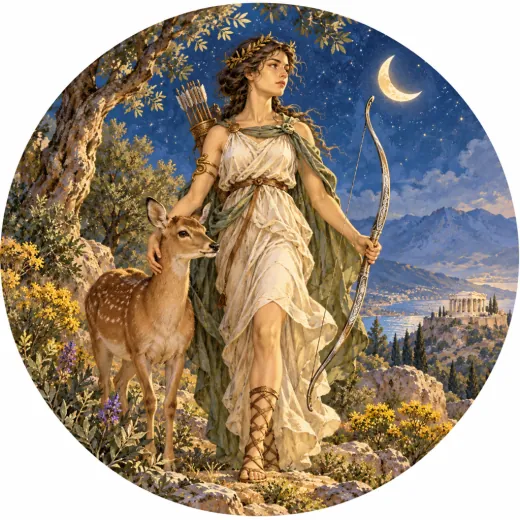
Artemis
Ártemis, in Ancient Greek
not scary at all
Artemis is the goddess of hunting, of the woods, of wild animals and of the moon. She is Apollo's twin sister and roams the forests with bow and arrows, followed by a group of nymphs and hunting dogs. She always stays a maiden and wants to live free in the woods, without marrying. Woe to anyone who disturbs her: a hunter called Actaeon, who came by chance, having lost his way, to where she was bathing, was turned into a stag. The Romans called her Diana.
Did you know? the ancient hymns call her the goddess of the arrows and of the golden bow: the silver bow is instead an epithet of her brother Apollo.
The story
In the woods of Greece, the old hymns say, there lives a goddess who does not love cities.
Her name is Artemis, and the Romans will call her Diana. She is Apollo's sister, the maiden who delights in arrows. She runs over shadowy mountains, draws her golden bow and makes the peaks shake with her hunting. Then, when she is tired and happy, she unstrings her bow and goes to her brother's house at Delphi to lead the dance of the Muses and the Graces. With her live the nymphs who serve her, and the hounds, and the night, and the silence of the trees.
There is only one rule in her kingdom: no one must see her when she is alone.
But a rule can be broken without knowing it. That is what happened to Actaeon, grandson of Cadmus, the founder of Thebes.
He was a young hunter. He had been over the mountains all morning with his friends and his pack of hounds, and the nets were full. At noon, when the shadows grow short and the woods seem to hold their breath, he stopped.
“Friends,” he said, “that's enough for today. Tomorrow, as soon as the light comes back, we'll start again.”
The others scattered to rest in the shade, the hounds stretched out beside them, tongues hanging, chests rising and falling. Actaeon was not sleepy, so he went for a walk on his own. He did not know where he was going. Ovid says it clearly: chance brought him there, or fate, but not any wish to spy on anyone.
Nearby was a valley called Gargaphie, full of cypresses and pines, sacred to Diana. At the far end opened a cave that no hand had dug. Nature, playing, had imitated art, and the roof was a vault of light stone, curved like an arch. On the right ran a spring, and its water spread into a clear pool with grassy banks.
That very day the goddess, tired from hunting, had come down there to bathe.
She had handed a nymph her javelin, her quiver and her unstrung bow. Another had taken her cloak. Two had untied her sandals, and another, the most skilful, was gathering her hair into a knot. Others were filling great jars with water. In the valley there was only the sound of the water and the low voices of the nymphs, and the heat of noon did not reach that far, under the trees.
Actaeon stepped into the sacred wood, slowly, and saw the cave.
The nymphs saw him at the same moment.
There was a scream, just one, long, and it filled the whole valley. They ran around the goddess to hide her with their bodies, but Artemis was taller than all of them: her head rose above the heads of the girls. Her face turned red, like clouds when the setting sun colours them.
She wished she had her arrows to hand. She did not. She had only the water.
She scooped up a little in her hand and threw it in the young man's face, over his hair. “Now,” she said, “go and tell everyone you saw me unveiled. If you can.”
She said nothing more. But on Actaeon's wet forehead, a stag's antlers began to sprout.
His neck grew longer. His ears became narrow and pointed. His hands turned into hooves, his arms into thin legs, and a spotted coat spread over his body. Inside, his heart leapt with fear.
Actaeon ran, and as he ran he was amazed at how fast he was. He stopped at a pool to drink, saw in the water a muzzle and two great antlers, and tried to cry out, “Poor me!” Not a word came out. Only a groan. Tears ran down a face that was no longer his. All he had left was his mind, exactly as it had been before.
What should he do? Go back to the king's palace, or hide in the woods? Shame stopped him from doing the first, fear from doing the second.
While he hesitated, his hounds saw him.
Melampus and Ichnobates gave the signal with their barking, then the whole pack shot after him, faster than the wind. They were his own dogs. He had raised them himself, called each one by name, with the same voice he could not use to call them now. Some came up behind him. Others, who had taken a short cut over the mountain, blocked the way in front. Actaeon ran through the places he knew best, over cliffs, over rocks, through gorges where there is no path, fleeing across his own hunting grounds.
He wanted to shout, “I am Actaeon! Know your master!” The words would not come. The air was full of barking.
His companions arrived, urged the hounds on, and called, “Actaeon! Actaeon!” as if he were far away. Hearing his name, he turned his head.
“Where is he?” his friends were saying. “Shame he isn't here. He's missing the show.”
Actaeon truly wished he were not there. But he was, and all he wanted was to watch, not to feel.
Ovid does not linger over what follows. He says only that the hounds were on him from every side, and that only when his life was over, so the story goes, did Diana's anger cool.
Then the valley of Gargaphie went back to how it had been: the spring, the arch of stone, the clear pool, the nymphs around their goddess. The sun was still high, and for a while no one felt like speaking.
Afterwards, people told the story in two ways. Some said the goddess had been harsher than was fair. Others praised her and said it was a punishment worthy of her stern purity. Each side found good reasons.
Ovid, though, writes a line that neither side can erase. If you look closely, he says, in that story you will find the fault of fortune, not the crime of a man. And he adds a question: what crime can there be in a simple mistake?
Relatives around the world
Listen / Read next
- Music to read by: Cinematic JourneyEpic film-style music, no lyrics, by Ciro Simone IrmiciSpotifyYouTube Music
Sources
- Homeric Hymns
- Ovid, Metamorphoses, Book III (Actaeon)
