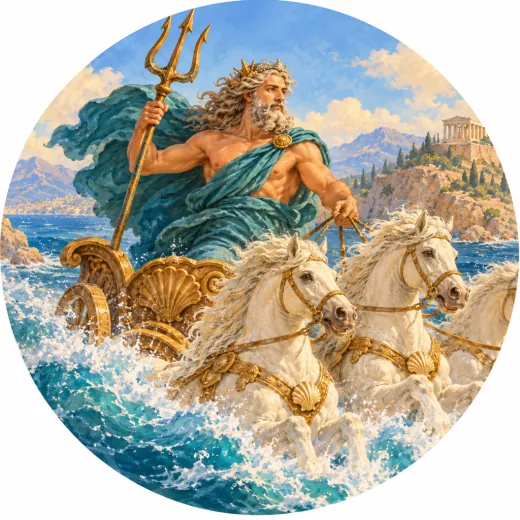
Poseidon
Poseidôn, in Ancient Greek
a little scary
Poseidon is the brother of Zeus and the lord of the seas. With his trident he can stir up storms, calm the waves and even make the ground shake: that is why he was also called the “earth-shaker”. In the Odyssey he is seen whipping his horses and going to Aegae. In the Odyssey he is the great enemy of Odysseus, who blinded his son, the Cyclops Polyphemus, and for years the god stops him from getting home.
Did you know? According to other Greek authors, for example Pindar, he had created the very first horse, which is why he is also the god of horses.
The story
When Poseidon was born, he was swallowed.
His father Cronus was afraid of his children, and he gulped them down as soon as they were born. That is how Hesiod tells it: his sister Hestia, his sister Demeter, Hera, Hades and finally Poseidon, one after another, down into the dark, without a cry. Only the last-born, Zeus, was saved, and it was he who brought his brothers and sisters back into the light.
When the world was divided up, they drew lots. Zeus got the sky. Hades got the darkness of the dead. Poseidon got the grey sea, and everything beneath it.
They called him “the earth-shaker” and “the dark-haired god”. He had a trident, and horses. Above all, he had a very long memory.
Odysseus knew that well.
After the Trojan War, Odysseus had lost his ship, his companions, everything. There was one thing Poseidon would not forgive him: the blinding of his son Polyphemus. On the shore of his island the Cyclops had raised his hands to the sky and prayed: “Father, earth-shaker, dark-haired one: if I am truly your son, let Odysseus never reach home.”
The god had heard, and for years he had made the journey home impossible.
Then one day the other gods gathered to talk about Odysseus, who for seven years had been a prisoner on the island of the nymph Calypso. Poseidon was not there. He had gone far away, to the Ethiopians at the edge of the world, where sacrifices were waiting for him. So, while he was away, the others decided: Odysseus must go home. Zeus sent Hermes to Calypso, and Odysseus built himself a raft from twenty tree trunks, with an axe and a drill, and set sail.
He sailed for seventeen days, steering by the stars. On the eighteenth he saw a dark land in the distance, like a shield lying on the sea.
That was when Poseidon, on his way back from the Ethiopians, spotted him from the mountains of the Solymi.
He shook his head. “Well. The gods have changed their minds about Odysseus while I was away. There he is, close to the land of the Phaeacians, where fate says he will be saved. But first, I think, I'll give him plenty of trouble.”
He gathered the clouds. He seized his trident and churned up the sea. He called all the winds together, East and South, West and North, and night fell from the sky like a black sheet.
Odysseus felt his knees give way. “Poor me,” he said to his heart. “Lucky the Greeks who died at Troy. At least they had a grave.”
A towering wave crashed down on the raft. The steering oar was torn from his hands, the mast snapped, the sail flew away. He went under and stayed down a long time, dragged by the wet clothes Calypso had given him. When he came up, he spat out mouthfuls of salt water. But even so he did not forget the raft. He swam to it, grabbed hold, and sat down in the middle of it to escape death.
Then, among the waves, a woman appeared.
It was Ino, who had once been mortal and was now a goddess of the sea. She landed on the raft in the shape of a seabird and spoke to him kindly. “Poor Odysseus, why is Poseidon so angry with you? He will not kill you, however hard he tries. Take off your clothes, leave the raft to the winds and swim for the land of the Phaeacians. Take this veil: tie it under your chest and you will have nothing to fear. But as soon as you touch the shore, untie it, throw it far out into the dark sea and turn away.”
She vanished into the water like a gull.
Odysseus hesitated. He did not quite trust her. “As long as the logs hold together, I'm staying here,” he thought.
The sea did not let him. Poseidon sent a huge wave, curved like the roof of a falling house, and the logs scattered like straw in the wind. Odysseus climbed onto a beam as if it were a horse, pulled off his clothes, tied on the veil and threw himself into the water with his arms spread wide.
The god saw him and shook his head again. “Go on, then, wanderer, suffer out there on the sea until you meet people dear to Zeus. But you will not say you had too little.”
He whipped his horses and went off to Aegae, where his famous palace stands.
Odysseus swam for two days and two nights. At dawn on the third day the sea was calm, and he saw land close by. He heard the roar of waves on the rocks. There were no harbours. He found the mouth of a river and prayed to it, and the water stood still for him.
He reached the shore with swollen skin and a mouth full of salt, out of breath and out of voice. Then he untied the veil and threw it into the current, turning his back.
The rest of the story is long. The Phaeacians welcomed Odysseus into their palace, listened to him, loaded him with gifts and took him back to Ithaca on a fine ship. The voyage was easy: he slept the whole way.
And the god noticed.
He went up to Olympus and spoke to Zeus. “I will have no honour left among the immortals if mortals do not respect me. The Phaeacians are of my own blood, and they have carried home the man I wanted to suffer. They have even covered him in gifts.”
Zeus replied, “Do as you think best, earth-shaker. No one among the gods looks down on you.”
Poseidon waited for the ship on its way back. When it was close to shore, in sight of the harbour and the whole city, he touched it with the flat of his hand. In an instant it turned to stone, rooted to the bottom of the sea. Then he left.
The Phaeacians on the walls did not understand. “Who has stopped our ship? A moment ago it was racing along!” The old king Alcinous remembered a prophecy: one day Poseidon would destroy a Phaeacian ship and cover their city with a great mountain.
He ordered twelve bulls to be sacrificed. The people crowded around the altar and prayed to the lord of the sea.
The “Odyssey” does not say whether the god listened. It says only that, in front of the city, there was a ship made of stone, and the waves kept beating against it.
Relatives around the world
Listen / Read next
- Music to read by: Cinematic JourneyEpic film-style music, no lyrics, by Ciro Simone IrmiciSpotifyYouTube Music
Sources
- Homer, Odyssey, Books I and IX
- Hesiod, Theogony
