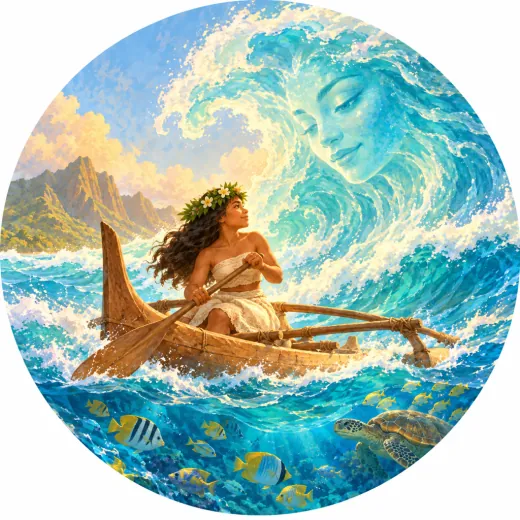
Tangaroa
Tangaroa, Tagaloa or Kanaloa
not scary at all
Tangaroa is the great sea deity of almost all of Polynesia, with slightly different names from one island to another: Tangaroa in New Zealand, Tagaloa in Samoa, Kanaloa in Hawaii. In Māori tradition he is one of the children of Rangi and Papa, and the father of all the fish and creatures of the ocean. According to the accounts collected by Grey, his descendants Ikatere, the fish, and Tū-te-wehiwehi, the reptiles (sons of Punga, a son of Tangaroa), quarrelled: the fish took refuge in the sea, the lizards in the forest. In Māori tradition fishermen said prayers and returned the first part of the catch to the sea.
Did you know? Polynesian navigators reached extremely remote islands in the ocean without a compass, by reading the stars, the waves and the flight of birds.
The story
In the beginning, the sea had no master. Then it had Tangaroa.
He was one of the children of the Sky Father and the Earth Mother, one of those who grew up squeezed in the darkness between their two parents. When light came into the world, Tangaroa was perhaps the first to look at the stretch of water that opened up before him. It was dark and immense, without edges. He felt that he belonged to it. He went all the way down to the bottom, where the currents cross like roads, and built his home there.
From then on, the sea was his.
He had many children. There were the fish, the most numerous of his children, and there was Ikatere, their ancestor, with a body that shone like silver. And there was Tū-te-wehiwehi, the father of the reptiles, who loved the darkness of hidden places. Children or grandchildren, depending on the story: in many tellings their father is Punga, a son of Tangaroa. For a while, they all lived in peace. They swam and slithered among the seaweed, under the calm water, and their father watched them from the depths, in silence.
Tangaroa’s home had no walls. It had sunken valleys, forests of seaweed that swayed without any wind, lights that switched on and off at depths no sun has ever reached. The little fish followed the big ones, the big ones followed the currents, and the currents followed his breathing. He had no need to give orders. It was enough for him to be there: everything in the sea knew where to go.
But high above, over the waves, a storm was gathering.
The god of the winds, Tāwhiri-mātea, Tangaroa’s brother, was furious because the sky and the earth had been parted. So he hurled himself at his brothers with all his strength. The clouds thickened, the sea began to boil, and the waves became mountains of black water that climbed on top of one another and smashed against the shore. The frightened fish looked for shelter. The reptiles, tossed among the breakers, looked for land.
It was at that moment that Tangaroa’s children split apart.
“Come with me!” cried Ikatere. “Out to the open sea! The sea is our home, our father will protect us!”
“No!” answered Tū-te-wehiwehi. “The sea will swallow us! Let’s go ashore, into the forest, among Tāne’s trees!”
For a moment they looked at each other, and the storm came down between them. Then each made his choice. The fish dived into the deep, where the waves could not reach, and found themselves in a world of blue silence. The reptiles ran up the beach, climbed the dunes and went into the woods. And the woods took them in.
From the bottom of the sea, Tangaroa saw it all. He saw the fish arriving one after another, tired and scared, and he welcomed them into the dark. He saw the reptiles disappear among the trees, and felt something like a hand opening and letting something fall. When a father loses children, he does not forget. Not even a god.
He did not complain to his brother of the winds, because there is no point. But he turned in anger on Tāne, the god of the forest, for sheltering the runaways. “You have taken my children,” he said, in a voice that made the shells tremble. “What you have taken from me, I will take back.”
And so the war began.
The waves rose against the coasts and began to bite. A piece of beach, a piece of cliff, a piece of land: the water carried them away, a little at a time, day after day. The woods along the shore collapsed. The canoes, which were made from Tāne’s trees, were overturned and sunk. Houses and fields ended up under water. They say that ever since, the sea has never stopped eating away at the land, and that it is the sea that holds the world tight on every side.
But there was another brother who was not afraid: Tū-mata-uenga, the warrior, the father of human beings. He was the one who decided to strike back. He took flax fibres and made nets. He took branches and made hooks. He went down to the shore and began to fish. He pulled up Tangaroa’s children by the dozen, by the hundred, and ate them. The sea roared and the nets filled. From the depths, Tangaroa felt each time the weight of a child gone missing, and his anger rose in the waves until it crashed down on the shore with a long boom.
That, they say, is how people began to live from the sea.
Today, when Tangaroa speaks, he does so with the breathing of the tides. In, out, in. His slow breath enters the bays and goes away again. The old people on the beaches listen to it the way you listen to a relative who is sleeping: with respect, and without waking him.
At dawn, on a shore, a family is loading a canoe. There is a grandmother with white hair, a man with a net, a child whose eyes are still full of sleep. The water is as smooth as skin. The grandmother wades in up to her ankles. She says a few words softly, in a language the child only half knows. Then she bows, and the child copies her.
“Who are you talking to, Nana?”
“To the master of this house. We’re about to take something from him. It’s good manners to ask.”
They set off. The sun rises behind the hills. When the net comes back on board, full of silver sparks, the man takes the first fish, the finest one, and puts it back in the water. The sea takes it without a sound.
Because Tangaroa is the father of everything that has fins and a tail, and you have to remember to say thank you.
On other islands his name changes. In Samoa he is Tagaloa, the great creator god. In Hawaii he is Kanaloa, and he stands beside Kāne in the oldest stories. Three names for the same great water. With these names in their minds, Polynesian navigators left their islands and trusted themselves to the stars, the waves and the flight of birds, and came home again or discovered lands no one had ever seen. Everywhere, before setting out, they asked for a safe journey, and they left certain that the ocean, however vast, is not empty.
Someone is breathing it.
A living tradition, told with respect: how we tell myths.
Relatives around the world
Listen / Read next
- Music to read by: Cinematic JourneyEpic film-style music, no lyrics, by Ciro Simone IrmiciSpotifyYouTube Music
Sources
- Te Ara, the Encyclopedia of New Zealand, Tangaroa, the sea
- Martha Beckwith, Hawaiian Mythology (1940)
