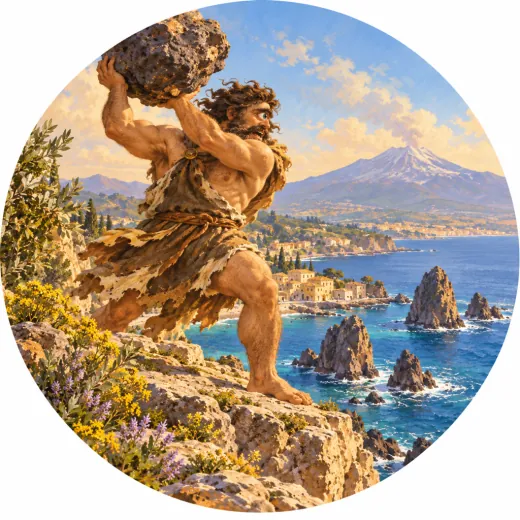
Polyphemus the Cyclops and Etna
“Polyphemos”, in Greek
scary
According to a tradition later than Homer, the Cyclopes, giants with a single eye, lived in the caves of Etna. In the Odyssey, Ulysses and his companions are trapped in the cave of one of them, Polyphemus. Ulysses says his name is “Nobody”, blinds him and escapes hidden under the bellies of the sheep. Furious, Polyphemus hurls huge boulders at the ship: according to tradition they are the sea stacks off Aci Trezza. Ovid also tells of his unrequited love for the nymph Galatea.
Did you know? When Polyphemus shouted “Nobody has blinded me!”, the other Cyclopes thought it was an evil sent by the gods and advised him to pray to his father, instead of helping him.
The story
After the Trojan War, Odysseus travelled for years, and almost always had to get by with his head, because strength alone would not have been enough.
He arrived with his ship in a land where nobody ploughed and nobody sowed. There lived the Cyclopes, giants with a single eye in the middle of the forehead. They had no laws, no assemblies. Each ruled his own cave, his own family, his own sheep.
In front of the landing place was a small island full of wild goats. Odysseus left the ship with the others and chose twelve men. He took with him a skin of dark wine, very sweet, a gift from a priest named Maron, son of Euanthes. That wine was so strong that it had to be mixed with twenty measures of water.
On the shore he saw an enormous cave, with a pen of stones as big as towers. Inside were baskets of cheeses, lambs, kids, pails full of milk.
"Let's take the cheeses and run," his companions whispered.
Odysseus shook his head. He wanted to meet the master of the house. He hoped for a gift, as one does with guests. It was the greatest mistake of the voyage.
Towards evening, the earth began to tremble. The master came back with the flock, carrying on his shoulders a load of dry logs. He threw it down with a crash that made the pots shake. Then he drove the sheep in and closed the entrance with a boulder so heavy that none of the twelve men could have moved it.
The darkness grew thick. In the cave there remained only the glow of the fire and, at the back, that single eye turning.
"Strangers," the voice thundered. "Who are you?"
Odysseus told the truth, but not all of it: they were Greeks, returning from Troy, and asked for hospitality in the name of the gods. Polyphemus did not answer the plea. He seized two of the companions, and of what happened next it is better to tell nothing. Suffice it to know that that night nobody slept, and that in the morning two more vanished, and the next evening two more still.
Odysseus could not kill the giant in his sleep. The boulder on the door was too heavy: if Polyphemus died, they would be walled up alive in the cave.
So he thought. He thought while the fire died down, he thought while everyone breathed softly. And he saw, in a corner, a big trunk of green olive wood, as large as the mast of a ship.
With his companions he cut off a piece, sharpened the point and hardened it in the fire. Then he hid it under the dung, at the back of the cave. They drew lots for four men to help Odysseus. With him there were five.
In the evening Polyphemus came back. He sat down, milked, ate. And then Odysseus came forward with a cup full of dark wine.
"Cyclops, drink," he said. "See what wine we carried on the ship."
Polyphemus drank. He drank again. He asked for a third cup, and licked his lips.
"Tell me your name," he said. "I want to give you a present."
"My name is Nobody," replied Odysseus. "That is what my mother, my father and my friends call me."
"Then I will give you my present," sneered the Cyclops, his tongue thick. "I will eat Nobody last."
Then he fell backwards and went to sleep. From his mouth came wine and breath as long as a bellows.
Odysseus and the four chosen men put the stake in the embers, until the point turned red. They gave each other courage, and in the silence of the cave, with all the strength they had, they thrust it into the giant's single eye.
The scream made the walls shake. Polyphemus tore the stake from his face and shouted so loudly that from every cavern of the mountain his neighbours came running.
"Polyphemus, what is wrong? Why do you wake us in the night? Is someone stealing your sheep? Is someone killing you by force or by trickery?"
"Friends," he roared from behind the boulder, "Nobody is killing me! Nobody by force! Nobody by trickery!"
The neighbours were silent for a moment.
"If nobody is hurting you," they said, "then it is an affliction sent by Zeus, and there is no remedy. Pray to Poseidon, your father."
And they went away, one after another, into the dark.
In the cave Odysseus did not move. But the danger was not over: the blinded giant moved the boulder, sat on the threshold with his arms open and waited for the men to try to get out.
Then Odysseus tied his companions under the bellies of the biggest rams, one for each animal. For himself he chose the largest ram, with the thickest fleece. He clung beneath its belly, without a breath, and waited for dawn.
The sheep went out. Polyphemus touched them one by one on the back, with fingers as big as branches, and felt nothing. His hand never went below the belly, and men and rams passed.
Running, driving the flock before them, they reached the ship. They rowed with all the strength they had. When they were far from shore, Odysseus could not resist. He shouted, in a voice that carried far:
"Cyclops, if anyone asks who took your eye, say it was Odysseus, son of Laertes!"
His companions begged him to be quiet. Too late.
Polyphemus climbed to the top and tore off a piece of mountain. He hurled it at the voice, and the ship nearly sank. He threw another, further. Then he raised his arms to his father and prayed: that Odysseus should never reach home; and, if he did get there, that he should arrive late, alone, on a ship not his own, and find it in mourning.
The rocks fell into the sea. The Odyssey does not say where the island of the Cyclopes was, but tradition places it in Sicily. And to those who go out by boat today at Aci Trezza, at the foot of Etna, they say they are still there: the sea stacks of the Cyclopes, rocks and a little island in a row in the water, dark with lava, as if someone had only just thrown them.
Relatives around the world
In the trails
Listen / Read next
- Music to read by: Cinematic JourneyEpic film-style music, no lyrics, by Ciro Simone IrmiciSpotifyYouTube Music
- The words of the dialect: SicilianNonnese, the dictionary of Italian dialects
Sources
- Omero, «Odissea», libro IX
- Ovidio, «Metamorfosi», libro XIII
- ENIT, italia.it, «Riviera dei Ciclopi»
