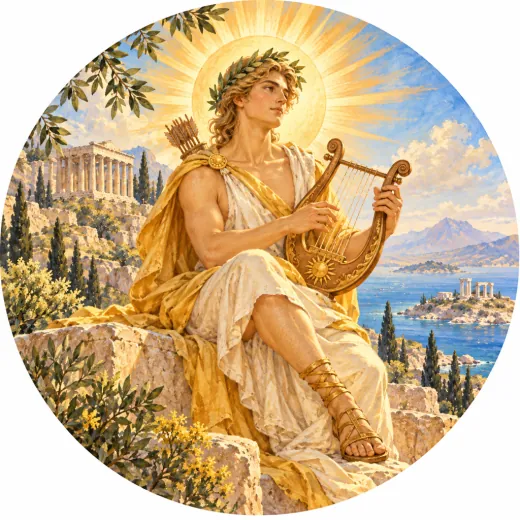
Apollo
Apóllōn, in Ancient Greek
not scary at all
Apollo is the god of light, music, poetry and medicine. He was born on the island of Delos. He plays the lyre, which the ancient hymn gives him, and leads the Muses, the goddesses of the arts. His most important sanctuary was at Delphi, where, according to the ancient hymn dedicated to him, the cult was entrusted to Cretan priests. In Ovid it is he himself who says that the art of medicine is his invention.
Did you know? According to Pausanias, a very famous saying was carved on the temple at Delphi: “Know yourself”.
The story
No island wanted to take Leto in.
She was expecting the child of a god, and Hera, the wife of Zeus, hated her. So Leto wandered from land to land, heavy with her baby, her feet aching, and wherever she knocked, the islands trembled. Lesbos trembled. Chios trembled. Samos trembled. Not one of them dared to give a bed to a woman the queen of the gods wanted driven away.
Then she came to Delos.
Delos was small and poor: rocks and goats, no temples, no riches. But it listened to Leto, and it said, “I would be glad to welcome your son. But I am afraid. They say he will be mighty. I fear he will despise me, kick me, and push me down to the bottom of the sea.”
“I swear by the Styx,” said Leto, “that your temple will be my son's first. People will come from everywhere. You will be rich.”
Delos agreed. With a long sigh, Leto sat down under a palm tree, her back against the trunk.
The birth lasted nine days and nine nights. All the goddesses of the sky came to Delos to help her, all except Hera, who was keeping Eileithyia, the goddess of childbirth, far away so that she would not come down. In the end the other goddesses sent a message to Eileithyia, offering her a golden necklace nine cubits long. Eileithyia could not resist. The moment she touched Delos, Leto threw her arms around the palm tree, the ground turned soft as a meadow, and the god was born.
The goddesses washed him in clear water and wrapped him in a white band of cloth. Themis, the ancient goddess, gave him nectar and ambrosia, the food of the gods. And as soon as the baby had tasted them, he snapped his swaddling bands like threads. He stood up. And he spoke his first words:
“The lyre shall be mine. The curved bow shall be mine. And I will tell mortals the sure will of Zeus.”
Delos was covered in gold from top to bottom, the way a mountaintop is covered in flowers in spring. It was no longer the poor island of rocks and goats. It had become the home of a god.
As soon as he had grown, Apollo set off to find a place to build his temple. He found a valley shut in among the mountains, at the foot of Parnassus. A place of silence and stone, where the air seemed full of voices. But a huge monster lived there, a she-dragon that terrified people and their flocks, the one Ovid calls Python. Apollo drew his bow and let an arrow fly. The monster writhed and died. The place was called Pytho, and later Delphi. The sun, says the Hymn, made the monster's body rot under its rays, and that is how the place got its name.
One thing was still missing: someone to serve in the temple.
Apollo looked out to sea and saw a ship. It was Cretan, from Knossos, full of merchants on their way to Pylos. The god leapt down from the sky, took the shape of an enormous dolphin, gleaming like a living wave, and crashed onto the deck. The ship tilted. The terrified sailors could not steer. The wind carried the ship on by itself, along the coast and into the Gulf of Crisa, and ran it aground on the sand.
The Cretans climbed ashore, shaken. In front of them on the beach stood a beautiful young man, his long hair falling over his shoulders.
“Strangers,” he said, “I am Apollo, son of Zeus. I was the dolphin that brought you here. This will be my temple, and you will be its keepers. Because I appeared to you on the sea as a dolphin, you will pray to me as Delphinios, and this place will be called Delphi. And you will have all the offerings people bring from every corner of the world.”
The Cretans followed him up the mountain, singing.
Time passed, and Apollo, who was young, thought he could never be beaten.
After his victory over the serpent, Ovid tells us, he strutted about as proud as a peacock. One day he saw Cupid, the little god of love, bending his bow. Apollo burst out laughing.
“What are you doing with a bow, child? Weapons like that are for me. I brought down the serpent with a thousand arrows. You just light your little torches.”
Cupid did not answer. He climbed Parnassus and drew two arrows from his quiver: one of gold, sharp-tipped, which makes love begin, and one of lead, blunt, which makes love run away. With the first he wounded Apollo. With the second he struck Daphne, a nymph, the daughter of the river god Peneus.
From that moment Apollo had eyes for no one else. Daphne ran through the woods with her hair streaming in the wind. She hunted like Diana and would not hear a word about love. Apollo chased her. “Wait!” he cried. “I am not your enemy. I am Apollo, son of Zeus. I am the god of the lyre, of the bow, of the herbs that heal. But no herb, alas, can cure love!”
Daphne ran without looking back. She could feel his breath on her neck. Her strength was failing. Ahead of her shone her father's river.
“Father,” she cried, “help me! Change this body that has made me too beautiful!”
She had barely finished speaking when a heavy numbness gripped her legs. A thin bark closed over her chest. Her hair turned into leaves, her arms into branches. Her feet, so quick a moment before, took root in the ground. In front of Apollo stood a laurel tree.
The god laid his hand on the trunk and felt a heart, still beating beneath the bark.
“If you cannot be my wife,” he said softly, “you will be my tree. I will crown myself with your leaves. I will put you on my lyre and on my quiver. And just as my youth never grows old, your leaves will always be green.”
From that day on Apollo always wore a crown of laurel, and after him so did the winners of the games and the generals in their triumphs. The god played his lyre, healed the sick with his herbs, and answered mortals at Delphi. But whenever he passed near a laurel tree, they say, he slowed down.
And the laurel bent its branches. As if it were saying yes.
Relatives around the world
Listen / Read next
- Music to read by: Cinematic JourneyEpic film-style music, no lyrics, by Ciro Simone IrmiciSpotifyYouTube Music
Sources
- Homeric Hymn to Apollo
- Ovid, Metamorphoses, Book I (Apollo and Daphne)
