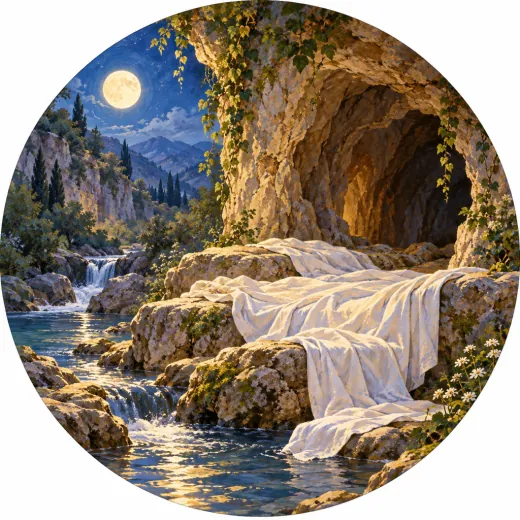
The Anguane of the Buso
“el Buso dele Anguane”, the cave of the Anguane
a little scary
Between Crespadoro and Durlo, in the valleys near Vicenza, a cave opens in a rock face, called “el Buso dele Anguane”. Old people said that the Anguane, water women, lived there. In the stories about them, sometimes they teach men their trades, other times they draw men to them, and nobody ever knows how it will end. Their stories were told during the “filò”, winter evenings spent in warm cowsheds while it snowed outside. They are cousins of the Anguane of Trentino and the Agane of Friuli.
Did you know? The “filò” was a winter evening when whole families gathered in the cowshed, warmed by the animals, to spin wool and tell stories.
The story
Outside it had been snowing for three days, and in the stable it was warm.
It was the stable of a hamlet of Durlo, in the valleys above Crespadoro, and that evening a lot of people had gathered there: men, women, old folk, children, all squeezed in among the cows, who warmed the air with their breath. The women were spinning wool. The spindles turned, the threads grew longer, and now and then somebody coughed to fill the silence.
That winter evening was called the filò. People held it to save firewood, to be together, and to tell stories.
The lantern flame danced on the walls, and the shadows of the spindles stretched up to the ceiling. Outside you could only hear the snow sliding off the roof, now and then, with a soft thud. Nobody was in a hurry to go to bed. On evenings like these, in the valleys, time seemed longer, and stories made it shorter.
That evening, the grandfather had already finished the story of the wolf. He had already finished the one about the soldier coming home from the war. Then he did something strange. He lowered his voice.
"Now I will tell you about the Anguane, the water women," he said.
The women stopped spinning for a moment. Somebody turned towards the door, as if they might be heard.
Because there was a rule in the filò. You spoke of the Anguane quietly. People said they were listening. You could speak ill of a neighbour without any danger, but not of the women of the water, who have ears as long as the mountain streams.
"You know where they live," the grandfather went on. "Up there, in the Buso."
Everyone knew. The Buso dele Anguane, the Anguane's Hole, was a cave, opening in the wall of a great rock that looked over the valley. To get there you had to climb a path in the woods, starting from Contrada Micheletti. From below you could see only a dark hole, like an eye.
"They are beautiful," said the grandfather. "The Bele Butèle, the Pretty Girls. That is what they call them, and they are right. But do not be fooled by the hair and the voices. If you look closely, you see something is not right. They have feet unlike ours. And some say that under the dress their back is hollow like an old tree trunk, and that they cover it with moss."
A little boy beside him opened his mouth to ask a question, but his grandmother tapped him on the shoulder.
"Once," said the grandfather, "there was a boy in the hamlet, one like you, who never wanted to listen. They would tell him: do not go alone into the woods. And he would say: why? And they would say: because of the Anguane. And he would laugh."
The grandfather waited a moment.
"One evening like this, but without snow, he ran away from home. I do not know why. Perhaps after a quarrel, perhaps as a game. He took the path towards the Buso. It was already dark and there was fog. All you could hear was the stream, far below."
A cow shifted, and everyone jumped.
"Then, at a certain point, the boy heard singing."
In the stable you could have heard a pin drop.
"It was a sweet song, a woman's. A melody that seemed to come from the water and the rock together. The boy stopped. Then, without knowing why, he began to climb towards the voice. The higher he went, the closer the voice was, and the lighter he felt, as if the path were making itself."
"And then?" whispered a little girl.
"And then he reached the cave."
The grandfather took a breath.
"Inside there was a cold light. And on the threshold, standing still, were some women, very beautiful, who looked at him and smiled. One of them held out her hand. The boy was about to take it. He was really about to take it. But just at that moment, he saw her feet."
"What feet?" asked the little boy.
"They were not a woman's feet."
Nobody spoke.
"The boy did not scream. He had no time. He did only one thing. He started to run. He ran down the path, in the fog, without turning round, and behind him he heard the voice still singing, and with every step it seemed further away, but also sadder. He reached the hamlet with his shoes soaking wet, as white as snow. His mother hugged him and asked him nothing."
The grandfather looked at the children one by one.
"From that day he never ran away again. He grew up to be a man, and he had children, and he told them the same story. And he always ended it the same way."
"How?" asked the little girl.
"He would say: if one evening you hear singing from the woods, do not answer. If you answer, they hear you. And if they hear you, they call you by name."
In the stable there was a long silence.
Then, from the door, came a gust of wind, and the lantern flame trembled. Somebody laughed, a laugh that was a little too loud. The women went back to spinning, the spindles turned again, and the grandfather relit his pipe.
But that night, walking home through the snow, the children stayed very close to the grown-ups. And nobody looked towards the mountain, where, in the rock wall, there had to be a dark hole.
If someone, at that moment, had listened carefully, perhaps they would have heard something. Very far away, down towards the stream. A woman's voice humming, alone, in the dark. Not a song. Only a name. Repeated softly, ever more softly, as if to see who would answer.
Relatives around the world
Listen / Read next
- Music to read by: Cinematic JourneyEpic film-style music, no lyrics, by Ciro Simone IrmiciSpotifyYouTube Music
- The words of the dialect: VenetianNonnese, the dictionary of Italian dialects
