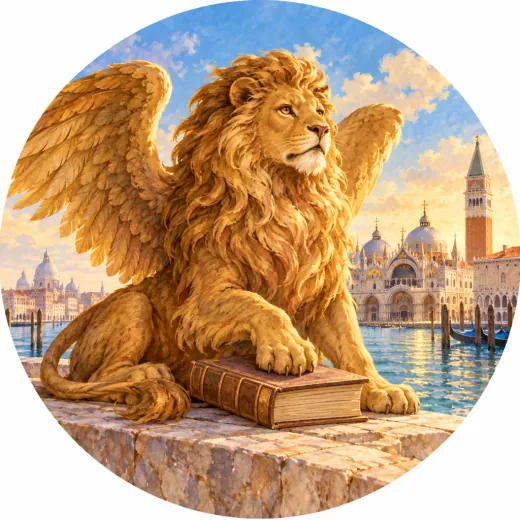
Saint Mark and the Lion of Venice
“Pax tibi Marce”, peace be with you, Mark
not scary at all
According to tradition, Mark the Evangelist was travelling when he stopped on an island in the lagoon. In a dream an angel appeared and told him: “Peace be with you, Mark: one day your body will rest here.” Many centuries later, in 828, some Venetian merchants “stole” the saint's body in Alexandria in Egypt and brought it to Venice: this is a historical fact. The dream was told afterwards, to explain why the saint had to rest right there. Since then the winged lion with an open book has been the symbol of the city.
Did you know? The lion of Saint Mark almost always holds a book, and on the book is written “Pax tibi Marce, evangelista meus”: “Peace be with you, Mark, my evangelist”.
The story
If you go to Venice and look up, anywhere, sooner or later you find him.
He sits on columns, on portals, on flags, above the doors of palaces. He is a lion with wings, and he holds a book between his paws. Sometimes the book is open, and on the pages there is a sentence in Latin. Few tourists stop to read it. It says: Pax tibi, Marce, evangelista meus. Peace be with you, Mark, my evangelist.
To understand why a lion with wings is the symbol of a city of water, we have to begin with a journey.
Mark was one of the evangelists, the ones who wrote the story of Jesus. One day, tradition says, he was sailing towards Rome, and the boat stopped in a lagoon: a flat and silent place, where water and sky were the same colour, and the islands seemed to float like leaves.
There was nothing there, then. No palaces, no bell towers, no bridges. Only reeds, birds, a little wet earth, and the sound of water brushing the boat.
Mark went ashore to rest. He fell asleep.
And in a dream an angel appeared to him. In another version, the angel had the shape of a lion. It did not shout and it did not frighten him. It greeted him with gentle words, almost whispered.
"Peace be with you, Mark. Here your body will rest."
Mark woke. The lagoon was the same as before: the still water, the pale sky. But from that moment, the old tales say, that place was marked.
Those words were not new. In an even older legend, Jesus had spoken them to Mark in a vision, when the evangelist was a prisoner in Alexandria in Egypt. Peace be with you, Mark, my evangelist. Whoever told the dream of the lagoon took them up, but moved them to another place, the way you move a candle from one room to another.
Historians explain it without beating about the bush: that legend served to show where the holy relics were meant to be kept. It was destiny, in short, that Mark should become the protector of Venice.
The interesting thing is that the dream, it seems, was told afterwards. And that what brought Mark to the lagoon, in the end, was not a fishermen's boat.
Let us jump forward, to the year 828.
In Alexandria in Egypt, in the harbour, there were some Venetian merchants. They were doing their work: buying, selling, loading. But they were there for another reason too, and they told nobody.
In the city lay the body of Mark, his relics. For the Venetians it was a treasure greater than any cargo of spices.
We can imagine their talk, in low voices, in the evening, on the ship's deck.
"If we take him home, we shall be the city of Saint Mark."
"And if they catch us?"
"Then they won't catch us."
The source says one blunt word: the relics were stolen. There is no other polite way to put it. The merchants took them and carried them off, and the ship put out to sea, northwards, with the open water ahead.
When they arrived, Venice was already a city, but not yet the one you know. To thank Mark, they built a chapel beside the doge's palace. It was the doge's church, owned by the State: not just any church, but the church of the whole city. That church is Saint Mark's Basilica, the same one you can visit today, with its domes and its mosaics.
Now, there was one last thing to decide. Every saint, in those days, had a symbol.
Already in the year 180 a bishop, Irenaeus of Lyon, had recalled that in the Bible, in the visions, four living creatures appear: one like a lion, one like a calf, one like a man, one like an eagle in flight. And he had thought that each one matched one of the four evangelists. In time, the idea spread. Matthew got the winged man, Luke the calf, John the eagle.
And Mark got the lion.
Venice adopted him at once. Between the city and the saint there was no longer any difference: if Mark was her protector, his lion was her face. So the winged lion went up on ships, on coins, on the gates of conquered cities. He had to follow a few rules: the wings, the book, open or closed, and both eyes clearly visible.
The most common lion is the one the Venetians call "andante", that is, walking, with all four paws on the ground; he often looks to the left, and has a rather fierce expression. With one paw he holds the book. With the other, sometimes, a sword.
The lion "in moleca" is another kind: you see the muzzle, the wings and the paws, and the curved wings recall the claws of a crab, which in the local dialect is called exactly moleca. But the most common one is the other.
It is funny, if you think about it. A fearsome animal, holding an open book and a sentence of peace.
Perhaps this is the real secret of Venice. A city born on the water, where there was nothing, chose as its symbol a lion with wings, who can walk on land and fly over the sea. And beneath his paws it wrote, in Latin, the greeting of an angel.
Next time you go to Saint Mark's Square, raise your eyes. Look at the lion. Look at the book.
And try, for a moment, to feel beneath your feet the silence of a lagoon without houses, where a tired man fell asleep, long ago, and dreamed of his own rest.
Listen / Read next
- Music to read by: Cinematic JourneyEpic film-style music, no lyrics, by Ciro Simone IrmiciSpotifyYouTube Music
- The words of the dialect: VenetianNonnese, the dictionary of Italian dialects
