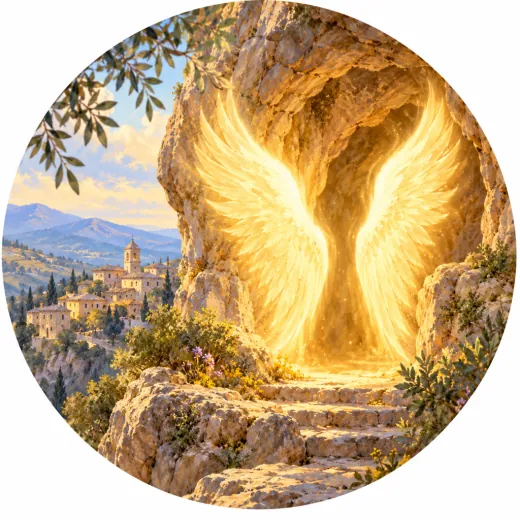
Saint Michael and the Cave of Sant'Angelo in Grotte
the archangel's cave
not scary at all
Above the village of Sant'Angelo in Grotte a cave opens in the rock. The cave is dedicated to the archangel Michael, and his cult here began after the apparitions on the Gargano, where his most famous sanctuary still stands. The village itself takes its name from the cave and from the angel it is dedicated to. The cave is still a place of devotion, and it is part of a long chain of places dedicated to Saint Michael along the Apennines.
Did you know? According to the Pro Loco, the first traces of worship in this cave date from around the year 800, about twelve hundred years ago.
The story
If you want to reach the cave, you have to climb.
The village, Sant'Angelo in Grotte, sits high up, and the cave is higher still, in the rock of the hill, on the side where the sun arrives every morning. A stairway runs along both sides of the entrance. It is not a stairway like others. Those who climb it, for centuries, do so slowly, and their lips move. They recite the chaplet to the Archangel, one bead after another, one step after another.
You do not know the words. You simply climb.
All around there are dark holm oaks and straight cypresses. The air smells of leaves and warm stone. Then, among the trees, a white bell tower appears, with the bells showing through four arched openings. And below it, at last, the façade, with its great Gothic windows. Here, in 1890, the cave was rebuilt and enlarged. But on the ruins of an older one, the records say. And that older one, in turn, was born from a story older still.
To understand it, we must take a step back, and go far away. To the Gargano, in Puglia.
There, around the year 490, Saint Michael had appeared to the bishop of Siponto, Lorenzo Maiorano. There were three apparitions, and from that mountain the news ran through the whole of Italy. Michael was not a saint like the others. He was the supreme chief of the angels, the one who in the holy books fights the dragon. His name, in Hebrew, is a question and a challenge together: "who is like God?"
The Lombards, who loved warriors and high places, chose him as their protector. Where they arrived, he arrived. And where there was a cave open to the east, people saw a house ready for the Archangel. One of these was on the slope above a Lombard settlement, in Molise. The people built a place of worship there. Around that place the first cluster of houses formed. In the name of the village it is all there: Sant'Angelo, and the caves.
About those times the sources know little. They say that the first traces, in the records, appear around the year 800. They say that knights and warriors climbed up here to call on the Archangel before their enterprises, and to be freed from evil. And that with the crusades the cult spread further, along a road of four stages: Monte Sant'Angelo on the Gargano, this cave, Sant'Angelo in Toscana, and at the far end, beyond the Alps, Mont Saint-Michel in France. A chain of places, like lanterns lit one after another.
But now you are standing at the door.
Or rather, at two doors, both of bronze. The first, the larger, is by the Tuscan sculptor Urbano Buratti. It has four panels, and you need only look at them to take a little tour of the beginning of the world: the creation, the Archangel fighting the dragon, Isaac on the altar, the expulsion from Paradise. The second is by the Abruzzo sculptor Giuseppe Madonna, and has a single panel: many different people entering the cave, each under the protection of the Archangel.
You go in too.
The first effect is the cool air. The second is the silence, which is not true silence: there is water. From the hollowed rock, full of cracks and stalactites of green and pink stone, a few drops fall, slowly, and you can hear them land. A well gathers the water that drips from the ceiling. Down there, time seems measured in drops.
Then your eyes get used to the light, and you begin to see.
There is a baptismal basin of stone, round as a big bucket. On the rim, an inscription in Latin. But it can no longer be read: someone, a long time ago, struck it with hammer blows, perhaps without understanding what they were ruining. The mark of those blows remains, and it makes you fall quiet.
Behind it, on a base of the hill's own rock, stands the altar table. And further back, the throne, built with old bricks by local craftsmen to a design by the architect Franco Valente. Around the throne there are nine bronze panels, with scenes of angels from the Old and New Testaments.
Then, the statue. It is heavy, by an author nobody knows. Michael is a victorious warrior, standing above the Devil, who lies beneath his feet. And here, in the village, there is a detail that makes children smile and keeps the rest of the world serious: according to local tradition, the crushed devil looks like a woman, and has a name, a courtyard name, a neighbour's name. They call him Peppinella. Evil, in Sant'Angelo in Grotte, has a name, and a small one: that way it is less frightening.
At the top left, near the entrance, on a small stone base, there is a painting: Saint Francis as a pilgrim at the Gargano, in 1216. On the floor a T-shaped cross is carved. It recalls the sign that, according to the tale, Francis carved at the entrance of the cave on the Gargano, because he felt unworthy to enter. Whether he passed through here as well, nobody knows: it is only a hypothesis, much loved.
You stand in the half-light and think of how many people came in before you. Soldiers, farmers, mothers with children in their arms. In the Jubilee of 2000 someone placed the cave among the stops of a path of penance. Before that, there were the knights. And before the knights, the first people of these hills.
The drops keep falling into the well.
When you come out, the sun is higher. Below lies the village, which bears the name of the angel and of the rock. On the threshold you turn once more, and for a moment you seem to understand why, after a thousand years and more, people keep climbing.
Relatives around the world
Listen / Read next
- Music to read by: Cinematic JourneyEpic film-style music, no lyrics, by Ciro Simone IrmiciSpotifyYouTube Music
