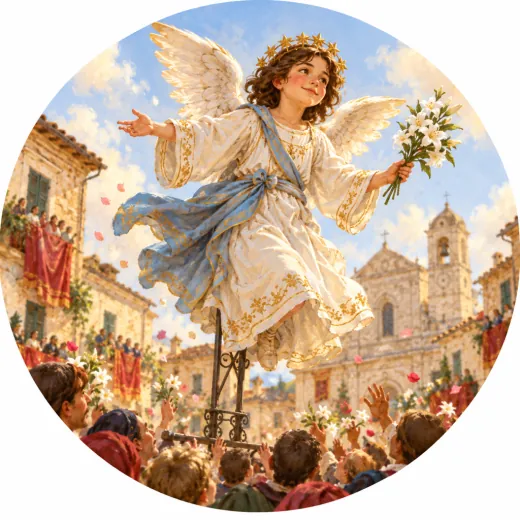
The Mysteries of Campobasso
the “ingegni” that make people fly
not scary at all
More than a legend, it is a wonder repeated every year. For the feast of Corpus Domini the “Misteri” parade through Campobasso: thirteen iron machines called ingegni, carrying real people, mostly children. The machines are metal structures with complex and daring stage sets, and the figures seem to hang in mid-air, as if flying above the crowd. The machines were invented in the mid-eighteenth century by a Campobasso sculptor, Paolo Saverio Di Zinno, and since then they have been carried through the streets.
Did you know? According to the FAI heritage trust, the Mysteries have paraded for more than 260 years, since the mid-eighteenth century.
The story
All year round, in a room in via Trento, in Campobasso, thirteen machines wait, perfectly still.
It is the former ENAL building, an ordinary-looking place. Inside, though, is the Museum of the Misteri, opened on the seventh of October 2006. One room carries the name of Rino Savastano: it holds period costumes and photographs. Another is called Gino Aurisano: it has forty seats and shows films of the procession, the oldest from 1929. And then there is the room of the ingegni, named after Cosmo Teberino. There they are. The thirteen machines.
For almost the whole year they are silent. Iron structures, big and strange, in a room where nobody moves and you hear only the footsteps of a visitor.
Then comes the day of Corpus Domini, and Campobasso changes its face.
From the morning, the streets fill up. Families with pushchairs, grandfathers with folding chairs, boys climbing wherever they can. In the air there is a waiting you can breathe, as before a concert, except that this is not a concert. It is a procession. It is the strangest you have ever seen.
Because at a certain point, at the end of the street, they appear.
They are the Misteri.
They look like nothing else. They are ingegni, that is, iron machines, big and tall, that carry whole stories on stage. And on top of the machines, showing those stories, are real people.
There are seventy-six in all. Fifty-eight are children. Then there are sixteen adults. And two are not people: a lamb, in the Mystery of Abraham, and a little dog, in the Mystery of Saint Roch.
Imagine being one of those children. You have a costume, maybe it is heavy, maybe the collar itches. You are at the top of a machine that moves forward through the crowd, carried through the streets of the city. You see the street from above, the heads, the crowded balconies, the clapping hands. You know you must keep still. And yet you feel like laughing, because it is not serious at all. Or perhaps it is, and that is why you do it.
The people around you look at you with their noses in the air. They whisper, they point out the scenes. Those born here have watched them go by year after year, and every time they make the same face, as if it were the first. For one day the whole city looks up.
The Misteri have been like this for over two hundred and sixty years. They were invented, in the middle of the eighteenth century, by a sculptor from Campobasso: Paolo Saverio di Zinno, or simply Paolo Di Zinno. He was born in 1718 and died in 1781. He trained in Naples, where he refined a remarkable technique. In his life he carved more than a hundred statues of coloured wood, so that today he is considered the leading figure of the Baroque in Molise.
But his strangest idea was not a statue. It was a machine.
It was he who thought up the ingegni: metal structures that carried bold, complicated scenes through the streets, like Baroque paintings that had stepped out of their frames. To build them, he often resorted to unconventional devices. We know this because some of his drawings have come down to us, and scholars have studied them closely, trying to understand how he managed it.
Those drawings, and the solutions they show, are still a subject of study today. The Bollettino d'Arte of the Ministry of Culture devotes a whole article to his building tricks, and to how the scenes managed to imitate the daring perspective of Baroque painting.
Who knows, perhaps that is why they are called Misteri, mysteries. For certain, they are something you look at with your mouth open.
Since then, every year, on the day of Corpus Domini, the ingegni come out of their rest. The crowd parts to let them through, and the scenes move through the streets of the city with the solemnity of a ship.
The museum today says that those thirteen machines are unique in the world. And the numbers tell how much Campobasso cares: over four hundred thousand visitors, three hundred and fifty events, a hundred and ten thousand photographs, six hundred videos, five hundred dated documents. It is the most visited museum in Molise.
But the numbers do not explain the moment when the procession ends. The machines stop. The children climb down, tired and proud, with their costumes creased. The last spectators drift away, and each takes home the same image: a scene passing over their heads, and someone, high up, smiling.
Then everything goes back to its place. The ingegni take the road back to the museum, where the silence of the room in via Trento awaits them, and the light coming through the windows onto all that iron.
They no longer carry their scenes before the crowd. They are standing machines again, that make you think. A group of visitors comes in, lowers its voice, looks up. A little girl reads on the sign the number of characters and stops. "But was there really a lamb?" she asks, tugging her mother's sleeve.
It is true. The museum's numbers say so: a lamb in the Mystery of Abraham, and a little dog in that of Saint Roch, among the seventy-six who parade on the day of Corpus Domini. Real people, children and adults, and two animals who, like all the others, took their turn around the city and then went home.
And they wait for another year.
Listen / Read next
- Music to read by: Cinematic JourneyEpic film-style music, no lyrics, by Ciro Simone IrmiciSpotifyYouTube Music
