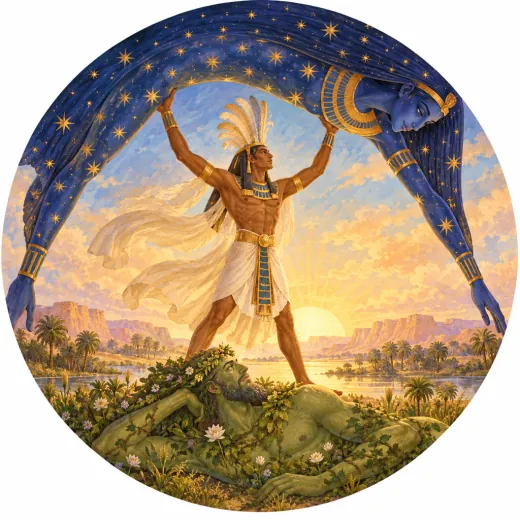
Nut and Geb
Nwt and Gbb, sky and earth
not scary at all
Nut was the goddess of the sky and Geb the god of the earth. The Egyptians drew Nut as a very tall woman, arched over the world, with her hands and feet resting on the two horizons and her body covered in stars; below her lay Geb, green with plants. Between them stood Shu, the god of air, who held them apart. According to tradition, every evening Nut swallowed the sun, which travelled through her body all night long, and every morning she gave birth to it again. From the two of them came Osiris, Isis, Set and Nephthys.
Did you know? Inside many Egyptian coffins, on the lid, Nut was painted with her arms open, so that she would protect the dead person as the sky protects the earth.
The story
In the beginning, the sky was not high up.
It lay on the earth like a blanket on a bed, with not even room for a breath between them. The sky was called Nut. The earth was called Geb. They were brother and sister, and they spent their time gazing at each other.
By day nothing strange happened. The sun of the god Ra, king of the gods, passed over the rooftops of the world, and the world was small and full. But Ra did not know everything. He did not know that in that cramped world, beneath his light, Nut and Geb had fallen in love and were expecting a child.
When he found out, he was furious.
It was not a father's fear. It was the jealousy of a king who sees his kingdom growing behind his back. In a voice that shook the columns of every temple, he spoke words to Nut that no mother would want to hear:
“You shall not give birth in any month of the year. You shall not give birth on any day of the year. That is my word, and no god can undo the word of the king.”
Then he called Shu, the god of the air, and gave him an order.
Shu slipped between them, gently, like someone opening the door of a room that has been shut for a long time. He put his hands under Nut's body and began to push upwards. Nut rose. She arched like a bridge, her fingers resting on one horizon and her feet on the other. The harder Shu pushed, the wider the world became. Where before there had been nothing, now there was a sky.
Beneath her lay Geb, flat on his back. His body became covered in grass, in trees, in rivers. He had become the earth.
Between the two, holding them apart, stood Shu with his arms raised. It was not meant as a cruel punishment, but it felt like one. Nut looked down at Geb. Geb looked up at Nut. They could not touch. And between them, always, there was the wind.
Nut was too big to cry. But stars appeared all over her body.
Ra's curse weighed on her like a boulder. The Egyptian year had three hundred and sixty days, and on not one of them could she give birth. The child grew inside her, with no way to be born. One night, standing in the arch of the sky, Nut spoke into the dark:
“Brother. I don't know what to do.”
Geb, beneath her, did not answer. He was a silent god, the god of the earth. But his roots tightened, and Nut felt it without even looking.
It was Thoth, the god of writing and reckoning, who had the idea.
Thoth was the cleverest of the gods. He went over the curse word by word, head tilted, and noticed that the king had said “on any day of the year”. He had not said “on any day”. All they needed were some days that did not belong to the year.
So one evening, Thoth went looking for the Moon.
“Shall we play?” he said. “Draughts.”
The Moon was a kindly goddess who loved games, and she agreed. They set the board in the middle of the sky and began. The first time Thoth lost, and the second time too. But every time he lost, he raised the stakes: “Another one. This time let's play for something.” And the Moon, who did not expect to lose, agreed to wager a little of her light.
They played all night long. In the end Thoth had won enough light to make five whole days.
Five extra days, which were not part of the year. Five days nobody had ever counted.
When Thoth returned to Nut's sky, the Moon was paler than before, and for a few nights she shone only faintly. Nut asked no questions. She simply looked at the new days, one by one, like five open doors in a wall that had seemed to have no way out. Ra could say nothing. He had spoken himself, and spoken clearly: the year stayed as it was.
On the first day a son was born, and he was Osiris.
On the second, old Horus was born, who already carried the strength of the falcon inside him.
On the third day Seth was born, and he was born with a tearing, like a storm that splits the sky.
On the fourth day Isis was born, small and watchful, with eyes that took in everything.
On the fifth day Nephthys was born, the last, the one who never made a sound.
Down below, Geb felt every birth like a gentle knock in the chest of the earth. Even then he said not a word. But that spring, people said, the fields blossomed earlier than usual.
From that day on the Egyptians had a year of three hundred and sixty-five days, and those five were the days of Nut's children. Days when, people said, time was not yet quite in order.
But Nut, high above, never stopped being a mother.
Every evening she did something the Egyptians painted on their temple ceilings, in deep blue with golden stars. When the sun went down in the west, Nut opened her mouth and took it in. The sun entered her body and travelled through it all night long. In the morning, in the east, the goddess gave birth to it again, red and new, like a baby. Every day. For ever.
And Geb, lying beneath her, gazed up at his sky, and his sky gazed down at him, and between them blew the air of Shu, which nobody could ever take away.
That is how Egypt tells it.
When a king died, the priests wrote words addressed to Nut in his burial chambers, on the walls of the pyramid. They asked her to stretch herself over him, all her length, to cover him with stars, to take him to her as a mother takes a sleeping child. And Geb, the earth, would open his arms to receive the bones.
Over the centuries the scene was repeated on thousands of coffins. Inside the lid, painted in blue and gold, was Nut with her arms open. The dead person, lying on their back, looked up at her from the dark. And above them, as above the world, the sky went on doing what it has always done.
Holding someone asleep beneath it.
Relatives around the world
Listen / Read next
- Music to read by: Cinematic JourneyEpic film-style music, no lyrics, by Ciro Simone IrmiciSpotifyYouTube Music
Sources
- Pyramid Texts (about 2400 BC)
- Plutarch, On Isis and Osiris (1st–2nd century)
