Bes
Bs, in Egyptian
not scary at all
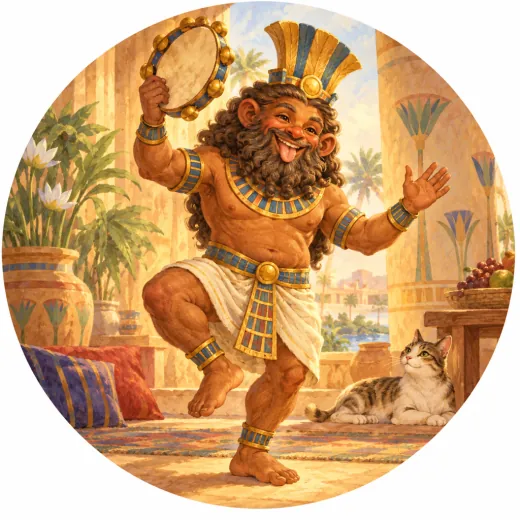
Bes had no great temples, but he was a very popular god in Egyptian homes. He was short and stocky, with a lion's mane, a beard, his tongue sticking out and a face that was funny and fierce at the same time. That face was meant to scare away snakes, scorpions and evil spirits. Bes protected children, mothers about to give birth and everyone's sleep: he was painted on beds, headrests, mirrors and amulets. He was often shown dancing and playing a tambourine.
Did you know? Some scholars think the name of the island of Ibiza comes from the Phoenicians and means “island of Bes”.
The story
In the house there was a woman who was expecting a baby, and tonight was the night.
Everyone knew it. The midwife had brought clean cloths and hot water. The woman's mother had lit a small lamp, the kind that gives off very little smoke. The husband had been sent out to the courtyard, because he kept tripping over the baskets.
On the wall facing the bed, painted in slightly faded colours, was Bes.
Bes was not a handsome god. He was short, almost square, with bandy legs and sturdy arms, a lion's mane around his face, a bushy beard, and a long, long tongue stuck out in a grimace. People painted him everywhere in their homes: on the bed, on the headrest, on the mirror. The great temples did not give him much room. But no house in Egypt would have done without him.
The woman looked at him between contractions.
“Do your job properly, do you hear?” she whispered. “Tonight more than ever.”
On the wall, Bes did not move. But his grimace seemed a little wider.
Around midnight, silence came into the house.
It was not the good silence of the night. It was a silence that came from outside, through the cracks in the door and the hole in the roof, a silence shaped like someone moving slowly so as not to be heard.
The scorpion came first.
It was black and shiny, as big as a hand, and it walked across the floor with its tail held high, one step, then another, towards the bed. The midwife did not see it. Nor did the mother. They were all watching the woman.
Behind the scorpion came the snake.
It came in through the wall, where the mud bricks did not quite fit together. It stretched out on the floor, long and thin, its tongue tasting the air, and headed for the wicker cradle waiting in a corner, still empty. Then, behind it, something colder than the snake came in through the window. It had no face and no body. It was only a shadow with long fingers, the kind that creeps up on newborn babies to make them cry for no reason.
The lamp flickered.
That was when, on the wall, Bes closed his eyes for a moment, like someone taking a deep breath before diving in.
Then he jumped down.
He made a noise. He made a wonderful noise: a boom, and another boom, and then a jingle, because he had a tambourine in his hand and had brought it with him. He landed with his legs wide apart and his mane on end, and he yelled.
It was not a warrior's yell. It was the yell of a clown, of a storyteller in the market square, of someone who bursts into a room shouting: “Here I am, it's me, and you're all about to have a very bad time!”
He bared his teeth. He stuck his tongue out down to his chin. He goggled his eyes. He wobbled his cheeks. He pulled a face so hideous that the scorpion, which had never been afraid of anything, froze with its tail in mid-air.
“You,” said Bes, pointing at it with a finger as fat as a pine cone. “Not here. There are mothers at work here.”
The scorpion lowered its tail, turned and scuttled back to the crack as fast as it could.
The snake was prouder. It raised its head as high as Bes's knees and hissed. In reply, the god began to dance.
He started with a heavy step, a stomp, and the tambourine went boom. Then another stomp, boom, and a hop, and a spin with his arms in the air. The snake followed him with its eyes, to the right, to the left, and the more it followed him, the dizzier it got. After the tenth spin it found itself tied up in knots, muddled, its eyes rolling. It untangled itself as best it could and shot off through the hole it had come from.
That left the shadow.
The shadow was not afraid of funny faces. The shadow was not afraid of dancing. It drifted towards the cradle, slowly, with its long fingers, and for the first time Bes stopped playing the fool.
He planted himself in front of the cradle. He stayed silent. Then he spoke, in a much smaller voice than before:
“I know this one. I've chased away a hundred of them, and a thousand more. She isn't wicked. She's only cold, and she doesn't know where to go.”
And without taking his eyes off her, he began to sing. Not a proper song. A rickety lullaby, with the words wrong and a wobbly rhythm, the kind mothers sing when they are tired and cannot remember the words. He sang it softly, barely tapping the tambourine, and little by little the shadow began to grow thinner. As if the sound were melting it. Thinner and thinner, paler and paler, until it was nothing but a smudge of smoke on the ceiling.
Then nothing.
The cool morning air came in through the window.
And at that very moment, from the bed, came a cry.
A small cry, strong and alive. The midwife laughed, the woman's mother laughed, and the father, out in the courtyard, heard that cry and sat down on the ground without a word, because his legs would not hold him.
“It's a girl,” someone said.
The woman took her in her arms. She was tiny, red and wet. And as she looked at her, without quite knowing why, she raised her eyes to the wall.
Bes was back in his place. Painted again, in slightly faded colours, tongue out and mane all tousled. But one thing had changed. His face looked a little tired. It surely was. Nobody had ever asked Bes whether he felt like it. It was his job, and that was that.
“Thank you,” the woman said quietly.
When the baby was a month old, her mother did something. She took a brush and a little paint and painted a tiny Bes on the wooden headrest her daughter would sleep on: a funny little face with its tongue out, standing guard over her dreams.
That was how it was done in Egyptian homes.
Because the most beautiful god can stay in the temples, receiving offerings of gold. But there are nights when you need someone who can pull a terrible face and dance with a tambourine, and who is not ashamed of anything.
Relatives around the world
Listen / Read next
- Music to read by: Cinematic JourneyEpic film-style music, no lyrics, by Ciro Simone IrmiciSpotifyYouTube Music
Sources
- Véronique Dasen, Dwarfs in Ancient Egypt and Greece, Oxford University Press (1993)
- Geraldine Pinch, Egyptian Mythology, Oxford University Press (2004)
