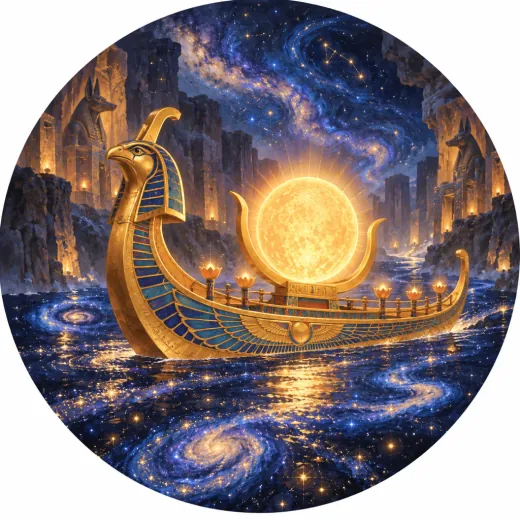
The boat of Ra
Mandjet and Mesektet, the two boats of the sun
a little scary
The Egyptians imagined that the sun travelled on a boat, like the boats that sailed down the Nile. By day it sailed across the sky on a boat called Mandjet; in the evening it moved onto another, Mesektet, and entered the Duat, the world below. The night journey lasted twelve hours, and each hour was a different region, with gates, guardians and dangers. The sun did not travel alone: there was a crew of gods on board, and, according to other funerary texts, at the prow mighty Set defended the sun with his spear.
Did you know? In 1954, at the foot of the Great Pyramid, a real cedarwood boat more than 40 metres long was found, buried for the pharaoh Khufu.
The story
When the sun sets in Egypt, someone is afraid.
Not the living. The living shut their doors and go to sleep. The one who is afraid is the sun god, Ra, because every evening he has to do something that nobody can swear he will manage again tomorrow: cross the Duat.
The Duat is the world below. It is not the sky and it is not the earth. It is a long, narrow river in the dark, divided into twelve hours, and every hour has its gates, its guardians and its dangers. The Egyptians painted it on the walls of the kings' tombs, at the far end of corridors where no light ever reaches. It is the Amduat, the book of what lies in the world beyond.
By day Ra sails across the sky in the boat Mandjet, and everyone can see him. But at the western horizon the boat stops. Ra steps down and climbs into another one, the Mesektet, the boat of the night. Its crew is already in place. There is Sia, who can recognise all things. There is Heka, the god of magic. There is Thoth, who counts the hours and keeps count of everything. And at the prow, say other texts, stands Seth the strong, spear in hand. By day he is a restless god, but at night he is good for one thing only: defending the sun.
The great gate of the horizon shuts behind them with a dull thud.
The first hour. The boat glides over black water that makes no sound at all. On both banks, baboons raise their hands to the sun and worship him in low voices. It is the only greeting the boat will receive all night.
The second hour, the third. The banks grow wider, and wherever the boat passes, something strange happens. From the shores, out of the darkness, figures wrapped in bandages rise up. They are the dead. They have been waiting all day, motionless, heads bowed, and now they feel a light they have not seen for twenty-four hours.
“It's him,” whispers one.
“It's Ra,” says another, and the whisper runs from bank to bank. “We can breathe. We can speak. Look, there's light.”
For the time it takes to pass one gate, the dead stand up, eat the bread the living have left for them and look at one another. Then the boat moves on. The light goes out, and the heads bow again. The silence afterwards is worse.
The fourth hour, the fifth. Here the water runs out.
Ahead there is only sand. Dark sand, as far as the eye can see, full of caves that give out noises no god would want to recognise. The boat can no longer sail. So it changes: its prow becomes the head of a serpent, and the crew drag it across the desert, step by step, while all around them something hisses.
The sixth hour, halfway through the journey. It is here, in the middle of the night, so they say, that the god of light meets the god of the dead.
For in a hall deep in the Duat lies Osiris, still, his body wrapped in white linen. Ra comes close to him. For a moment the sun and the king of the dead are together, and their union is the greatest secret in the whole book: Ra gives him light, and Osiris gives Ra the strength to return. Neither can do without the other. When the boat sets off again, the sun is stronger than when it arrived.
The seventh hour.
From the bottom of the river comes a sound like rock shifting. It is Apophis.
Apophis is a serpent so long that nobody has ever seen his tail. He is everyone's enemy. He does not want treasure, he does not want the throne: he only wants the world not to exist. He stretches across the river like a barrier and drinks the water with his enormous mouth, and the boat runs aground on a sandbank like a fishing boat.
The Duat seems to hold its breath.
Isis rises to her feet on the boat and begins to speak spells, softly, unhurried, word after word, like someone knotting a rope. The serpent's coils stiffen. At the prow, Seth raises his spear. The serpent hisses and thrashes, and every hiss is a lash of cold across the faces of the crew.
Seth is the god the other gods do not love, the god of storms and the desert, the one who killed Osiris. But on the boat his strength is needed, and he gives it.
The water begins to flow again. Apophis withdraws, wounded, not dead. He never dies. That is why, the next night, it all begins again.
The eighth hour, the ninth, the tenth. The gates open one after another, and at every gate a guardian asks for the name, the right word. Sia answers. Every answer opens a gate. The last of the dead the boat meets are the ones closest to dawn: you can already see them moving their arms, like people about to wake up.
The eleventh hour. The darkness is starting to take a different shape. It is no longer the darkness from before, thick and still. It is a darkness that is waiting.
The twelfth hour.
Ra has reached the end of his journey, but there is no gate ahead of his boat. Ahead there is a serpent, another one, not Apophis: long, motionless, with its mouth gaping like a tunnel. Its name is “Life of the Gods”. The boat goes in through its tail.
Inside it is as dark as the belly of an animal. The sun lets himself be carried through, little by little, and the old god's body grows small, grows light, curls up on itself. When the boat comes out of the serpent's mouth, the tired old king is no longer on board. In his place is a scarab, Khepri, brand new, pushing the ball of the sun in front of him.
The god Shu, the god of the air, lifts the red disc in his hands and carries it over the horizon.
It is dawn.
On a rooftop in Thebes a child wakes up, sees the sky change colour and thinks about none of this. He thinks about breakfast.
But the Egyptians knew. Every morning someone had fought a serpent at the bottom of the world, so that the child could eat that bread.
And that night, once again, the gate of the west would close.
Relatives around the world
Listen / Read next
- Music to read by: Cinematic JourneyEpic film-style music, no lyrics, by Ciro Simone IrmiciSpotifyYouTube Music
Sources
- Amduat, the book of what is in the underworld, tombs in the Valley of the Kings
- Erik Hornung, The Ancient Egyptian Books of the Afterlife, Cornell University Press (1999)
