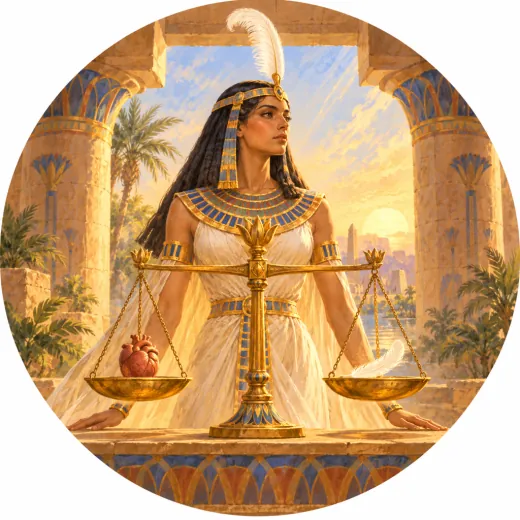
Ma’at and the weighing of the heart
Mꜣꜥt, “truth, justice”
a little scary
Ma’at was the goddess of order, truth and justice, with an ostrich feather on her head. For the Egyptians she was also an idea: the world stayed in balance only if everyone, from pharaoh to farmer, respected Ma’at. After death, said the Book of the Dead, each person came into a great hall before forty-two judges and had to declare that they had done no wrong. Then their heart was weighed against Ma’at's feather. Beside the scales waited Ammit, a being half crocodile and half lion.
Did you know? The real name of the “Book of the Dead” was more cheerful: the Egyptians called it the “Book of Coming Forth by Day”.
The story
In Egypt, the heaviest thing in the world was a feather.
It was an ostrich feather, white and light, and it sat on the head of a goddess called Ma’at. Ma’at was not a goddess of battles or storms. She was the goddess of order. She was the reason the sun rose every morning and the Nile rose every summer, the reason the farmer weighed his grain honestly and the pharaoh judged without fear. As long as everyone respected Ma’at, the world stayed upright. If no one respected her any more, it would tip over sideways, like a boat loaded too heavily on one side.
After death, everyone had to bring her their heart.
The scribe Hunefer knew that better than anyone. In life he had written lists of oxen, sacks and fields for the king’s officials, and he had had a copy made for himself of the Book of Coming Forth by Day, the book the dead take into their tombs. He had learned the spells by heart. He knew the path, the guardians, the gates.
But when he was truly there, standing, he discovered it was not the same thing at all.
He had arrived after a long walk through a windless dark, where every step sounded like a door closing. There was no one ahead of him any more, and no one behind.
The Hall of the Two Truths was vast and silent. Its columns rose into the darkness, and along the walls, seated in a row, were forty-two figures: the judges. Each had a different face, and a name that was frightening. Long-Strider. Bone-Breaker. None of them spoke. They watched Hunefer without moving, like statues that breathe.
At the far end, on a throne, sat Osiris, king of the dead, with green skin, wrapped like a mummy, still and patient. Before him, in the middle of the hall, stood a great pair of scales.
Beside the scales stood Anubis, with the head of a jackal, checking the plumb line with a craftsman’s care. A little further off, Thoth, the ibis-headed god, held a tablet and a pen, ready to write. And in a corner, crouching in the shadows, was something Hunefer had never wanted to look at in the papyrus drawings, and which now he could not avoid.
It had the head of a crocodile. The front of its body was a lion, the back a hippopotamus. Its name was Ammit, the Devourer. It made no sound. It only waited, its jaws slightly open.
“Speak,” said a voice.
Hunefer swallowed. He turned to the judges one by one, calling each by name, and said the words he had learned.
“I have done no harm to anyone. I have not stolen. I have not killed. I have not made anyone weep. I have not cheated with the grain measures. I have not told lies. I have not taken milk from the mouths of children.”
He said it forty-two times, in forty-two ways. At each sentence a judge seemed to listen, and then looked away. No one answered.
At last Anubis came up to him. He laid a hand on his chest, with an almost gentle gesture, and took his heart. Hunefer saw it in a small jar, warm and beating. Anubis carried the jar to the scales and placed it on one pan.
On the other pan, Ma’at laid a feather just like the one she wore on her head. She was there beside the scales, tall and quiet, and she had not said a word in the whole hall. She did not need to: her weight was the measure of everyone.
The hall held its breath. Hunefer did not dare to look, but he could not tear his eyes away. He thought of all the things he had done. Not so much the big ones, which were on the list. He thought of the small ones: a lie told to his sister so as not to visit her, a harsh word to a servant, a day when he had walked straight past a beggar. Things no one had seen. Things the heart, though, had seen every one of.
The heart was the only witness that could not be silenced. Around him the judges waited, and the silence lasted so long that Hunefer heard, far away, the beat of a wing, and realised it was his own blood in his ears.
“O my heart,” he whispered, and his voice broke, “do not rise up against me as a witness. Do not speak against me.”
The pans swayed.
His heart rose a little, sank again. The feather rose, sank again. Anubis held his hand over the beam of the scales, fingers spread. Thoth stopped his pen in mid-air. In the corner, the crocodile head lifted.
The pans slowed. They swayed again, less and less. They stopped.
They were level. The heart and the feather weighed exactly the same.
For a moment, nobody moved. Then Thoth calmly wrote a single line on his tablet and turned to Osiris. “His heart has been weighed, and his testimony is true.”
In the corner, Ammit lowered its head, rested its snout on its paws and closed its eyes.
Hunefer realised he had been holding his breath. He breathed, and the air tasted sweet. His heart was back in its place in his chest, warm, as if it had never left.
From the far end of the hall came a god with the head of a falcon, Horus, the son of Isis, and took him by the hand. “Come,” he said. “I will take you to my father.”
He led him down the hall, between the forty-two judges, who now looked at him differently, all the way to the foot of Osiris’s throne. The green god looked at him for a long time. Then he gave a nod.
Only then did Hunefer fully understand why his book was called the Book of Coming Forth by Day: from that moment on, he could go out. It was not a guide to the dark, but a door towards the light. Whoever had a heart as light as truth could cross the night and see the sun again.
Behind him, on the pan of the scales, the feather of Ma’at had stayed where it was. White, light, perfectly balanced.
The heaviest thing in the world.
Relatives around the world
Listen / Read next
- Music to read by: Cinematic JourneyEpic film-style music, no lyrics, by Ciro Simone IrmiciSpotifyYouTube Music
Sources
- Book of the Dead, chapter 125
- Papyrus of Hunefer, British Museum (about 1275 BC)
