Set
Stḫ, in Egyptian
scary
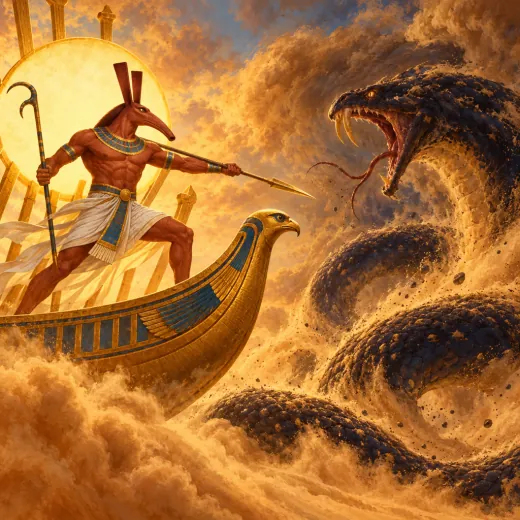
Set was the god of the desert, of storms and of disorder. He had the head of a mysterious animal, with a long snout and square-topped ears, which scholars have never been able to identify. In the most famous myth he is the jealous brother who gets rid of Osiris and fights against Horus. But he was not only the villain: according to funerary texts, every night he stood at the front of the sun's boat and defended Ra from the serpent Apophis. He was strong and dangerous, but necessary too.
Did you know? Some pharaohs proudly carried his name, like Seti I, the father of the famous Ramesses II.
The story
When the wind rose from the desert in Egypt, and the sky turned the colour of rust, everyone knew who was passing by.
Doors were shut. Children were called indoors. Women covered the bread with a cloth, and men tied up the animals. The sand got in through every crack and smelled of burning. The sky sank low, and the sun became a pale disc with no rays. The wind howled through the streets like a pack of blind animals. Nobody spoke above a whisper.
Set had been born wrong.
That is what Plutarch said, who had gathered the stories from Egyptian priests. He was not born at the right time or in the right way: he burst out before his time, violently, tearing his way out of his mother's side. His colouring was red, like the sand of places where nothing grows. He ruled the desert, drought, whirlwinds, and everything in the world that is out of place. Artists painted him with the head of an animal that does not exist: a long snout, and upright, square-topped ears. No one has ever been able to say what beast it was.
His brother Osiris was the opposite: the king of wheat, of laws, of the Nile. Set looked at him and could not breathe.
One evening he invited him to a feast, with seventy-two companions, and brought along a chest. Osiris, who suspected nothing, lay down inside it as a game. The lid was nailed shut and the river carried the chest away. But Set had not finished yet. A long time afterwards, on a night of full moon, he went out hunting a boar, and his dogs led him to a chest hidden among the reeds. Set already knew what was inside. He opened the lid in the moonlight. And this time he cut his brother's body into fourteen pieces and scattered them, one by one, the way you throw away something you never want to see again.
That was when his war with his nephew began.
Osiris's son was called Horus. He was young, and he wanted his father's throne. Set was strong, and he wanted the same throne. They ended up before the court of the gods, with Ra, the king, presiding, and the trial lasted eighty years. Set shouted that strength was on his side: anyone with an arm like his could hold up a kingdom. Horus, who was small, answered that a throne is inherited from your father.
There were tests, tricks and contests.
Once they decided to hold a race in boats made of stone. Set, with his own hands, broke the top off a mountain and carved from it an enormous boat, as shiny as a pebble polished by the river. Horus looked at it and said nothing. He went home and built his boat out of pine wood, covered it with plaster and painted it so that it looked like stone too.
On the day of the race Set climbed into his boat. The moment it touched the water, it sank like a stone. Set came up furious and, without a word, turned himself into a hippopotamus. He hurled himself at Horus's boat and smashed it to pieces.
Then Horus changed his shape too. Two hippopotamuses at the bottom of the river, to see who could hold out longer. Down there everything was green and still. Bubbles rose one by one, and on the surface there was nothing to see. Three months went by, the papyrus says, and Isis, Horus's mother, on the riverbank, no longer slept. She tried to help her son, but her harpoon struck Set instead, and Set, wounded, cried out: “Sister, what have I done to you? Let me go, I'm your brother!” Isis took pity on him. She set him free. And Horus, furious, ran off into the mountains.
There Set caught up with him, in the dark, and wounded him in the eyes.
Horus lay on the ground for a long time, blind, his face against the stones. A goddess, Hathor, found him like that, and healed him with the milk of a gazelle.
In the end the gods sent a letter to a very ancient goddess, Neith, to ask who should have the throne. She answered: Horus, son of Osiris. For a moment, Set was silent.
Then he said something nobody expected: “Yes. Let it be so.”
At that point Ra, who had been watching everything, did something unexpected. He did not drive Set away. He took him with him and placed him in the sky, at his side. And from that day, the papyrus says, Set thunders from on high, and people are afraid of him. Thunder was his voice: a long rumble that comes from far away and makes the walls shake.
This is not the end of the story.
The Egyptians knew that every night the sun goes down beneath the earth, and that at the bottom of that darkness lives Apophis, the serpent. A monster as long as a river, who tries to stop Ra's boat, because without the boat there is no dawn. That is why, they used to say, beside Ra, standing at the prow, there was someone nobody loved but everybody needed: Set. Only he had the right kind of strength. With his spear raised in the dark, he looked the serpent in the eye and drove it back.
That is how it must have been, on those nights beneath the earth. The black river, with no moon. The serpent's hiss rising from the water, long and low, and the boat rocking. The gods hold their breath. Set stands there, enormous, and when Apophis opens its jaws wide, he does not step back an inch. All you hear is the blow of the spear, and then a scream that fades into the water. The boat will set off again. It will set off again every night.
The wind that blows over the desert at night is his breath: the same breath that frightens children is the one that keeps the serpent away.
That is why some pharaohs, Seti I among them, bore his name with pride.
But at night, in the desert, when the wind rises, nobody goes out to check.
Relatives around the world
Listen / Read next
- Music to read by: Cinematic JourneyEpic film-style music, no lyrics, by Ciro Simone IrmiciSpotifyYouTube Music
Sources
- Chester Beatty Papyrus I, The Contendings of Horus and Set
- Plutarch, On Isis and Osiris
