Horus
Ḥr, “the one on high”
not scary at all
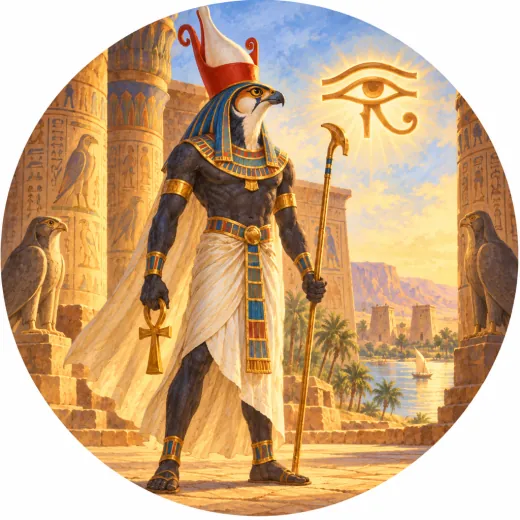
Horus, who had the head of a falcon, was the son of Osiris and Isis. When he grew up, he challenged his uncle Set to win back his father's throne. The trial of the gods between the two lasted eighty years and was full of contests and tricks: once they turned into hippos to see who could stay underwater longer. In one fight Set injured Horus's eyes, which were healed by the goddess Hathor. In the end the gods ruled in favour of Horus, and every pharaoh saw himself as his heir on earth.
Did you know? The “Eye of Horus”, the healed eye, was a very popular good-luck charm in Egypt to protect people's health.
The story
The gods argued for eighty years.
Not with swords, not with thunderbolts: with words. They sat in a circle in a great hall, before Ra, the king of the gods, and they debated. Every day someone stood up, spoke and sat down again, and the next day they started all over from the beginning. There was only one question: who should have the throne of Osiris, the king Set had killed?
On one side was Horus. He was young, with the head of a falcon and bright eyes, the son of Osiris and Isis. He said the throne was his because a throne is inherited from your father.
On the other side was Set, his uncle. He was big, red in the face and as strong as three men. He said a kingdom needs a king who can defend it, and that a boy would never be able to.
The gods were divided. Some were on Horus's side, because the law was with him: Thoth, the god of writing, and Shu, the god of the air, stood up at every session to say that a son comes before an uncle, and always has. Others were on Set's side, because strength always impresses. Ra, who was presiding, seemed to lean towards the uncle. They debated, they voted, they quarrelled, and at every session no one gave an inch. The years passed over the hall the way floods pass over the river. Isis, Horus's mother, listened with her eyes flashing with anger.
So Isis decided to act.
One morning Set was walking alone near an island when he saw a young woman in tears, sitting on the shore. She was beautiful, and she wept without a sound. Set stopped.
“What's the matter?” he asked.
“I was married to a herdsman,” said the young woman. “My husband died and left me a son, who looked after his cattle. Then a stranger came and said to my son: I'll beat you and throw you out, and take your cows. I'm here because I want someone to give me justice.”
Set was outraged. “What? Are the cattle to be given to a stranger, while the son of the man who owned them is still alive? The stranger must be driven out.”
At that moment the young woman turned into a kite, flew up onto a branch of an acacia tree and cried: “Weep, Set. Your own mouth has spoken. You yourself have said how this must be judged.”
Set burst into tears of rage and ran to Ra. But Ra, though he had a soft spot for him, could only tell him the truth, with a long sigh: “You have pronounced your own sentence.”
Set would not give up. “Let's have more contests,” he said.
First he challenged Horus to a race in two boats made of stone. Set went up a mountain, broke off its top with his bare hands and carved from it an enormous boat, as smooth as a river pebble. Horus looked at it and said nothing. He went away. He built his boat out of pine wood, covered it with plaster and painted it, and when it was dry it looked like stone too, but it was as light as a feather.
On the day of the race, all the gods gathered on the riverbank. Set climbed into his boat and pushed off. A moment later it was at the bottom of the Nile, and Set came bursting up, gasping, soaked to the top of his head, as ridiculous as a cat that has fallen into a bucket.
Furious, he turned himself into a hippopotamus. He hurled himself at Horus's boat and smashed it to splinters.
Then Horus changed too. Two hippopotamuses at the bottom of the river, face to face, to see which of them would come up first. Days passed. Weeks passed. Three months passed, the papyrus says, and on the bank Isis, who no longer slept, decided to help her son: she took a harpoon, threw it into the water, and struck Set.
Set cried out: “Sister, what have I done to you? Let me go, I'm your brother!”
Isis took pity on him and set him free. When Horus found out, he was so angry with her that he ran away into the mountains.
There Set found him. He struck him in the eyes and left him lying under a tree, blind, in the dark. Horus covered his face with his hands. For a while he could see nothing at all.
But Hathor, the goddess of love and joy, found him. She sat down beside him, took the milk of a gazelle and poured it over his eyes. And the light came back.
In the end the gods, tired of eighty years of arguing, wrote a letter to Neith, a very ancient goddess, and asked her who should rule. The answer came quickly: “Give the office of Osiris to his son Horus.” And to comfort Set, they promised him a place of honour.
Set listened. He was silent for a long time. Then he said: “So be it. Let Horus be called.”
They brought Horus before everyone. They told him: “You are the king. Take your seat on your father's throne.” Isis rejoiced, and her voice was heard all the way up in the sky. He was proclaimed king of the Egyptians: Horus, son of Osiris, lord of the Two Lands.
And Set?
Ra took him with him into the sky, like a son. From that day, the papyrus says, Set thunders above the earth and people are afraid of him. He had lost the throne, but not his place.
All over Egypt, that day, fires were lit. In Edfu, the city of the falcon, people danced in the streets until nightfall, and children ran between the houses shouting the name of the new king. After eighty years of words, the matter was settled.
That is why, from then on, the pharaohs wrote the name of Horus as the first of their names. Each of them saw himself as his heir.
Every time a new king took the throne in Egypt, it was as if the young god with the healed eyes was sitting in his place once more.
Relatives around the world
Listen / Read next
- Music to read by: Cinematic JourneyEpic film-style music, no lyrics, by Ciro Simone IrmiciSpotifyYouTube Music
Sources
- Chester Beatty Papyrus I, The Contendings of Horus and Set (12th century BC)
- Plutarch, On Isis and Osiris
