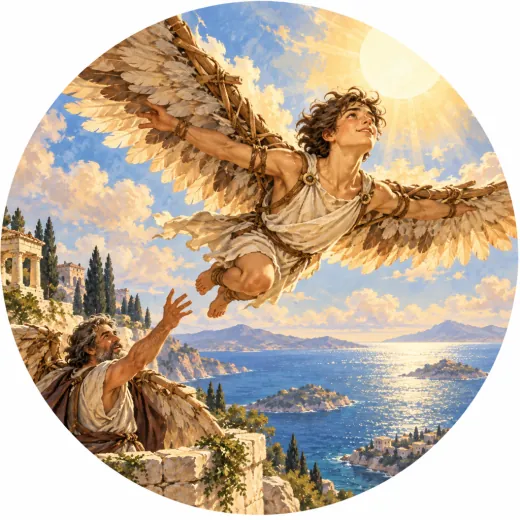
Icarus and Daedalus
Íkaros and Daídalos
a little scary
Daedalus was the finest inventor of the ancient world, the man who had built the Minotaur's labyrinth. King Minos kept him prisoner on Crete together with his son Icarus. To escape, Daedalus made two pairs of wings out of feathers and wax. Before leaving he warned his son: “Don't fly too low, or the sea spray will make the feathers heavy; and not too high, or the sun will melt the wax.” But Icarus, overjoyed to be flying, rose higher and higher, the wax melted and he fell into the sea.
Did you know? According to the myth, the stretch of sea where he fell is still called the Icarian Sea, near the island of Ikaria.
The story
Daedalus had made things nobody before him had ever made.
He had built statues so lifelike that they seemed to breathe. He had built the Labyrinth for the king of Crete, a palace nobody could find the way out of. He knew how to work wood, bronze and stone, and every time he invented something, people told him, “It can’t be done.” And he would answer, “Watch.”
But King Minos did not love him. He feared him. A man who knows the secret of the Labyrinth is a dangerous man, and Minos kept him prisoner on Crete, together with his son Icarus, in a house near the sea.
There were no chains. There was no need for them. On land, Minos ruled every road and every harbour. At sea, he ruled every ship. Every boat that set out was stopped, every sail was checked. The island was the cell, and the sea was the wall.
Daedalus would stand at the window and watch the birds.
They flew low over the waves. They soared high over the cliffs. They went wherever they wanted, without asking anyone’s permission. One evening Daedalus said under his breath, as if talking to himself, “Minos is master of the land and of the sea. But he is not master of the sky.”
That night he did not sleep.
The next day, and for many days after, he began collecting feathers. Small ones, middle-sized ones, long ones, from gulls, from falcons, from eagles. He laid them out on the table from the shortest to the longest, like the pipes of a bagpipe. He tied them in the middle with linen thread, then joined them together with wax, and finally bent them gently, so that they took the shape of a real wing.
Icarus watched him. He was a boy, and to a boy the most serious things look like a game. Every now and then he picked up a feather and held it under his nose to make it tickle. He took a lump of wax, warmed it between his fingers and squashed it into a little ball, and his father would say, “Icarus, please, that isn’t for playing with.”
“But it’s lovely,” the boy would answer, laughing.
When the wings were ready, Daedalus strapped them to his shoulders. He climbed onto the roof, spread his arms and pushed off. He fell, rose, fell again. Then a gust of wind caught him under the feathers and lifted him up. For the first time in human history, someone was flying.
Daedalus landed with tears in his eyes. He made a pair of wings for his son.
Before they set off, he took the boy’s face in his hands. He was a father, and like all fathers, that day he was more frightened than he wanted to show.
“Icarus, listen to me carefully. Don’t fly too low, because the seawater will soak the feathers and make them heavy. And don’t fly too high, because the sun melts the wax. Stay in the middle. Fly behind me. Follow me, and don’t look at anything else.”
“Yes, Dad.”
“Promise.”
“I promise.”
Daedalus kissed his forehead. Then they spread their arms wide and launched themselves into the empty air.
From up there, the sea was a blue carpet. The boats were walnut shells. The waves were lots of little white teeth. The wind carried a smell of salt and thyme, and the feathers sang softly with every beat.
Down below, people stared open-mouthed. A fisherman holding his rod, a shepherd leaning on his staff, a farmer ploughing his field. All three of them stopped. They said, “They are gods.” Because a man does not fly. A man cannot.
Icarus was not thinking about anything any more.
His arms felt light, his chest was full of air, and he felt a happiness so great that it hurt. He was free. It was the first time since he was born that no wall was holding him back. In front of him, the sky opened wider and wider.
His father flew ahead, calmly, with steady wingbeats. Icarus overtook him. His father shouted something, but the wind carried the words away. Icarus laughed and climbed higher. Above his head was a bluer sky, and the sun, blazing hot, calling to him.
He did not feel the first bit of wax melt.
What he felt instead was a tickle. A feather came loose and drifted past his eyes, slowly, dancing. Then another. Then five, ten. The wings that had been strong a moment before were going limp. His flapping arms found no more air: only emptiness.
“Dad!”
He shouted it only once.
Daedalus turned round. He saw a boy falling, his arms spread wide and a cloud of feathers flying around him like black snow. He saw the sea waiting for him. He could not reach him. There was nothing more he could do.
When all he found among the waves were the feathers, Daedalus understood.
He flew down and searched for his son’s body. He found it on the shore of a nearby island, buried it with his own hands and left the wings there, so that nobody would ever find them. The sea where Icarus fell has been called the Icarian Sea ever since. The island, Icaria.
But Daedalus flew on. He reached Sicily, and there he built again, and again, because it was the only thing he knew how to do. They say, though, that from that day on he never touched a feather again.
The Greeks told this story to their children. And they told them two things.
The first: don’t climb too close to the sun when you are happy, because happiness makes you forget the wax.
And the second, more quietly, for fathers: when you teach a child to fly, warning them is not enough. You have to fly beside them for as long as you can. And when you can no longer stay close, you have to stay there and watch, with your eyes open, even when it hurts.
Relatives around the world
Listen / Read next
- Music to read by: Cinematic JourneyEpic film-style music, no lyrics, by Ciro Simone IrmiciSpotifyYouTube Music
Sources
- Ovid, Metamorphoses, Book VIII
- Apollodorus, Epitome
