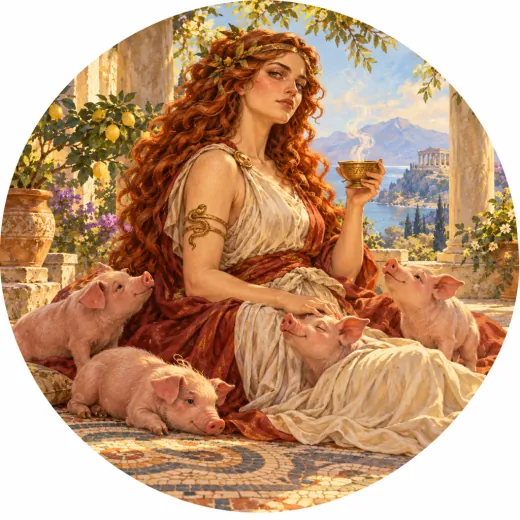
Circe
Kírkē, in Greek
a little scary
Circe was a powerful sorceress, a daughter of the Sun, who lived in a palace on an island surrounded by strangely tame wolves and lions. When Odysseus's companions came to her, she welcomed them with a feast and a magic drink, and turned them into pigs. Odysseus was able to resist thanks to a magic herb given to him by the god Hermes, and he persuaded Circe to give his men back their old shape. Then he stayed with her for a whole year, and she gave him valuable advice for the journey.
Did you know? According to the Romans, Circe's island was the headland of Circeo, in Lazio, which still bears her name.
The story
For many days, Odysseus's ship had not seen land.
The sailors were exhausted, and when a low island covered in woods appeared on the horizon, nobody cheered. They had learned not to trust islands. After the Cyclops, after the Laestrygonians, after the storm that had blown them all the way here, every unknown shore looked like a trap.
Odysseus climbed onto a rock and looked. He saw no houses and no fields. All he saw was a thin thread of smoke rising from the oak woods, far off, where the trees grew thickest.
“Someone lives there,” he said. “But we won't all go together.”
That day he killed a great stag on its way down to the river and carried it back to the ship. They ate, they drank, and for one evening they forgot their fear. The next day, Odysseus split his companions into two groups. One would stay with him; the other would follow Eurylochus, a careful man who could sniff out trouble. They drew lots. It fell to Eurylochus, with twenty-two men, to go and explore.
They headed into the woods. After a while, they realised they were being followed.
Wolves and lions. They padded along behind the men, unhurried, heads low. The men huddled together, spears in hand, but the animals did not attack. Instead they came closer, whimpering, and rubbed against the men's sides like happy dogs. Lions wagging their tails. Wolves asking to be scratched behind the ears.
“I don't like this,” Eurylochus muttered.
The path ended in front of a palace of polished stone. From inside came singing: a woman's voice, sweet and clear, singing at her loom. The men looked at each other. Then one of them called out, and the door opened.
Circe was the daughter of the Sun, and she did not need to introduce herself. She was beautiful, but with a beauty that made people uneasy, like a lamp burning in a dark room. She smiled at them all, pointed to the chairs and sat them down at a table covered in food.
There was cheese, there was barley, there was golden honey, there was wine. The men ate for a long time without speaking, with the simple happiness of people who had never seen such a feast. Nobody noticed that there was something in the wine. Nobody noticed that, little by little, their thoughts were growing slow and sweet, and that home, the ship and their faraway country were fading from their minds like mist in the sun.
Then Circe raised a wand.
She touched them on the shoulder, one by one. There was a soft flash, and the room filled with grunting.
Where there had been twenty-two men, there were now twenty-two pigs: bristly, pink-snouted, their little trotters tapping on the floor. But their eyes had stayed the same. You could tell from their eyes that they remembered everything. Circe herded them, smiling, into the sty and threw them some acorns.
Eurylochus had stayed outside the door, because he had a bad feeling. He sat and waited a long time, but no one came out. So he ran, without looking back, and when he reached the ship he could not even speak.
At first Odysseus did not believe him. Then he took his sword and set off alone. He walked slowly, his heart pounding, and the whole way he thought of those twenty-two faces he could never mourn enough.
In the wood near the palace, a youth with his first beard came to meet him, a golden wand in his hand. Odysseus recognised him: it was Hermes, the messenger of the gods.
“Where are you going on your own, you poor wretch?” said Hermes. “Circe will change you like the others. Take this.”
He bent down and pulled a small plant out of the ground. It had a black root and a flower as white as milk. The gods call it moly, and it is hard for a human to pull up.
“With this herb, the drink will do you no harm. When Circe touches you with her wand, draw your sword and rush at her as if you meant to kill her. She will be afraid. She will invite you to her bed: accept, but only after she has sworn by the gods that she will do you no harm.”
Odysseus followed the advice, word for word.
He went into the palace. Circe welcomed him with the same smile and offered him the same cup. He drank. She touched him with the wand and said, “Off to the sty, with your friends.”
Nothing happened.
Odysseus drew his sword and pointed it at her. Circe gave a cry, fell to her knees and clutched his feet.
“Who are you? No man has ever drunk that drink without changing. You have a mind no spell can bend. You must be Odysseus, the one Hermes told me about!”
“I want my men back,” said Odysseus. “And first I want your oath.”
She swore. Then she went to the sty and rubbed the pigs with an ointment, and one after another the animals stood up on two legs, their bristles fell away, and they became men again, younger and more handsome than before. They all hugged each other, weeping. Even Circe was moved at the sight.
Odysseus stayed on the island for a whole year. They ate, they drank, they listened to stories. In the end his companions, who could not bear waiting any longer, said to him, “Remember home.” He asked Circe to let them go, and she did not stand in their way.
“First you must go somewhere else,” she said. “You must go down to the house of Hades and question the shade of Tiresias, the blind prophet. He will tell you the way.” Later, when they came back, she would tell him what lay ahead: the song of the Sirens, which bewitched sailors; the rocks where Scylla lived; the whirlpool of Charybdis; the sacred cattle of the Sun, which no one must touch. And Odysseus would listen without interrupting, and remember every word.
There were no more pigs on the island after that. But sailors used to say that on certain evenings, when the wind carried the song of the woman at her loom, you had to block your ears and not listen. Because at sea, a sweet song can lead you anywhere.
Relatives around the world
In the trails
Listen / Read next
- Music to read by: Cinematic JourneyEpic film-style music, no lyrics, by Ciro Simone IrmiciSpotifyYouTube Music
Sources
- Homer, Odyssey, Book X
- Ovid, Metamorphoses, Book XIV
