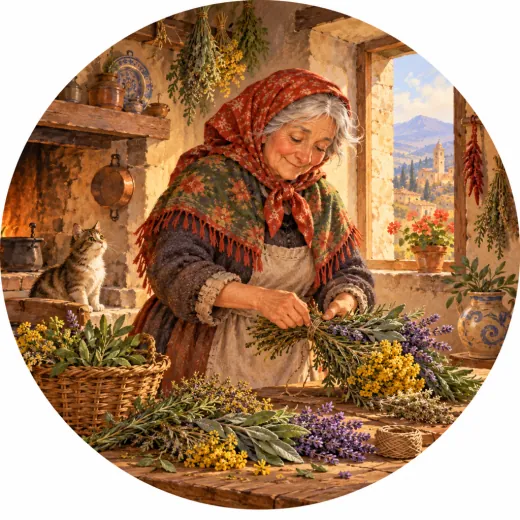
The Masciara
from “magic”, the village sorceress
a little scary
Every village in Lucania had its masciara: a woman who knew formulas, herbs and gestures to lift the evil eye, cure an ache or protect a child. People believed that an envious look, even an unintended one, could make you ill: they called it “affascino”, and the masciara knew how to undo it. For some she was a healer, for others a witch to keep away from. In the 1950s the anthropologist Ernesto de Martino travelled through these villages to understand why that magic mattered so much to people.
Did you know? Colobraro was known as “the village not to be named”, because it was said to bring bad luck: today it has turned that into a summer festival.
The story
In every village of Lucania, until a few decades ago, there was a door you knocked on in the evening, when nobody was watching.
It was the door of the masciara.
The word comes from "magia", magic, and it means the woman who knows. Not the witch of fairy tales, with her broom and her black cat. A real woman, in flesh and blood: a neighbour, a peasant, a weaver, who knew herbs, gestures and words that others did not know. The sources describe her with a phrase that says it all: a figure halfway between healer and witch. Feared, respected, and, when things went badly, consulted.
To understand why people knocked at that door, you have to understand what they thought of the world.
Life in Lucania was hard then. The fields gave little, illness took children away, the doctor was far off, and bad things arrived without explanation. One day you were well, the next day you were not. And you needed a way of saying why.
The way was the affascino.
The affascino was a particular kind of evil eye. People believed that one person could make another ill even without meaning to, just with a look: a look full of envy, of excessive admiration, of longing. It was enough for someone to gaze with eyes too full at a beautiful child, an abundant harvest, a house that was doing well. And the one who had been looked at began to feel unwell.
The symptoms were easy to recognise. A ring around the head, like a tight band. A weariness that reached right into the bones. Yawns, one after another, with no way to stop them.
Then the family sent for the masciara.
Let us imagine the scene. It is evening, in a low-ceilinged kitchen. An elderly woman, with a scarf on her head, comes in without a sound. She sits down beside the sick person. She looks at him for a long time, in silence. She asks how long he has been like this. She asks whom he has met. Then, calmly, she begins to do what she knows how to do. I cannot tell you what she said: her words were private, handed down by word of mouth, sometimes from mother to daughter, sometimes from one masciara to a chosen girl. The scholars who heard them wrote them down, but we do not repeat them.
One thing, though, we do know: afterwards, people felt better. And often it was true.
Because the masciara did not heal only the body. She healed the fear. She explained to a family that what was happening had a name, a cause, and a remedy. She gave a frame to a pain that would otherwise have been mute.
A great scholar noticed this, Ernesto de Martino, an ethnologist from Naples. In the 1950s he travelled the villages of Basilicata with a group of researchers, listening to the masciare, the sick, the families. He recorded the formulas in dialect, described the rites. And in 1959 he published a book, "Sud e magia", that is, "South and Magic".
De Martino did not want to decide whether magic was true or false. He was interested in a different question: why those people needed to believe in it. His answer is one of the most beautiful ideas in Italian anthropology. For him, magic was a technique for defending oneself against precariousness, against what he called "the negative": the ever-present possibility that things go wrong, that the world collapses on top of you. In a poor and forgotten South, that technique was the only defence many people had.
Among the best-known masciare, De Martino cites one they called the "Cattre"; and Maddalena La Rocca is also remembered, a peasant and weaver.
The village most famous for these stories is Colobraro, a village of just over a thousand inhabitants, perched six hundred metres above the Sinni valley. The neighbouring villages call it "chille paise", that village, because saying its name would bring bad luck. The tale goes that in the 1940s a podestà, the fascist-era mayor, during a meeting warned those present that if they did not tell the truth a chandelier would fall. And the chandelier fell. It is an anecdote nobody has ever been able to verify. But Colobraro has kept it.
Indeed, it has built a festival on it. Today, in summer, the village fills with spectators following a theatre show through the alleys, "Sogno di una notte a Quel Paese", or "A Midsummer Night at That Village". There are masciare, brigands, werewolves. Thousands of people, in a few evenings. And the Region recognises it among the intangible heritage of Basilicata.
The masciara, meanwhile, has disappeared from people's homes. But she remains in memory, as a figure that reminds us of something simple: that behind every superstition there is a real fear, and behind every rite a person who wanted to help another.
Relatives around the world
In the trails
The word in dialect
Listen / Read next
- Music to read by: Cinematic JourneyEpic film-style music, no lyrics, by Ciro Simone IrmiciSpotifyYouTube Music
Sources
- Ernesto de Martino, «Sud e magia», Feltrinelli (1959)
- SportOutdoor24, «Masciare, malocchio e il festival delle streghe: Colobraro»
