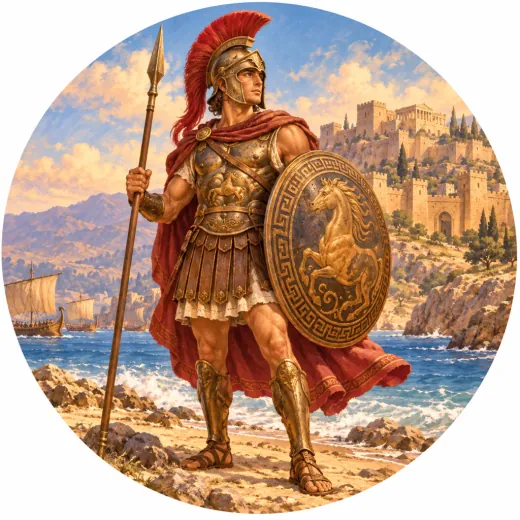
Achilles
Achilleús, in Greek
a little scary
Achilles was the strongest of the Greek warriors in the Trojan War, the son of the sea nymph Thetis. A legend says that when he was a baby his mother dipped him in the river Styx to make him invulnerable, but she held him by the heel, which remained his only weak spot. The Iliad tells of his anger: after being wronged he withdrew from the fighting, and he went back to battle only when his best friend, Patroclus, was killed. He was struck in the heel by an arrow from Paris.
Did you know? The tendon that joins the calf to the heel is still called the “Achilles tendon”.
The story
Achilles was the son of a goddess and a man, and that is why he faced a choice no young person should ever have to make.
His mother, Thetis, the sea nymph, had told him. “You have two destinies. If you stay at home, in Phthia, you will live a long life, happy and forgotten. If you go to Troy, your glory will never die, but you will die young.”
Achilles chose Troy.
They say that when he was a baby, his mother dipped him in the river Styx, which flows through the kingdom of the dead, to make him invulnerable. Thetis held him by one foot, never imagining that this very spot, the heel, would stay dry. But this story is not in the Iliad, the oldest poem: it was added later, by poets who loved things that can be remembered in a single picture.
In that poem, Achilles is simply the strongest. The fastest, the most terrible. After nine years of war around the walls of Troy, his name made his enemies tremble.
But Achilles also had a temper.
One day, in the Greek camp, there was a quarrel. King Agamemnon, the commander of them all, had been forced to give a captive girl back to her father, and to make up for it he took Briseis, the girl who had been given to Achilles as a prize. In front of everyone, without any respect.
Achilles stood up. His hand was on the hilt of his sword, and Athena, invisible, pulled him by the hair to stop him. He did not kill Agamemnon. He did something that was perhaps worse.
“I won’t fight for you any more,” he said. “You can all fight without me. When the Trojans reach the ships, you’ll remember who it was you insulted.”
He withdrew into his tent beside the beach, and did not come out again.
The Greeks began to lose. Hector, the prince of Troy, led his men forward, closer and closer to the ships, and every day there were more dead. Achilles watched from the doorway of his tent, arms folded, without moving.
His best friend, Patroclus, could not bear to see him like that any longer.
“Achilles, please. If you won’t fight yourself, at least let me wear your armour. The Trojans will think it’s you and they’ll run.”
Achilles hesitated. Then he said yes, with just one warning: “Drive the Trojans back from the ships and then come back. Don’t chase them all the way to Troy.”
Patroclus put on Achilles’ shining armour and went out. The Trojans saw him from far away and shouted, “It’s Achilles! He’s back!” They fled. For a whole day Patroclus chased them, happy, his blood on fire. He forgot the warning. He reached the foot of the walls.
And there Hector killed him.
When the news reached the tent, Achilles did not make a sound. He threw himself on the ground, covered his head with ashes, and then let out a cry so loud that his mother heard it from the bottom of the sea.
His grief turned into rage. A new kind of rage, with no fear left in it, and no pride. He made peace with Agamemnon, who admitted his mistake and gave him back Briseis with many gifts, and Achilles no longer cared at all. Thetis brought him new armour, forged by Hephaestus: a shield with the whole world on it, the earth, the sea, the sky, and two cities, one at peace and one at war.
The next day, Achilles went out of the camp.
When they saw him, all the Trojans ran back inside the walls. All except one. Hector stayed outside the gate, alone, waiting for him. He knew he ought to go back in. But he had promised his people that he would not hide.
“Achilles,” he said, when Achilles was close. “Let’s make a pact. Whoever wins gives the other’s body back to his people.”
“There are no pacts between lions and men,” Achilles answered. “There are no oaths between us.”
For a moment, Hector lost his courage. He ran. Three times round the walls of Troy, with Achilles at his heels, while the whole city watched. Then he stopped, turned and faced him.
It was quick. Achilles’ spear struck him in the throat, where the armour, the armour Hector had taken from Patroclus, left a small gap.
Hector fell. “Please,” he said, “give me back to my father.”
“Dog,” Achilles answered. “You would beg me? I’d like to eat you raw.”
He tied him to a chariot with leather straps and dragged him round the city, through the dust, for days, before the eyes of his parents. And every morning, at dawn, he began again, round Patroclus’s tomb.
But the gods were watching. And at a certain point, Zeus had had enough.
One night, someone came into Achilles’ tent. It was an old man. He wore a threadbare cloak and his hands were trembling. He had made his slow way past the guards, and none of them had managed to stop him. He knelt before Achilles and kissed his hands, the same hands that had killed his sons.
It was Priam, the king of Troy.
“Think of your father,” he said. “He is old too. He too is waiting for you to come home. I had fifty sons. Almost all of them are dead. The last one, you killed. All I ask is to be allowed to bury him.”
Achilles, for the first time in days, looked at a face instead of an enemy. And he wept. He wept for Patroclus, for his father whom he would never see again, for the old man in front of him. Priam wept with him. For a long time, neither of them said a word.
Then Achilles stood up. He gave back the body. He promised that there would be no fighting for eleven days, time for the mourning and the funeral. Before the old man left, Achilles shared bread and meat with him.
This is where the Iliad ends. Soon afterwards, they say, came the day of the arrow shot by Paris and guided by Apollo, which struck Achilles right in the heel. But the poets told that part later. The great poem ends with a man who, at the very moment he could have taken his revenge forever, chose not to.
Achilles was the strongest warrior in the world, and the proudest. And all his life, he could never save the people he loved.
He learned only one thing. But he learned it face to face with an enemy, with bare hands, beside a candle that had gone out.
That grief is never yours alone.
Relatives around the world
Listen / Read next
- Music to read by: Cinematic JourneyEpic film-style music, no lyrics, by Ciro Simone IrmiciSpotifyYouTube Music
Sources
- Homer, Iliad
- Statius, Achilleid (the story of the heel)
