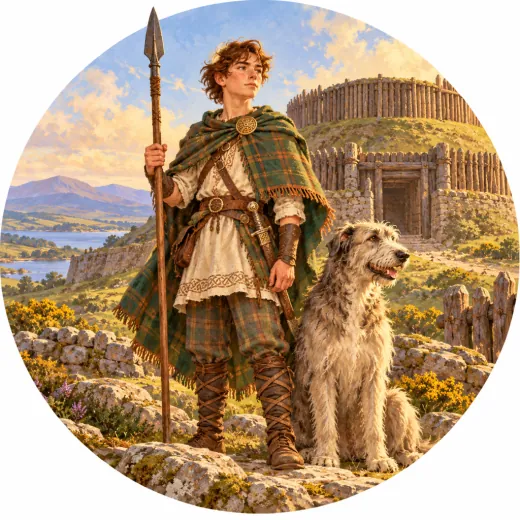
Cú Chulainn
“the hound of Culann”
a little scary
As a boy he was called Sétanta. One evening, arriving late at a feast, he was attacked by the fierce guard dog of Culann the smith, and he defeated it. Seeing how sad the smith was, the boy promised to stand guard himself until another dog had grown up: from then on everyone called him Cú Chulainn, “the hound of Culann”. As a man he became the greatest hero of Ulster: on his own he defended his land against the army of Queen Medb, while the other warriors were struck by a strange illness.
Did you know? According to another tale, “Aided Con Culainn”, at the end he tied himself to a stone so that he would die standing up; a statue in his memory stands in the General Post Office in Dublin.
The story
He was still a little boy when he arrived late for a feast and found a hound waiting for him.
Back then, his name was still Sétanta. His uncle, King Conchobar, had been invited to a banquet by Culann the smith, and the boy was to follow once he had finished a game with his friends. By the time Sétanta reached the smith's house, the sun had gone down. The gate was shut. And loose in the yard was the guard dog.
It was an enormous, savage hound that took three chains to hold. That evening nobody remembered it, because Culann thought all his guests were already inside.
The hound heard the boy and sprang.
Inside the hall, they heard a noise. The king put down his cup. Culann went pale. “My hound,” he said. “Who's out there?” They all ran out, and found Sétanta standing in the yard with his hurling stick in his hand, and the hound lying dead on the ground.
The boy was angry with himself. The smith, though, was sitting in the mud with his face in his hands. “That hound was my home,” he said. “He kept the thieves away and watched over my animals. Now I have nothing.”
Sétanta looked at him. He knew what he had done. And he said something that no seven-year-old should ever have had to say.
“Raise me a pup from that hound's line, and until it is grown, I will guard your house myself.”
And that is how Sétanta became Cú Chulainn: the Hound of Culann.
As he grew, he became faster than anyone. One day he heard the druid Cathbad say that whoever took up arms on that day would be famous for ever, but that his life would be short. The boy heard every word. He ran to the king and asked for weapons. “Better a short life and a long memory,” he said.
Years later, Queen Medb of Connacht decided to make war on Ulster. She wanted a bull, the brown bull of Cooley, the finest in all Ireland. She gathered an army as big as a forest and set it marching north.
Ulster should have defended itself, but an ancient curse had fallen on its warriors. A woman called Macha had cried out that the men of that land would suffer, in their hour of greatest danger, like a woman about to give birth. And in those days every warrior lay in bed, white-faced and weak. All except one. Cú Chulainn was young, and the curse did not touch him, though no one quite knew why.
So the boy found himself alone at a ford, one evening, with an army in front of him.
He stayed there all night, and the next night, and the night after that. The water was cold and dark, and the ford so narrow that only one man at a time could cross. You could hear the river, the horses in the enemy camp, and now and then the song of a bird that knew nothing about war. By day one warrior came, and Cú Chulainn fought him; by night Medb's camp trembled, imagining something worse waiting in the dark. In truth Cú Chulainn barely slept, and ate whatever his charioteer brought him: Láeg, a loyal friend.
Medb had only one idea left. She sent for the one man who could beat Cú Chulainn. His name was Ferdiad.
They had been boys together. They had learned to fight from the same teacher, Scáthach, in a land far away across the sea; they had slept under the same roof and eaten the same bread. Ferdiad did not want to come. He said he would never raise his spear against his friend. But Medb knew how to use words. She promised him riches, she promised him her daughter, she promised that poets would sing his name. And when that was not enough, she told him that Cú Chulainn called him a coward and laughed at him in front of everyone. It was not true. Ferdiad, stung, gave in.
He came to the ford at midday.
“Have you come for me?” asked Cú Chulainn, and he could not stop his voice from shaking.
“Yes,” said Ferdiad. “Not out of hatred. Out of duty.”
They fought for days.
On the first day they threw spears until they dropped with exhaustion. On the second they fought on horseback. On the third, each went back to his own camp with open wounds. And then came the thing that makes this story so sad: every evening, Cú Chulainn sent Ferdiad healing herbs, and Ferdiad sent Cú Chulainn the best food in his camp. There was no hatred, only a kindness that could not stop anything. Their horses spent the night in the same stable. Ferdiad slept among the warriors of Connacht and thought of the other, sleeping on the far bank with the same wounds.
On the fourth day, they both knew it was the last.
“Do you remember?” said Cú Chulainn. “We were friends. We were brothers. No man loved you as much as I did.”
“I remember,” said Ferdiad. “But the time for remembering is over.”
They fought from dawn until evening, out in the water, and neither could wound the other in the right place. Towards sunset Cú Chulainn told Láeg to send him, down the river, the spear called Gáe Bulg, the one no one could block. He would use it only because there was no other way.
Ferdiad fell.
Cú Chulainn took him in his arms. He carried him to the northern bank of the ford, the Ulster side, so that his friend would not lie dead on the enemy's side. And there he stayed, kneeling in the water, saying that this fight had been no game: it had been grief from beginning to end.
In the end Medb got her bull. But that is not what the story remembers.
Another book tells how, long afterwards, Cú Chulainn stayed on his feet to the very last. Wounded, he tied himself to a standing stone with his belt, so that he would die upright and not lying down in front of his enemies. His enemies did not dare come near. Until a crow landed on his shoulder, and only then did they understand that he was dead.
It was a goddess's crow. But that is another story.
Relatives around the world
Listen / Read next
- Music to read by: Cinematic JourneyEpic film-style music, no lyrics, by Ciro Simone IrmiciSpotifyYouTube Music
Sources
- Táin Bó Cúailnge, The Cattle Raid of Cooley
