The Morrígan
Mórrígan, “the great queen”
scary
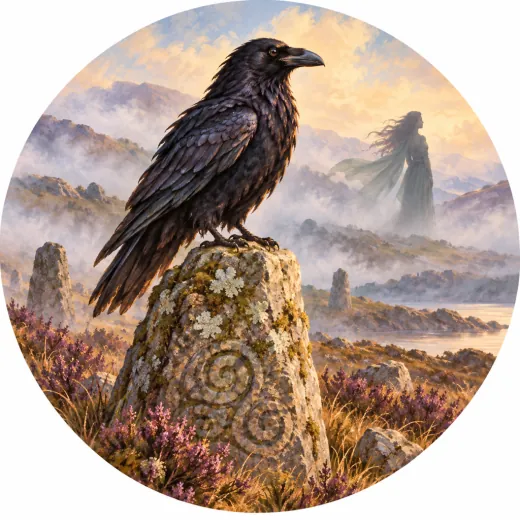
The Morrígan was a mysterious Irish goddess connected with war, fate and the land. She could turn into a crow, an old woman, a young woman or an animal: in the Táin she appears as an eel, a she-wolf and a heifer. In the tales she meets the great hero Cú Chulainn and offers him her help; he turns her away without recognising her, and from that moment she makes his life very hard. In another tale, “Aided Con Culainn”, when the hero fell a crow landed on his shoulder.
Did you know? Some scholars think the Morrígan was not a single goddess but a group of three sisters.
The story
There is a place in Ireland where the night ends before the morning comes.
They call it the ford. A shallow stretch of river between two banks of reeds, where the water runs cold and smooth and makes no sound. People who live there know it is not a place to cross after sunset. And they know that if a crow settles on the ford, you look away.
Cú Chulainn knew it. That winter he was the only man of Ulster still on his feet, because all the other warriors lay in bed, struck down by a curse, and on his own he was holding back Queen Medb's army. He was waiting by the river for the next enemy to come. He was tired. He had not slept for days.
Around midnight he heard a light footstep.
A girl was coming along the bank, in a chariot drawn by a red horse with only one leg. She had long hair and a cloak as red as fire, and she moved without a sound, as if her feet never touched the ground. There was no one else around. There were no birds. Not a single cricket in the grass.
“Who are you?” asked Cú Chulainn.
“I am a king's daughter,” she replied. “I have come to you because I have heard of your deeds and fallen in love with you. I bring you my cattle and everything I own.”
Cú Chulainn looked at that face. It was beautiful, and there was something wrong in its stillness, like a face in a painting. He did not believe her.
“I didn't come here for a woman,” he said. “I'm tired, and I have a war to fight. I have no time for someone who turns up in the dark with a gift.”
The girl's face did not change. But the air did. The river stopped flowing.
“That is no way to answer,” she said quietly. “Remember what you have said. When you fight at the ford, I will be with your enemy. You will see me as an eel, and I will wrap myself round your feet. You will see me as a she-wolf, and I will drive the cattle against you. You will see me as a heifer, and I will run at the head of fifty others. And you will never be safe until you have asked my forgiveness.”
Then she turned and vanished into the shadows without bending a single blade of grass.
Cú Chulainn paid no attention to her words. A warrior with a war on his shoulders does not worry about threats from a strange girl. Not yet.
The next day, the warrior Medb had sent against him arrived. The two faced each other, knee-deep in the water. Cú Chulainn raised his spear.
Something seized his legs.
It was long and cold, and it coiled round his feet and tripped him. An eel as big as a snake. Cú Chulainn fell on his side, and for a moment water filled his mouth. His enemy raised his sword. But Cú Chulainn, still on the ground, managed to strike the eel with his foot, and felt something snap.
He got up. From the bank came a howl. A grey wolf, thin, with eyes like two hot coals, was running back and forth, driving a herd of terrified animals in front of it. The beasts charged towards the ford. Cú Chulainn put a stone in his sling and let it fly. The wolf howled and pawed at its face: one of its eyes was gone.
And then, from the far end of the valley, came a rumble. A big red heifer was galloping at the head of a herd of fifty more, leading them straight at him, through the middle of the river. Cú Chulainn planted his feet on the bank, took another stone and hurled it. The heifer went down with a broken leg, and the herd scattered into the dark.
The enemy warrior fell soon after. The fight was won.
Cú Chulainn went back to rest, wounded and exhausted. He still did not understand what had happened. The eel, the wolf, the heifer: three animals, on the same day, all against him. And yet he remembered the girl's words, and the memory sent a shiver down his spine.
The next day, as he walked up the river, he came upon an old woman.
She was sitting beside a cow, milking it. She was thin and bent, with only one eye, a crooked leg and an injured hand. Her bones creaked with every movement. She milked in silence, and the milk fell into the pail with a thin, soft sound.
“I'm thirsty,” said Cú Chulainn. “Will you give me something to drink?”
The old woman handed him a first cup, filled from a single teat.
Cú Chulainn drank. Then he said: “May the gods bless you, old woman.”
Something in the old woman eased. The eel's broken ribs knitted together.
She handed him a second cup, from another teat. Cú Chulainn drank and blessed her again, and the heifer's broken leg grew straight. A third cup, a third blessing: the wolf's lost eye opened again.
The old woman straightened up. For a moment her figure seemed to grow taller, and her shadows multiplied on the ground.
Cú Chulainn understood.
“If I had known who you were,” he said slowly, “I would never have healed you.”
“I know,” she said, and laughed. It was a small, dry laugh. “Now you know.”
Then the old woman, the cow and the pail turned into a flight of black crows that rose from the meadow and vanished over the river.
This was the Morrígan. Her name perhaps means “great queen”, perhaps “queen of phantoms”: no one is sure. In the tales she appears as a young woman, as an old woman, as a bird, as an animal. She is a goddess of war, of fate, of the land. Some scholars think she was not one but three sisters under the same name. She is not good and she is not wicked: she is there. Wherever there is fighting, she is watching.
Cú Chulainn would live on for a while yet, but the tales say his luck was never the same again. Long afterwards, mortally wounded in one last battle, he tied himself to a stone so that he would stay standing. His enemies did not dare come near. Until a black crow landed on his shoulder.
Then they knew it was over. And in the silence, for an instant, someone swore they had heard a laugh.
Relatives around the world
Listen / Read next
- Music to read by: Cinematic JourneyEpic film-style music, no lyrics, by Ciro Simone IrmiciSpotifyYouTube Music
Sources
- Táin Bó Cúailnge, The Cattle Raid of Cooley (Ulster Cycle)
