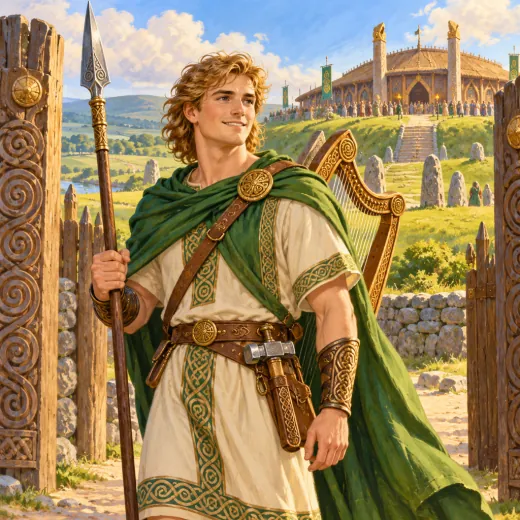
Lugh
Lugh Lámhfhada, “of the long arm”
not scary at all
Lugh arrived at the court of the Tuatha Dé Danann at Tara, and the doorkeeper would not let him in: “No one enters Tara without an art.” Lugh listed his skills: builder, smith, warrior, harper, poet, magician, healer. For each one the doorkeeper replied that they already had someone good. “But is there anyone who can do all of them together?” There was not. So Lugh went in, and he led his people in the great war against the enemy Fomorians.
Did you know? According to Irish tradition, August is called Lúnasa after the harvest festival dedicated to Lugh.
The story
The feast at Tara had only just begun when someone knocked at the door.
Inside the hall there was the usual noise: clinking cups, harps, laughter, the smell of roast boar. King Nuadu sat in the seat of honour, his silver arm resting on the arm of the chair. Outside, the doorkeeper checked everyone who came, because not just anybody got into Tara.
At the door stood a young man, out in the evening wind, with the music spilling from the windows and reaching him in pieces. He did not look like a king or a warrior. He had a worn cloak and the bright eyes of someone who has travelled a long way.
“Who are you?” asked the doorkeeper.
“My name is Lugh. I would like to come in.”
“Nobody comes into Tara,” said the doorkeeper, “unless he can do something. An art. A real craft. What is your art?”
“I am a builder,” said Lugh.
The doorkeeper shook his head. “We already have a builder. A very good one.”
“I am a smith.”
“We have a smith.”
“Then I am a champion, a warrior.”
“We have those too.”
Lugh smiled, just a little. He did not get angry, and he did not leave. He went on, as calmly as before, as if he were reading out a list.
“I am a harper.”
“We have a harper.”
“I am a poet, and I know the stories of the past.”
“That as well.”
“I am a sorcerer. I am a physician. I am a cupbearer. I am a worker of metal.”
At every name the doorkeeper gave the same answer, slower each time: “We already have someone. We already have someone.”
Then Lugh stopped.
“All right,” he said. “Then go and ask your king one thing. Ask him whether he has a single man who can do all these things together. If he has, I will go away and never knock again.”
The doorkeeper looked at him for a long time. He seemed about to say something, but nothing came, because he had no idea how to answer a question like that. Then he turned and went into the hall.
They heard him talking to the king. Then silence. Then footsteps.
The door opened.
“Come in,” said the doorkeeper, in a different voice. “The king says no one has ever been able to do all that. He will call you Samildánach: the man of many arts.”
Lugh stepped over the threshold.
Inside, nobody trusted him. The king put him to the test. They made him play fidchell, a game of strategy that needed a clear head and patience, against the best player in Tara. Lugh won, game after game. Then a big, strong warrior, Ogma, picked up a flagstone so huge that eighty oxen could not have moved it, and hurled it out of the hall into the middle of the meadow. “Put it back,” he said. Lugh went out, lifted it and threw it back inside with one hand. It landed exactly where it had been.
Then Nuadu handed him a harp.
“Play,” he said.
Lugh played. He began with the strain of weeping, and everyone in the hall wept, for no reason at all, cups still in their hands. Then he played the strain of laughter, and they all burst out laughing, clutching their sides. Then the strain of sleep, and one after another, snoring, the warriors of Tara fell asleep on the tables. They slept from one sunset to the next.
When they woke up, Lugh was sitting in the seat beside the king. And nobody complained.
The people of Tara had a big problem that year. The Fomorians, the giants of the sea, had been demanding heavy tribute from them for years, and now they were about to attack. Nuadu, who had lost his arm in an earlier battle, knew he was no longer the best one to lead. Now, in front of all those people, he saw it clearly.
“Take my place,” he said to Lugh. “For a year. You lead the war.”
Lugh gathered the chiefs: the Dagda, Ogma, Goibniu the smith, Dian Cécht the physician. He asked each of them what he could do, just as the doorkeeper had asked him. The smith would forge spears and swords without missing a stroke. The physician would heal the wounded, so that they could fight again the next day. The Dagda would bring his strength and his tricks. Lugh listened to it all, and put every piece in its place.
When the day of the battle came, at Mag Tuired, the field filled with dust and shouting.
Lugh was supposed to stay at the back. His people had decided it: he was too important to risk. Nine men were guarding him. But at a certain moment Lugh slipped free and threw himself into the fight, and the others were not quick enough to stop him.
He did not go to fight like the rest. He went round his army on one foot, with one eye closed, chanting an ancient spell to protect his warriors.
On the other side stood Balor.
Balor was the leader of the Fomorians, a giant with enormous hands, and he had a single eye that nobody dared to look at. It opened only in battle, and it took four men with a handle to lift the lid. Whoever met that gaze lost all their strength. Balor was also Lugh's grandfather, because his daughter Ethniu was the young man's mother.
The great eye opened.
Lugh did not hesitate. He had a sling and a stone. He took aim, with the calm of someone whose mind is already made up, and let fly.
The stone struck the eye and drove it back through his head and out the other side, so that from then on it looked at the Fomorian army. Its gaze fell on them, and the giants were thrown into confusion.
Balor fell. The Fomorians fled towards the sea.
The people of Tara had won.
They say that when they came home, Lugh asked for nothing. He had done what he was asked, in the way he knew how. And the warriors who had told him at the door “we already have someone” understood the simplest thing of all: one craft had never been enough. They needed someone who could hold them all together.
Even today, in Ireland, the month of August is called Lúnasa, after Lugh. An ancient festival, they say, to give thanks for the harvest.
Not bad, for someone who was stopped at the door.
Relatives around the world
Listen / Read next
- Music to read by: Cinematic JourneyEpic film-style music, no lyrics, by Ciro Simone IrmiciSpotifyYouTube Music
Sources
- Cath Maige Tuired, The Second Battle of Mag Tuired
