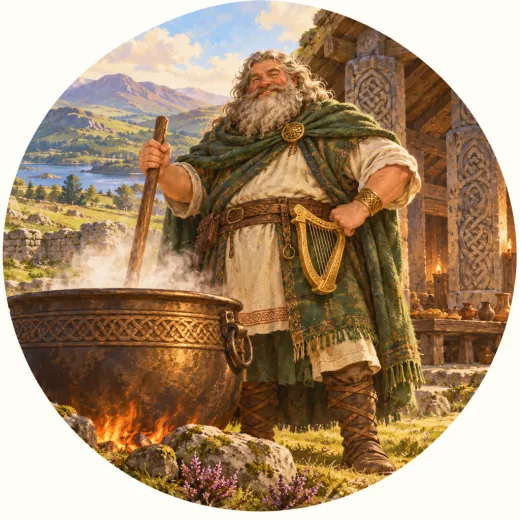
The Dagda
an Dagda, “the good god”
not scary at all
The Dagda was the chief of the Tuatha Dé Danann, the divine people of ancient Ireland. He was big, strong and a bit comical, with a short tunic and an endless appetite. He had three magic treasures: a cauldron from which nobody ever went away hungry, a harp that played three tunes, one that makes you weep, one that makes you laugh and one that makes you sleep, and a club so enormous that it left a furrow in the ground. His name does not mean “good” as in kind, but “good at everything”.
Did you know? When his enemies stole his harp, the Dagda called it by name and it flew by itself into his hands.
The story
They say the Tuatha Dé Danann came to Ireland on a dark cloud that hid the sun for three days. They brought with them four treasures, one from each of the four cities they had come from.
A spear that never missed its target. A sword that was never drawn in vain. A stone that cried out when a rightful king stood on it. And a cauldron, enormous and blackened by fire, from which no one ever went away hungry.
That cauldron belonged to the Dagda.
The Dagda was their chief, and he looked nothing like a king. He was huge. He had the shoulders of a bull and the walk of a bear. He wore a brown tunic so short it didn't even reach his knees, and a cloak that stopped at his elbows. On his feet he had shoes of horsehide, with the hair on the outside. And he dragged behind him a club so big that it took eight men to carry it: the furrow it left was as deep as a boundary ditch.
But his name meant “the good god”: good as in skilled, good at everything. He could build, sing, heal and fight. And eat.
When war came with the Fomorians, the giants of the sea, the Tuatha Dé Danann needed time. They had weapons to prepare, warriors to ready, magic to make. Someone had to go into the enemy camp and keep them busy.
Lugh, their commander, looked at the Dagda.
“You're the only one who can do it,” he said.
“Me?” said the Dagda, who was chewing something. “And what am I supposed to say?”
“Nothing. Just let them see you.”
The Dagda shrugged, slung his club over his shoulder and set off. He walked for a whole day, and along the way he mostly thought about what they would give him to eat. It wasn't really a worry. It was a habit.
When he arrived, the Fomorians welcomed him kindly, which is always a bad sign between enemies.
“You're hungry, aren't you, Dagda?” said their king. “We've got something for you.”
They had a hole dug in the ground, the widest they could make. They took eighty measures of fresh milk and the same of meal and fat. They threw in goats, sheep and pigs, chopped into pieces, and stirred it all with a shovel. They waited until it was hot. Then they poured it into the hole and said, smiling:
“Eat. All of it. If you leave anything, we'll kill you.”
It was a joke at his expense. The porridge steamed, fatty and thick, with a smell that filled the whole camp. No man could have finished it in a week. The Fomorians gathered round in a ring and waited to laugh.
The Dagda looked at the hole.
Then he looked at the Fomorians. Then back at the hole.
He did just one thing: he got himself a ladle. It was a ladle so big that a man and a woman could have lain down in it, with room left over for a piece of pork.
He dipped it into the hole.
He ate one ladleful, then another. Every so often he fished out a lump of meat and chewed it thoughtfully, like someone tasting a wine. The Fomorians stopped laughing. He ate some more. When the hole was nearly empty, the Dagda knelt down and scraped the bottom with his finger, and licked his finger, and scraped again, until there was nothing left but earth.
Then he sat down, wiped his mouth with the back of his hand and said calmly, “That was good.”
The Fomorians said nothing.
The Dagda lay down on his back, belly up, a couple of steps from the hole. His stomach was like the cauldron of a great house. He closed his eyes and fell asleep with a sigh, while the Fomorians watched him and had no idea what to do. When he woke up, he heaved himself to his feet, slung his club over his shoulder again and went back to his people, slowly, weighed down. When Lugh saw him coming, he said nothing. He clapped him on the shoulder, and the Dagda answered with a discreet burp, the polite kind.
Afterwards the Fomorians made fun of him, and one of them asked if he was feeling all right.
“Never better,” answered the Dagda, who still hadn't realised he had won.
But that time, they had lost a day.
The battle was long, and the Tuatha Dé Danann won it. The Fomorians fled. But in the confusion they carried something off: the Dagda's harper, with the harp.
The Dagda couldn't bear it. Together with Lugh and another warrior, Ogma, he chased them through the valley. They came to a great hall where the enemies were feasting, and there, hanging on the wall among the trophies, was the instrument. It was the Dagda's harp. It had never stopped waiting.
The Fomorians were sitting at the tables. They turned round. The Dagda looked at them without saying a word, then called the harp by its name.
A moment of silence. Then, from the wall, a sound.
The harp came loose. It flew across the hall, spinning as it went, knocking down nine Fomorians on its way, and landed in the Dagda's hands like a dog that knows its master.
He stroked it. He sat down and began to play.
First he played the strain of weeping. And all the Fomorians, men and women, began to cry without knowing why. Then the strain of laughter, and they all burst out laughing at the tops of their voices, until they were holding their sides. Then the strain of sleep, and one after another, snoring, they slumped onto the table.
The Dagda, Lugh and Ogma tiptoed out of the hall. The harp was still playing, softly, all by itself.
The Tuatha Dé Danann said the Dagda was funny, and not without reason. He had the appetite of a child and the strength of a mountain, and nobody saw him as an enemy. But he could do something few people can: laugh at himself, and win anyway.
And his cauldron, they say, is still there, somewhere in Ireland. With a place at the table for anyone who arrives hungry.
Relatives around the world
Listen / Read next
- Music to read by: Cinematic JourneyEpic film-style music, no lyrics, by Ciro Simone IrmiciSpotifyYouTube Music
Sources
- Cath Maige Tuired, The Second Battle of Mag Tuired (medieval Irish text)
- Lebor Gabála Érenn, The Book of Invasions of Ireland (11th century)
