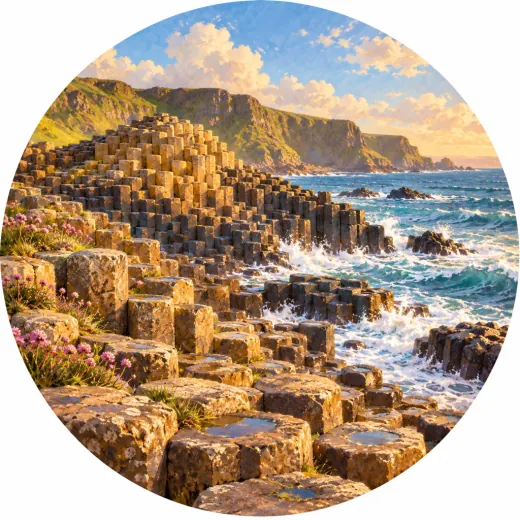
Finn McCool and the Giant's Causeway
Fionn mac Cumhaill
not scary at all
Finn McCool is the great Irish hero who, as a boy, gained all the wisdom in the world by tasting a magic salmon. In modern folk stories he became a giant. It is said that he built a path of stones across the sea to go and challenge a Scottish giant. But when he saw him up close he realised the other was much bigger than him, and he ran home. His wife dressed him as a baby and put him in a cradle: seeing how big the “baby” was, the Scottish giant imagined how enormous the father must be and fled, smashing the path behind him.
Did you know? The Giant's Causeway is real: it is made of about 40,000 six-sided basalt columns, formed when lava cooled 50 to 60 million years ago.
The story
Before he was a giant, Finn was a boy with a burnt thumb.
It happened long ago, in Ireland, on the banks of the River Boyne. An old poet called Finnéces had been waiting seven years for just one fish: a salmon that, so the stories said, had eaten hazelnuts fallen from a tree of wisdom. Whoever tasted its flesh would know everything. At last the salmon took the bait, and the poet gave it to his young helper to cook. Back then, the boy was called Demne.
“Cook it,” said the poet, “but don't eat a single bite.”
The boy turned the fish over the fire with the greatest care. But a blister of fat swelled up on its skin, and he pressed it flat with his thumb. Ouch! He stuck the thumb in his mouth to cool the burn. And in that instant all the wisdom of the world rushed into his head at once.
The poet looked at him and understood. From that day on the boy was called Finn, and whenever he needed to know something, all he had to do was suck his thumb.
The years went by. Finn became the leader of a band of warriors, and people began to say he was as big as a hill. And so, one day, in the stories, he really did become a giant. He lived on the north coast of Ireland with his wife Oonagh, and he could step over a river in a single stride.
One evening, as the sun was setting over the sea, Finn looked across towards Scotland. Over there, beyond the grey water, lived another giant. His name was Benandonner, and they said he had arms like tree trunks and a voice that knocked the nests out of the trees.
“That Benandonner is getting far too famous,” grumbled Finn. “Somebody needs to show him who's in charge on this side of the sea.”
“Somebody,” said Oonagh, without looking up from her loom. “And who would that be?”
“Me.”
“Ah.”
Finn broke off a handful of rock columns from the cliff and planted them in the sea, one beside the other, every one with six sides, every one smooth and exact, like a floor laid by a mason with a set square. He set down one block, then another, then another still, and the road stretched out across the water towards Scotland.
When he had finished, he strode across the sea. The waves splashed his knees, the seagulls wheeled around him screeching as if to warn him, and halfway over Finn noticed that his feet were colder than his courage. He kept going anyway. After a while he saw the coast, then a house, and in front of the house he saw Benandonner, stretched out asleep on the grass.
Finn stopped.
He had never seen a man like that. This one wasn't as big as a hill: he was as big as two. His snoring made the grass sway ten paces away, and one hand, resting on the meadow, was as wide as the sail of a boat.
Finn raised his thumb to his mouth. He sucked. He waited for the wisdom of the world to tell him something useful.
The thumb told him one thing only: run.
Finn turned back. He had never gone anywhere so fast.
“He's coming,” he panted, bursting into the kitchen. “He saw me. He's right behind me. Oonagh, he's twice my size.”
Oonagh put down her work. She was the only person in all of Ireland who had no need of the thumb, because her head already had everything it needed.
“Give me your biggest nightshirt and get into that cradle,” she said.
“What cradle?”
“The one I had made for the son you haven't got.”
“And what if he recognises me?”
“In that nightcap? You'll look like the loveliest baby in Ireland.”
Finn did as he was told. Within a minute he was lying in the cradle, with a nightcap on his head and a rattle in his hand. Meanwhile Oonagh was making griddle cakes. Inside many of them she hid an iron griddle plate. They looked like soft bread, and inside there was iron.
Outside, the ground began to shake. One step. Another step. A fist as big as a barrel knocked at the door.
“Where is Finn McCool?” thundered a voice.
Oonagh opened the door with a calm smile. “Oh, he's out hunting, he won't be back till tomorrow. But do come in, you must be tired. Can I offer you a griddle cake?”
Benandonner ducked under the doorway and came in. He took a cake, bit into it with his whole mouth, and...
Crack.
He held his jaw with both hands. “What sort of bread is this?”
“Ordinary bread,” said Oonagh. “The usual. The baby eats it every day. Would you like to try this one instead?”
Benandonner tried another. Crack. A tooth came loose and rolled across the floor.
That was when he noticed the cradle. Inside it, an enormous baby, red in the face, his nightcap all crooked, was eating one cake after another without even chewing. The baby was enormous, but he certainly couldn't talk yet.
Benandonner looked at the baby. Then he looked at Oonagh. Then he looked at the door, and thought something very simple: if this is the son, what is the father like?
“The bread is excellent,” he mumbled. “But I've left something at home.”
Out of the door he went, without looking back. Once he was on the stone path he broke into a run, and for fear that the father of that baby was hard on his heels, he tore up the path behind him, block after block, and flung the stones into the water.
From the cradle, Finn heard him go. He waited a moment. Then he poked his head out.
“Has he gone?”
“He's gone,” said Oonagh. “You can take the nightcap off now.”
They say Finn's path was left in pieces, half under the water and half on the shore. The piece you can still see today is the Giant's Causeway, in Northern Ireland: about forty thousand columns of basalt, almost all of them with six sides, formed when lava cooled millions of years ago. On the other side of the sea, on the Scottish island of Staffa, there are columns just like them.
As for Finn, they say that from then on, whenever he needed a good idea, he always asked his wife's opinion before sucking his thumb.
Relatives around the world
In the trails
Listen / Read next
- Music to read by: Cinematic JourneyEpic film-style music, no lyrics, by Ciro Simone IrmiciSpotifyYouTube Music
Sources
- Macgnímartha Finn, The Boyhood Deeds of Finn (12th century)
- National Trust, Giant's Causeway
