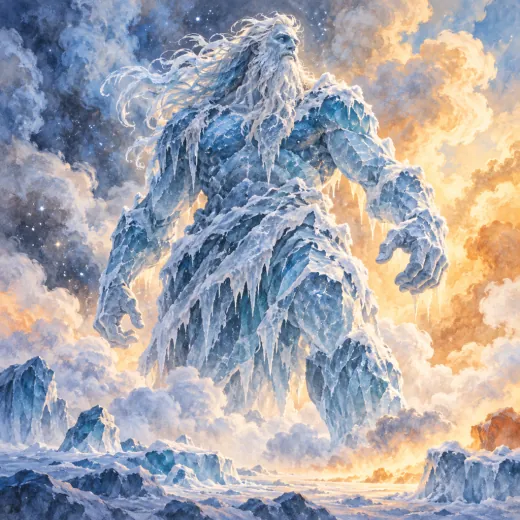
Ymir
Ymir, the first giant
a little scary
At the beginning of everything, the Norse myths say, there was a great emptiness between a realm of ice and a realm of fire. Where the ice met the sparks and began to melt, Ymir was born, the first giant. He fed on the milk of an enormous cow, who licked the salty ice and uncovered the first ancestor of the gods. When Odin and his brothers defeated Ymir, they built the world from his body: his flesh became the earth, his bones the mountains, his skull the sky.
Did you know? According to the myth, the clouds are Ymir's brains, which the gods threw up into the sky.
The story
Before the earth, there was nothing.
There was no sea, no sky, not a single blade of grass. Even time made no sound. There was only a bottomless abyss, as wide as nothingness and as silent as a closed mouth. The ancient people of the North called it Ginnungagap, the great void.
On either side of the void, though, there were two worlds.
To the south lay Muspell, a land of fire, so bright and so scorching that no one could go near it unless they had been born there. On its threshold sat a guardian called Surtr, with a flaming sword in his hand, and he never moved. To the north lay Niflheim, a land of fog and frost, where water sprang from the ground and froze at once. The rivers of Niflheim, the Élivágar, rushed towards the void, and before they reached it they stopped, hard as stone. The poison they carried hardened into layers of rime, one on top of another, until the whole northern side of the abyss was full of ice.
Meanwhile, from the south came heat. From the north came cold. For a time that no one has ever counted, the two breaths pushed against each other, and neither ever won. Then, in the middle of the void, they truly met: the warm wind touched the rime, and the rime began to give way.
The ice began to drip. One drop, then another. They fell in the silence, and the heat of the fire touched them, and those drops came to life.
That was how Ymir was born.
He was a giant, the very first. He was enormous and asleep, and every breath he took shook the abyss. The other giants also called him Aurgelmir. He was the father of the whole race of frost giants, and while he slept, more giants were born from his sweat: a man and a woman came out from under his arm, and one of his feet had a son with the other.
Ymir had nothing to eat. From the drops of ice a cow had been born too, as big as he was, called Auðumbla, and four rivers of milk flowed from her udder. The giant drank that milk, and grew.
And the cow? She was hungry too, and in that world of ice there was nothing to eat but the ice itself. She found some blocks of ice covered in salty rime and began to lick them with her broad, rough tongue. On the first day, hair appeared out of the ice. On the second day, a head. On the third day, a whole man, handsome and strong, whose name was Búri.
Búri had a son, Borr, and Borr married a giant's daughter called Bestla. They had three sons: Odin, Vili and Vé.
They were the first gods, and they were not kind to the giants, because the giants were not kind to them. They watched Ymir from afar, on his plain of ice, and they all thought the same thing: as long as he was breathing, the world could not exist. There was only one giant, and he filled everything. The sons of Borr spoke to each other in silence, with no need for many words.
Then they did what they had to do. The three brothers killed Ymir.
Snorri tells us nothing more, and that is just as well. He only says that so much blood poured from the wound that nearly all the frost giants drowned. Only one escaped: Bergelmir, with his wife. They climbed onto a great hollowed-out tree trunk, like a boat, and escaped the flood. From their children came the giants of today, who still eye the gods with suspicion.
Now the void had something to fill it.
The three brothers took the giant's body and carried it to the middle of Ginnungagap. Then they set to work.
From his flesh they made the earth, wide and dark and full of hills. From his blood they made the sea and the lakes, which wrapped around the earth like a belt. From his bones they made the mountains, and from his teeth and the broken bits of bone, the rocks and the gravel. His hair became trees and meadows. From his eyebrows they built a towering fence against the giants: they called it Midgard, the middle enclosure, and they put humans inside it.
But the highest part was still missing.
They took Ymir's skull and raised it above the earth, covering everything, and there was the sky, a great curved dome. To hold it up at the corners, they set four dwarves, one for each direction: North, South, East and West. They say the dwarves are still there today, backs bent, and they have never grown tired.
And the brain? They tossed it into the air, and the brain melted into clouds. That, they say, is why the clouds of the North are so heavy and always look as if they are thinking about something.
Then the gods looked at the sky. It was dark.
Sparks were still flying from Muspell, the land of fire. The brothers caught them, one by one, and fixed them to the dome, so they would shine above the earth and below the sky. Some they left free to wander, others they kept still. They were the stars.
Walking along the seashore, the three brothers found two logs washed up by the waves, an ash and an elm. From them they made a man and a woman, Ask and Embla, and gave them breath, mind and warmth. Every person in the world is descended from those two.
And so the world was made: the sea all around, the earth in the middle, the sky above, the dwarves at the corners and the fence against the giants.
When you look at a valley, or a mountain, or a plain that stretches away to the horizon, the tales of the North ask you to remember one thing. All of this was once someone. He breathed, he drank a cow's milk, he fell asleep in an abyss that had no name.
And now his skin is under our feet, his bones are the mountains, and the clouds above our heads are his thoughts.
On certain days, when the sky is clear and the air is still, some people swear they can still hear him.
It is not the groaning of someone in pain. It is the breathing of someone asleep.
Relatives around the world
In the trails
Listen / Read next
- Music to read by: Cinematic JourneyEpic film-style music, no lyrics, by Ciro Simone IrmiciSpotifyYouTube Music
Sources
- Snorri Sturluson, Prose Edda, Gylfaginning
- Poetic Edda, Vafþrúðnismál
