Pangu
盤古, in Chinese
not scary at all
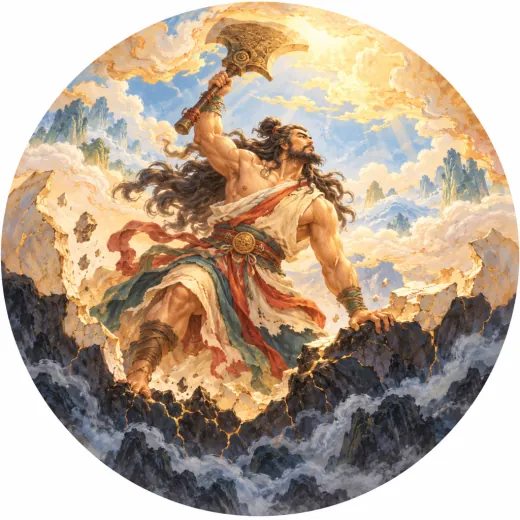
In the beginning, a Chinese myth says, everything was shut inside an enormous dark egg, and inside it was the giant Pangu. After eighteen thousand years heaven and earth split apart: the light, clear parts rose and became the sky, and the heavy, dark parts sank and became the earth. To keep them apart, Pangu stood between them and grew taller every day, pushing the sky higher and higher. When he died, his breath became the wind, his eyes the sun and the moon, and his body the mountains.
Did you know? It is an idea found in many parts of the world: the Norse giant Ymir also became the world after his end.
The story
Before there was a world, there wasn't even darkness.
To exist, darkness needs something that isn't dark: a light that is missing, an eye that cannot see. There was none of that. There was only one thing, closed in on itself and perfectly still, and the old books of China describe it with the simplest word they know: an egg.
An egg like a hen's egg, they say. Inside it, heaven and earth were mixed together, the clear with the murky, the light with the heavy, like the white and the yolk before anyone separates them. There was no up and no down. There was no before and no after.
And in the middle of that shapeless lump, on a day that was not a day, Pangu was born.
He was a giant, even though there was nothing to compare him with. He slept curled up, knees to his chest, and he did not dream, because there was nothing yet to dream about. He slept like that for eighteen thousand years. Nobody counted them, because nobody was there. But inside the egg, little by little, something began to move.
The clear, light parts, which the ancients call yang, slowly rose upwards. The dark, heavy parts, called yin, sank downwards. Like cream rising to the top of milk, like sand settling in muddy water. Above, the sky took shape. Below, the earth.
Pangu opened his eyes.
The first sound in the world was his breathing. A long, deep breath, like someone who has slept far too long. He stretched. He tried moving one arm, then the other. He stood up, and above his head, which had once touched the roof of the egg, there was now a little space.
But only a very little. The sky was just a thin veil above him, and the earth just a thin veil under his feet. Pangu could feel that if he stopped holding them apart, the two veils would close up again and everything would go back to how it had been: an egg, a lump, a darkness that nobody looks at.
So he made up his mind. He told no one, because there was no one to tell. He planted his feet on the earth, put his hands against the sky, and pushed.
The ancient text says something very exact, almost like a figure in an account book: every day the sky rose ten feet higher, the earth grew ten feet thicker, and Pangu grew ten feet taller. Every single day. Even when he was tired, even when his legs were shaking. It also says that in the space of a day he changed nine times, and that in heaven he was a god and on earth a sage, as if no single shape were big enough to hold him.
Try to imagine that long wait. There is no sun, so there are no days, but Pangu felt them passing by the weight on his shoulders. The sky pressed down. The earth pulled. Sometimes, if he had been able to speak, he would have said, “Enough, I can't do this any more.” But every time he was about to give up, he looked up and saw a new strip of empty space. A palm's width, a hand's span, an arm's length. The world was beginning to exist, because now there was room to put it.
Another eighteen thousand years went by. The sky had become immensely high. The earth had become immensely deep. And Pangu had grown so tall that no mountain, if there had been any mountains then, would have reached his knee.
It was then that the two veils stopped trying to find each other. The sky had hardened at its distance. The earth had settled into its depth. A giant was no longer needed to keep them apart.
Pangu understood this, and it was his last labour. He looked around. There was a sky without stars and an earth without grass: a well-made world, and completely empty. It was like a huge room where nobody has yet put a single chair.
So Pangu lay down. He was not afraid. He had held up the sky for longer than any story can tell. He stretched out on the new earth, closed his eyes, and died.
And here the myth becomes something no other story in the world could have invented: his body did not vanish. It changed, piece by piece, into everything that was still missing.
His last breath left his mouth and became the wind and the clouds. His voice broke apart in the distance and became thunder. His left eye came loose and rose high up, and became the sun. His right eye rose on the other side, and became the moon. For the first time there was light in the world, and for the first time there was also night, and from that moment darkness had something to be measured against.
His arms and legs stiffened and became the four corners of the earth, and his body rose up to form the great mountains. His blood flowed away and became the rivers. His veins stretched across the plains and became the roads, the ones people would one day travel without knowing they were walking on a giant. His muscles opened out into fields of good soil. His hair, long and dark, rose towards the sky and became the stars. The finer hairs on his body became grass, flowers and trees. His teeth and bones became metals and stones, and his marrow thickened into pearls and jade. His sweat fell from his skin in drops, and became the rain.
Nothing was lost. Everything Pangu had been, to keep heaven and earth apart, he still was, to fill them.
There is something you can still do today, on clear evenings: look up to where the moon is rising and remember that its light is his gaze. Walk along a mountain path and feel it under your feet, firm and ancient, like a great bone. Stand in the summer rain and think that it is the tiredness of a giant who pushed the sky for eighteen thousand years and never asked for anything in return.
When the wind blows through the mountains, on certain days in late autumn, it makes a sound like breathing. The old people say it is the first breath, the one that opened the world.
And the mountains, in silence, are still listening.
Relatives around the world
In the trails
Listen / Read next
- Music to read by: Cinematic JourneyEpic film-style music, no lyrics, by Ciro Simone IrmiciSpotifyYouTube Music
Sources
- Xu Zheng, Sanwu Liji (3rd century)
- Anne Birrell, Chinese Mythology: An Introduction (1993)
