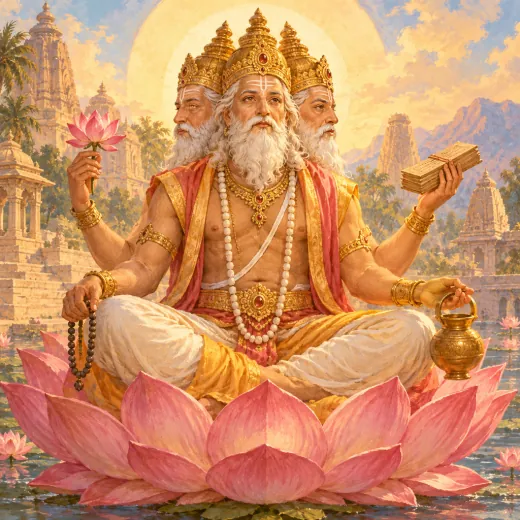
Brahma
Brahmā, in Sanskrit
not scary at all
In the Hindu tradition Brahma is the deity who creates the world. Together with Vishnu, who preserves it, and Shiva, who transforms it, he forms the Trimurti, the “three forms” of the divine. It is told that he was born from a lotus flower that grew from Vishnu's navel while Vishnu slept on the ocean. He is shown with four faces, looking in the four directions, and four arms, holding the Vedas, the sacred texts, in one of his hands. His companion is Saraswati, the goddess of knowledge and music.
Did you know? Although he is the creator, Brahma has very few temples in India: one of the best known is at Pushkar, in Rajasthan.
The story
Before the world, there was only water.
Not a sea with shores, not a lake with waves: an endless water, dark and still, stretching away in every direction. There was no sky and no earth, no day and no night, no voice, no bird, no tree. There was not even time, which had not yet begun to move.
On that water, Vishnu lay sleeping.
He slept stretched out on the great serpent Shesha, who had coiled himself up like a bed, with a thousand heads forming a canopy. Vishnu's breathing was slow, and each of his breaths was an age. There was nothing else around him, and he needed nothing else.
Then, from Vishnu's navel, a stem appeared.
It was thin, and then thicker, and it rose and rose, and at the top it opened into a flower: an immense lotus of gold and light. In the flower sat someone.
Brahma opened his eyes and saw nothing.
He turned to the right: water. He turned to the left: water. So he turned, and turned again, and to look in every direction he grew four faces, one for each side. But none of the four could see anything that had a name.
“Where am I?” he wondered. “Who am I? Where do I come from? Who put me here?”
Only silence answered.
He was the only living being in the world, and he did not even know why he existed. He looked at the flower he was sitting on. A flower does not grow by itself: it must have a root. And so he decided to find it.
He began to climb down the stalk, into the water. Down and down he went, into a darkness that grew ever thicker. His hands clung to the soft stem, and the stem did not end. A very long time passed. With every reach Brahma wondered whether the bottom was any closer, and with every reach the stalk carried on, smooth and unchanging, as if it were always the same piece. He was looking for his origin, and he could not find it. At last, tired, he turned back. He climbed up to the flower, which was waiting for him, and sat down again with his legs crossed.
“I won't find anything by searching outside,” he thought. “Perhaps I have to search within.”
He closed his eyes and breathed slowly. He made himself silent, a silence that was not easy for a being with four faces. And in that silence he heard a voice. It did not come from any one place: it came from the water, from the flower, from his own mind. It was a word of two syllables.
“Tapa.”
Brahma listened to it. Then he understood: it meant concentration, self-denial, inner fire. There was no one speaking, but the voice was right. He began to meditate, motionless, without eating and without sleeping, for a time no human could count. Outside, the water stayed still. Inside, something was changing. Brahma's breathing grew slower and slower, and his thoughts, which had been running in every direction like his four gazes, gathered into a single point, clear and quiet, like the flame of a lamp where there is no wind.
Little by little, a light made its way through the darkness. The lotus flower all around him began to shine. And before Brahma's eyes, as if he had always been there and Brahma was only now able to see him, Vishnu appeared, lying on the serpent.
Brahma looked at him. It was the first time he had seen another being.
“You thought of me,” he said. “You made this flower grow.”
Vishnu smiled. He did not answer straight away: he waited, because important words must be weighed. Brahma's heart was pounding, and there was a question in each of his four faces. Then Vishnu said:
“You looked for your origin outside yourself. And when you looked within, you found me. Now you have a task. Create the world. I will give you the knowledge you need, and when you make mistakes, I will not leave you alone.”
Brahma bowed. Beneath him, the lotus opened out into great petals. One petal became the earth. Another, the sky. Another, the worlds that lie above and those that lie below. From the water, one after another, the first things were born: light and dark, the seasons, day and night.
Then Brahma began to create living beings. From his mind came his first four sons, the Kumaras: Sanaka, Sanandana, Sanatana and Sanatkumara, young and wise. But as soon as they were born, they said they did not want to look after the world: they preferred to meditate. Brahma was disappointed, and angry too. It is said that from his anger another being was born, a god of stern appearance, Rudra, and that Brahma then calmed down and went back to creating, with more patience.
He created the sages. He created the gods. He created the animals and the plants. Then his own body divided in two: a man, Svayambhuva Manu, and a woman, Shatarupa. From them came human beings, and every family on earth still remembers that first couple in its own way. From his four mouths, it is said, came the Vedas, the sacred texts: four books, one for each face, holding the knowledge of all things. And in time the earth filled with sounds: the wind in the leaves, the footsteps of animals, the first song of a bird.
When everything was ready, Brahma looked around him. He was sitting in a flower, above an ocean, in a world that had not existed before. He realised something he had never thought of: if the world was born from him, and he was born from a lotus, and the lotus was born from Vishnu, then everything was connected. Nothing began or ended on its own.
That is why Brahma is shown with four faces looking in four directions: because the first thing he did, as soon as he was born, was to look around him.
And every time the world ends and begins again, say the Puranas, the lotus grows once more from Vishnu's navel, and a new Brahma opens his eyes on the endless water, and wonders where he comes from.
A living tradition, told with respect: how we tell myths.
Relatives around the world
Listen / Read next
- Music to read by: Cinematic JourneyEpic film-style music, no lyrics, by Ciro Simone IrmiciSpotifyYouTube Music
Sources
- Bhagavata Purana
- Wendy Doniger, Hindu Myths (1975)
