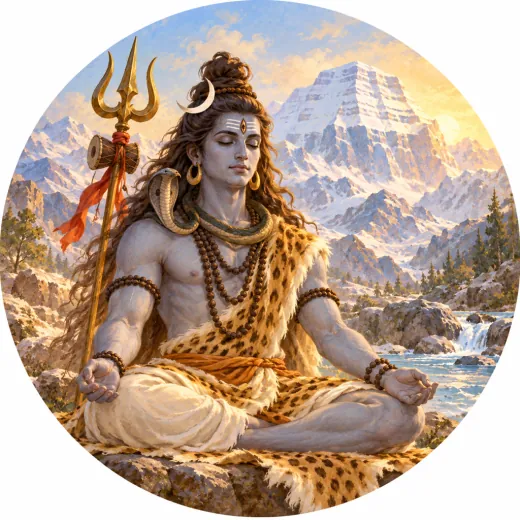
Shiva
Śiva, “the kind one”
not scary at all
Shiva is one of the most revered deities of Hinduism. In the Trimurti he is the one who transforms: he destroys what is old so that something new can be born. He is shown with a third eye on his forehead, a crescent moon and the river Ganges in his hair, a snake around his neck and a trident in his hand. He is a great ascetic who meditates on Mount Kailash, but also the king of dancers: with his dance, it is said, he keeps the universe moving. His wife is Parvati, and one of their sons is Ganesha.
Did you know? According to tradition, Shiva caught the river Ganges on his head as it came down from the sky, so that its force would not destroy the earth.
The story
At the top of Mount Kailash, where the snow never melts, sat a man whose skin was covered in ash.
His hair was twisted into a dark, matted mass, with a crescent moon resting in it, a snake was wound round his neck like a necklace, and a trident stood planted in the rock beside him. In the middle of his forehead, above his two closed eyes, he had a third one. He had been sitting like this since time out of mind, silent and still.
This was Shiva. Those who have met him say he is the calmest and the most fearsome of the gods, the one who destroys what is old to make room for what is being born, and he is also the king of dancers: they say his dance keeps the universe in motion.
But of all the stories told about him, one of the best loved is about a river.
Many centuries earlier, a king named Sagara ruled on earth. He had decided to perform a great sacrifice. For this, he had set a horse free to wander wherever it liked for a year, and his sixty thousand sons followed it at a distance to protect it.
One night the horse vanished.
The sixty thousand sons searched for it everywhere: on the land, in the mountains, in the valleys. They could not find it. So they took hoes and pickaxes and began to dig, in the middle of the world, going deeper and deeper, until the earth shook. And down there, in a cave, they found the horse, and next to it, sitting in meditation, a sage: Kapila.
The cave was silent. All you could hear was the sage's slow breathing and water dripping somewhere far away. But the sixty thousand sons were in a hurry, and they were afraid of the king, their father, and fear makes people blind. They thought the sage had taken the horse. They accused him, they insulted him, they raised their weapons. Kapila opened his eyes.
Nothing more was needed. A single look, and all that was left of the sixty thousand sons was ash.
Generations went by. The ash stayed down there, at the bottom of the earth, with no peace. It was said that the souls of Sagara's sons could not rise to heaven unless they were touched by the water of the great heavenly river, the Ganges, which flowed only up above.
One of Sagara's descendants, King Bhagiratha, decided to bring it down.
He withdrew to pray. He kept up his penance for years, eating little and sleeping even less, until Brahma, the creator, appeared to him. “I have heard you,” he said. “The Ganges will come down. But there is a problem: the river is so powerful that if it fell from the sky it would break the earth like a clay pot. Only one being can bear its fall: Shiva.”
Bhagiratha left his kingdom to his ministers and climbed Mount Kailash, where the air is so thin that every step costs a breath.
He stood on the tip of one toe, with his arms raised, for a whole year, in front of the motionless god. The wind froze his face. Snow settled on his shoulders. One morning a deep voice rang out through the air, like distant thunder.
“I am pleased,” said Shiva. “I will carry the river on my head.”
On the appointed day, Shiva rose, planted himself on the summit of the mountain, and waited.
Up in the sky, Ganga saw him. She was a goddess as well as a river: white, loud and proud. She looked down and saw a man with ash smeared over his skin. Who is this? she thought. I will sweep him along with me under the earth, down to the deepest worlds, like a twig.
And she leapt.
The roar was heard across the whole world. A column of water as big as a mountain plunged from the sky, turning the clouds white and making the valleys shake. Birds flew up from the trees. People threw themselves to the ground and covered their ears.
Shiva did not move. The rock trembled under his feet, but he stayed where he was, like a mountain inside another mountain.
The water fell on him and covered him. He knew. He had read the river's thoughts like an open book. So he drew his matted hair tight, and the river was caught in it. Ganga looked for a way out, round and round she went, and she could not find a single gap in that forest of hair. She wandered in there for years, but she never touched the ground.
Down at the bottom of the valley, Bhagiratha waited. A month went by, then a season. Every now and then a dull rumble came from the top of the mountain, like a sea shut up in a cave. But not one drop came down.
He understood. He climbed the mountain again and prayed once more, with the same patience as before. Shiva listened to him. He loosened one lock of hair, and the water flowed out, gently, in seven streams. Three went east, three went west, and the seventh followed Bhagiratha's chariot.
The king drove on in his chariot, and the river came behind him, long and shining. They crossed plains and forests and went over hills. Along the way, by mistake, the river flooded the home of another sage, Jahnu, who was praying. Annoyed, Jahnu drank the whole river in one gulp. Bhagiratha and the gods begged him to forgive it, and the sage let it out through one ear. That is why, they say, the Ganges is also called Jahnavi, the daughter of Jahnu.
At last it reached the sea. It went down to the depths of the earth, into the cave where the ashes of Sagara's sixty thousand sons lay. The water touched them.
And the sons rose to heaven.
Ever since, the Ganges has flowed through India. They say it came down from heaven for the sake of a promise made to the dead. Millions of people go to bathe in its waters, to bring flowers, to set little lamps afloat in the dark, one after another, as if the river still had many stars to carry along with it.
And on a mountain of snow, they say, a man covered in ash still sits with his eyes closed, with a little of that river in his hair.
A living tradition, told with respect: how we tell myths.
Relatives around the world
Listen / Read next
- Music to read by: Cinematic JourneyEpic film-style music, no lyrics, by Ciro Simone IrmiciSpotifyYouTube Music
Sources
- Shiva Purana
- Ramayana, Book I (the descent of the Ganges)
