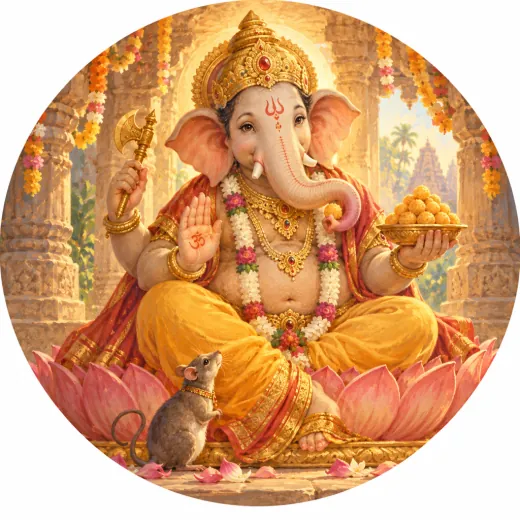
Ganesha
Gaṇeśa, “lord of the hosts”
not scary at all
Everyone can recognise Ganesha: he has the head of an elephant and the body of a chubby child, and he rides a little mouse. He is the deity who removes obstacles and protects beginnings, study and writing, so he is prayed to at the start of every important undertaking. One story tells how he got his head: Parvati had created him to guard the door, and he would not even let in Shiva, who did not know him. After the clash, Shiva gave him the head of the first animal he met, an elephant, and welcomed him as his son.
Did you know? According to tradition, Ganesha wrote down the very long poem Mahabharata as the sage Vyasa dictated it, using one of his own broken tusks as a pen.
The story
On Mount Kailash, in a house of snow and silence, lived Parvati.
She was the wife of Shiva, the great ascetic, and the house was usually full of creatures: Shiva's followers, the ganas, a crowd of small, noisy spirits who ran up and down the stairs at all hours. They obeyed Shiva. They listened to nobody else. One morning, as she was getting ready for her bath, Parvati realised that nobody in that house was truly hers.
So she did something simple. She took the fragrant paste she used to anoint her skin and worked it between her hands. She shaped a figure from it: two arms, two legs, a round face. She breathed on it. The figure drew breath, opened its eyes and said, “Mother.”
It was a little boy, and Parvati looked at him for a long time, the way you look at something you never expected to love so much.
“Listen to me,” she told him. “I am going to have my bath. Stay by the door. Don't let anyone in.”
“Anyone,” the boy repeated. “All right, Mother.”
And he planted himself in front of the entrance with a stick in his hand, as serious as a soldier of twenty.
Some time went by. Then Shiva arrived.
He was coming back from meditating, tired, his hair full of dust. He climbed the steps and found, in front of the door, a little boy he had never seen before.
“Stop,” said the boy. “My mother is having her bath. No one gets past.”
Shiva smiled. He was not used to being told no. “Little one, I am her husband. Let me through.”
“I don't care who you are. My mother said no one.”
Shiva insisted. The boy did not budge an inch. He did not know this man with dusty hair and a snake round his neck; all he knew was his mother's voice, and that voice had said one single word. So Shiva called his ganas, who came forward laughing: one puff would be enough. But the boy faced every one of them with his stick and sent them back, one after another, beaten and dishevelled. Even the gods who had rushed over to watch stood there open-mouthed.
Then Shiva's anger broke out, as sudden as a thunderstorm. It was one swift movement, and it could not be taken back. When the crash died away, the stick lay on the ground, the boy was gone, and the doorway was clear.
Parvati came out of her bath and found silence.
She did not scream straight away. She looked at her little boy, and she understood. Then she raised her eyes to Shiva, and those eyes were such that the ganas hid behind the pillars. “What have you done?” she said quietly. And out of her shadow terrible forces began to be born, hands, flames, storms, and the gods understood that unless this was put right, the goddess would destroy the world.
They all knelt before her. They begged her. “Be calm, Mother. We will put it right.”
Shiva himself, who bowed to no one, lowered his head. He spoke to his ganas: “Go north. The first living creature you meet with its head facing north, bring me its head.”
The ganas ran. They travelled for days. At the edge of the forest they found an elephant sleeping with its head towards the north, and they treated it with respect, and asked its permission, and brought its head to Shiva.
Shiva placed it on the boy's body. He spoke a word. And the boy opened his eyes.
He had the face of an elephant, ears like two broad leaves, and a trunk that moved slowly. He looked at Parvati. He was not afraid. He said, “Mother, I heard you crying.”
Parvati took him in her arms and never let him go again.
Beside them, Shiva said, “Now you are my son, just as you are Parvati's. You will lead the ganas. Your name will be Ganesha, the lord of the ganas. And anyone who begins something important must pray to you first, and then the obstacles will be cleared from their path.”
That is why in India, even today, people opening a shop, setting off on a journey, sitting down for an exam or moving into a new house name Ganesha first of all. Whoever forgets sets off with a closed door in front of them.
There is another story about him, and it is told in the Mahabharata.
The sage Vyasa carried a poem inside him, the longest ever imagined, the story of a great war between cousins. It was so long and so complicated that no human could remember all of it. He needed someone to write it down as he spoke. The god Brahma advised him: “Ask Ganesha.”
Ganesha agreed. But he set one condition: “All right, but the pen must never stop. If you pause for a single moment, I leave.”
“Very well,” said Vyasa. “But I have a condition too: do not write anything you have not understood.”
They began. Vyasa dictated, and Ganesha's pen flew across the leaves. But Vyasa knew a trick or two. Every now and then, in among the verses, he slipped in one so difficult and so full of hidden meanings that Ganesha had to stop and think. And in those moments Vyasa calmly composed the next verses.
The work went on for years. Then, one day, Ganesha's pen broke.
There was no time to look for another. If he stopped writing, he would lose the wager. Ganesha looked at one of his tusks, snapped it off with his hand, and went on writing with it, without stopping for a moment.
The poem was finished. And ever since, Ganesha has had only one tusk.
In temples and in homes, where he is painted with his round belly and open hands, a little mouse is placed beside him. They say it is his travelling companion: a small animal that can get through anywhere, even where no one else can.
Perhaps that is why his image hangs at the entrance of so many homes and shops, above the door. The first to guard that threshold, long ago, was a little boy who had promised his mother not to let anyone in. And he kept his word.
A living tradition, told with respect: how we tell myths.
Relatives around the world
Listen / Read next
- Music to read by: Cinematic JourneyEpic film-style music, no lyrics, by Ciro Simone IrmiciSpotifyYouTube Music
Sources
- Shiva Purana
- Mahabharata, Book I
