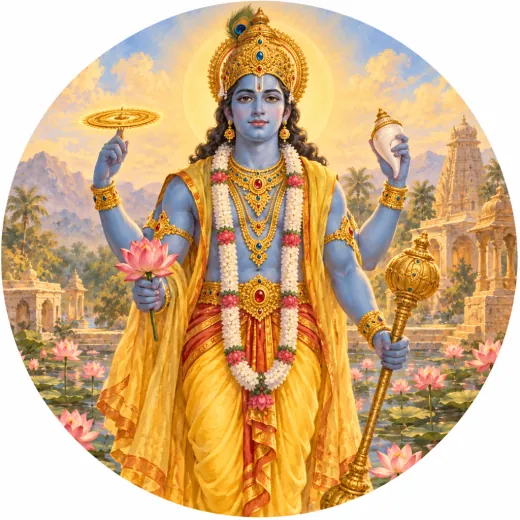
Vishnu
Viṣṇu, in Sanskrit
not scary at all
Vishnu is revered as the deity who protects and preserves the world. Whenever order and justice are in danger, according to tradition, he comes down to earth in a different form: these are the “avatars”. Among the best loved are Rama, the righteous prince of the Ramayana, and Krishna, the young cowherd who plays the flute. He is shown with blue skin and four arms holding a conch shell, a discus, a mace and a lotus flower, and he travels on the eagle Garuda.
Did you know? Tradition lists ten main avatars of Vishnu: among the first are a fish, a tortoise and a boar.
The story
There is a promise, in the Indian tradition, that Vishnu makes to those who believe in him: whenever what is right begins to falter and what is wrong raises its head, he will come down among people. Not always with the same face. Sometimes he will be a fish, sometimes a tortoise. And once he was something no one had ever seen.
It all began with a king who thought he was stronger than a god.
His name was Hiranyakashipu, and he was the lord of the demons. He had performed penance for years, standing on one foot, until Brahma, the creator, came down to reward him. “Ask for whatever you wish.”
And he had asked never to die.
Brahma had explained that this was not possible. So the demon thought hard about it. He wanted not to die by night and not to die by day. Not inside a house and not outside. Not at the hands of a man, nor of an animal, a god or a demon. Not on the ground and not in the sky. Not by any weapon.
“So be it,” Brahma had said.
Hiranyakashipu went back to his palace and began to rule. He had temples built in his own honour and ordered that no one should speak the name of any other god. When he passed through the city, people lowered their eyes.
He had a son. His name was Prahlada. He was small and quiet, and his eyes were always full of light. And he would not obey.
Because Prahlada, ever since he was in his mother's womb, had heard words about Vishnu, and he could not forget them. Every time the court teachers taught him to praise the king, he smiled and said a different name.
“Repeat after me,” the teacher would order.
“Vishnu.”
He was brought before his father.
“Who taught you this madness?” shouted the king. “Who is this Vishnu who is not afraid of me?”
“My lord,” Prahlada answered calmly, “he is everywhere. He is in you, in me, in the food we eat. You cannot wipe him out.”
The king would not listen. He ordered the boy to be done away with. First they had him attacked by warriors with spears, and the spears bent. Then they sent poisonous snakes against him, and the snakes curled up at his feet like puppies. They set raging elephants in front of him, and the elephants stopped. They tried poison in his food, and Prahlada ate without noticing. They threw him off a cliff, and he landed like a leaf. They tied him to a pyre, and the fire would not burn.
Each time, Prahlada repeated the same name. Not angrily. The way you say the name of a friend.
The people of the city began to murmur. After the last trial, when the boy walked out of the ashes without so much as a mark on his clothes, no one in the streets spoke aloud, but they all looked at one another: who could say the king was really stronger than everything? The king felt it, in the silence that followed him wherever he went, and his anger grew.
Then the king, beside himself, dragged the boy into the great hall, among the stone pillars.
“You say your Vishnu is everywhere. So is he here too? In this pillar?”
“Yes,” said Prahlada.
Hiranyakashipu laughed, and the laughter rang through the whole hall. He raised his fist and struck the pillar with all his strength. The hall was huge and dark, full of that smell of incense and fear that never left the palace any more.
For a moment nothing happened. Then there was a roar, like a mountain splitting apart, and the pillar burst open.
Out of it came a shape no one had ever seen. It had the body of a man and the head of a lion, with a mane of fire and eyes that burned like embers. Its claws were long and gleaming. Its roar made the walls shake. It was Narasimha, the man-lion, and within him was Vishnu.
The warriors fled. Hiranyakashipu, who had never been afraid, stood and stared. Then he began to fight. It was a long struggle, with blows that shook the palace. And while they fought, the daylight turned red, then grey. It was twilight: neither day nor night.
Narasimha seized the king and carried him to the threshold of the hall. It was not inside, and not outside. He lifted him and laid him across his lap: not on the ground, not in the sky. Narasimha was not a man, not an animal, not a god. And he took up no weapon: he used only his claws.
So the king met his end, in an instant, without a word. Every condition of the boon had been kept. Not one had been broken.
Then the god stood there, still blazing with fury. The gods watched from afar and no one dared come near, not even Lakshmi, his consort. The roar would not die down. Only a child was not afraid.
Prahlada came forward, barefoot, and bowed. He began to speak in his usual voice. He praised the god without asking him for anything, because he wanted nothing. He said that the world is full of fear, and that Vishnu is what remains when the fear goes away.
The lion listened. Little by little, the fire in his eyes died down. The hand that had stopped a tyrant came to rest on the boy's head, as lightly as a feather.
“Ask for a gift,” said Narasimha.
“I want nothing,” Prahlada answered. “If I asked you for something, it would be like buying you. I ask only that desire may never be born in me.”
The god smiled, and understood that this child knew him better than all the gods in heaven.
Prahlada became king. He ruled his people with justice, and the temples no longer served to show off anyone's power. Out of the pillar, people said, had come not a monster but a promise that was kept.
And so, they say, Vishnu keeps his promise: when the world grows too dark, he lights a lamp in the most unexpected place. Even inside a piece of stone.
A living tradition, told with respect: how we tell myths.
Relatives around the world
Listen / Read next
- Music to read by: Cinematic JourneyEpic film-style music, no lyrics, by Ciro Simone IrmiciSpotifyYouTube Music
Sources
- Vishnu Purana
- Bhagavad Gita
