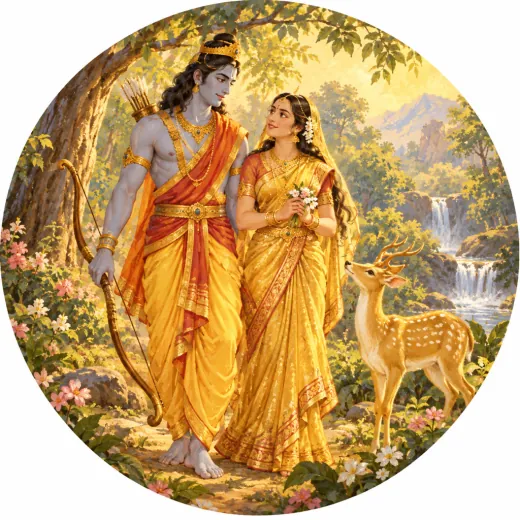
Rama and Sita
from the poem Ramayana
a little scary
Rama was the righteous prince of Ayodhya, revered as an avatar of Vishnu. Because of a palace plot he was sent into exile in the forest for fourteen years, and his wife Sita and his brother Lakshmana chose to follow him. There Sita was carried off by Ravana, the ten-headed king of the island of Lanka. With the help of Hanuman and an army of monkeys and bears, Rama built a bridge across the sea, defeated Ravana and set Sita free. Then they went back to Ayodhya together.
Did you know? During Diwali, the festival of lights, lamps are lit all over India, partly to remember the return of Rama and Sita.
The story
Rama was meant to become king the next day.
In Ayodhya, the city of his people, the streets were already full of flowers. Old King Dasharatha had decided to give him the throne, and everyone was happy about it: Rama was fair, he spoke gently, he listened to anyone. But on the night before the ceremony, Kaikeyi, one of the king's wives, remembered a promise. Years before, he had sworn to grant her two wishes. She asked for them now: that her son Bharata should become king, and that Rama should leave for the forest, for fourteen years.
Dasharatha wept. He could not go back on his word.
When Rama heard, he did not protest. He took off his princely clothes, put on a robe of bark and went to say goodbye to his father. “If this is the word you gave, I will keep it for you.”
Sita, his wife, would not stay behind. “Where you go, I go. The forest is home, if he is there.” And Lakshmana, his brother, said he would not leave him either. The three of them set off on foot while the whole city wept. Soon afterwards the king died of grief, and Bharata, who had never wanted the throne, hurried to the forest to beg his brother to come back. Rama refused: a promise was a promise. So Bharata asked him for his sandals, placed them on the throne, and ruled in his name, without ever sitting in Rama's place.
The three of them lived in the forest for a long time, in a hut of leaves, at Panchavati. It was there that Ravana, king of Lanka, came.
Ravana had ten heads and twenty arms, and a boon he had received from Brahma: no god and no demon could kill him. About humans, though, he had asked for nothing: he thought them too small to matter. He wanted Sita. He sent ahead a demon, Maricha, disguised as a golden deer, its coat shining among the trees. Sita saw it and said to Rama: “Bring it to me.”
Rama sensed that something was wrong, but he went. He left Lakshmana on guard. The deer ran off, from tree to tree, until Rama struck it. As it died, the demon cried out in Rama's voice: “Sita! Lakshmana!”
Sita was frightened. She urged Lakshmana to run and help. Lakshmana left her alone, against his will.
And Ravana, disguised as a holy hermit, appeared at the door with a staff and a bowl.
Sita offered him water and food. The hermit threw off his disguise, seized her and carried her away in his flying chariot, over the mountains, over the sea. Sita screamed and wept, and threw her jewels to the ground so that someone could find the way. Only Jatayu, the old king of the vultures, heard. He flew at the chariot and fought with all his strength, but he was too old. He fell. When Rama found him, dying, Jatayu managed to tell him where the chariot had gone: to the south. Rama gave him the honours given to a member of the family.
Rama and Lakshmana set out. They searched for months. They came to a mountain, where they met an army of monkeys, with their king Sugriva and his adviser Hanuman. They made a pact: Rama would help Sugriva win back his kingdom, and Sugriva would search for Sita.
The monkeys scattered in every direction. Hanuman and the others went all the way to the shore of the southern sea, facing an immense water with no other shore in sight.
Hanuman took a breath, and grew. Then he jumped.
He flew over the waves, and at sunset he landed on the island of Lanka. At night he made himself small and slipped between the golden palaces, past guards who were snoring. He searched the whole city for Sita and found her in a garden of ashoka trees, surrounded by women guards, thin and silent, in a single worn-out dress.
“Who are you?” she whispered.
“I am a messenger from Rama.” And he showed her the ring Rama had given him.
Sita wept, and for the first time in months she smiled. Hanuman told her that Rama was looking for her, that he would come soon, and that she must not lose hope. Then, before going back, Hanuman did one last thing: when the demons set fire to his tail to punish him, he leapt from roof to roof, and it was Ravana's city that burned, not him.
Hanuman came back with the news, and Rama marched out with the army of monkeys and bears, the bears led by Jambavan. They reached the sea. It was too wide, and they had no ships. Rama prayed to the god of the ocean for three days, in silence, and when the water gave no answer, he drew his bow with such fury that the sea was afraid. Then the ocean showed itself and said: “Build a bridge. Nala, the son of the architect of the gods, will make it.”
The monkeys brought rocks, trees, whole mountains. In five days the bridge stretched across the sea.
The battle of Lanka was long and loud. Brothers, heroes and giants fought; commanders fell on both sides. In the end, Ravana rode out onto the field in his chariot. He and Rama fought each other for days, and every time one of the king's heads fell, another grew back. Until Rama, with a sacred arrow given to him by a sage, struck the demon in the chest. Ravana fell, and with him the terror of Lanka.
Sita was brought before Rama, and before everyone. She told the truth: she was pure. But Rama had to show the world that no one could doubt it. Sita asked for a fire to be lit, and she walked into it, calm. Agni, the god of fire, brought her out again, unharmed, and said: “There is no fault in her.”
Rama took her by the hand. The fourteen years were over.
They returned to Ayodhya in a flying chariot, and when the people saw them coming, they poured out to meet them. Bharata went to greet Rama and put the sandals back on his feet. The city was full of lamps, and Rama was crowned king.
They say that ever since, every year, when darkness falls, people in India light many little lamps: because someone coming home after a long exile needs to see the way.
A living tradition, told with respect: how we tell myths.
Relatives around the world
Listen / Read next
- Music to read by: Cinematic JourneyEpic film-style music, no lyrics, by Ciro Simone IrmiciSpotifyYouTube Music
Sources
- Valmiki, Ramayana (about 5th–4th century BC to 3rd century AD)
