Hanuman
Hanumān, in Sanskrit
not scary at all
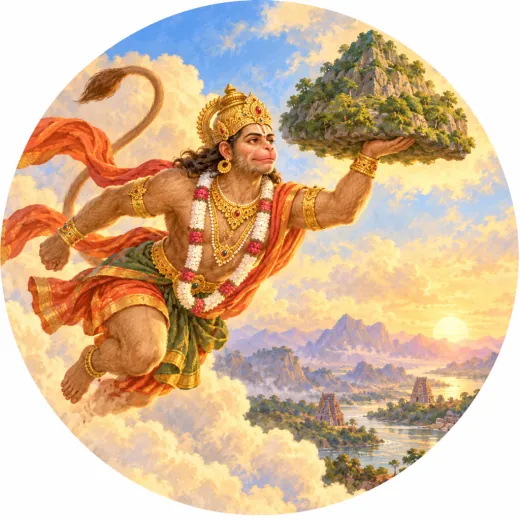
Hanuman is a deity in the form of a monkey, immensely strong, brave and deeply devoted to Prince Rama. In the Ramayana he is the great hero of the adventure: to find Sita, who had been carried off to the island of Lanka, he crossed the sea in a single gigantic leap. When Rama's brother was badly wounded, Hanuman flew all the way to the Himalayas to fetch a healing herb; unable to recognise it, he lifted the whole mountain onto his shoulders and carried it to the battlefield.
Did you know? It is said that as a child he mistook the sun for a ripe fruit and leapt into the sky to eat it.
The story
When he was little, Hanuman saw the sun.
It was a clear morning, the sun just born, a red and golden disc climbing up behind the mountains. The child, son of the wind, looked at it and had a simple thought: It's ripe.
He crouched, took a run-up and jumped.
Up he went, through the clouds, above the peaks, higher and higher, faster than a bird, faster than an arrow. The sun felt him coming close and did not burn him. Up above, the gods saw him coming and were frightened. Indra, the king of heaven, hurled his thunderbolt. It struck the child on the jaw and he fell to earth like a comet.
That, says the tradition, is why he is called Hanuman: “the one with the jaw”. His father, the Wind, wounded by so much grief, stopped blowing. The world began to suffocate, until the gods were sorry and gave the child gifts: no weapon would kill him, no flame would burn him, no sea would stop him.
But there was a snag. As Hanuman grew up, he forgot he had those powers.
For years he was a monkey like the others, strong, but no stronger than the rest. Until one day he met a prince named Rama, who was searching for his wife.
Sita, Rama's wife, had been kidnapped by Ravana, the king of the demons, and carried off to the island of Lanka, beyond the sea. Hanuman looked at Rama and at once understood three things: that this man was good, that he was suffering, and that he himself would do anything for him. He lifted Rama and his brother Lakshmana onto his shoulders and carried them to the king of the monkeys, Sugriva.
Search parties were sent out in every direction to look for Sita. The southern party, which Hanuman belonged to, reached the shore of the ocean and stopped.
Before them was nothing but water. A huge grey sea without a single boat, and somewhere out there, the island. A hundred leagues of water. The monkeys sat down on the sand one by one, with their heads in their hands.
“No one can do it,” someone said.
Then old Jambavan stepped forward, the king of the bears, who had lived so long that he remembered everything. He went over to Hanuman, who was sitting apart from the others, and spoke into his ear.
“Why are you so quiet? You are the son of the Wind. You took the sun for a fruit. You can leap where no one else can.”
Hanuman raised his head. And, the way you remember something from long ago, he remembered.
He began to grow. He rose up on the mountain, taller than the trees, taller than the rocks, until his shadow covered the beach. He pressed his feet down on Mount Mahendra, and the mountain shook, and the animals fled from their caves. He raised his arms. He spoke Rama's name. And he leapt.
The wind held him up. Beneath him, the sea rushed past like a grey carpet. After a while a golden mountain rose out of the water, Mainaka, and offered him a rest. Hanuman touched it with his hand, thanked it and flew on: he had no time.
Then Surasa, the mother of serpents, rose from the sea with her mouth wide open. The gods had sent her to test his cleverness. “You must go into my mouth,” she said. Hanuman made himself bigger, and Surasa opened her mouth even wider. Hanuman grew to twice his size, and she opened twice as wide again. Suddenly he shrank until he was the size of a thumb, slipped into her mouth, came out again an instant later and said, “I have kept my word. May I go now?” Surasa laughed and let him pass.
The last obstacle was Simhika, a demon who hid in the water and seized the shadows of birds in flight, and the birds along with them. When Hanuman felt his shadow being pulled, he understood. He made himself small, slipped into her mouth and came out again: Simhika had no way left to chase him.
By the time he landed on the coast of Lanka, it was already night.
He made himself as small as a cat. He entered the city with its golden walls and towering spires, slipping past the guards, the palaces, the halls full of music and lamps. He searched for Sita all night long. He looked behind every pillar, in every room, under every bed. She was not there.
He found her at dawn, in a grove of ashoka trees, sitting beneath a tree, pale and thin, surrounded by guards. She was no longer crying. She was staring at the ground.
Hanuman, hidden among the branches, waited for the right moment. Then he climbed down quietly and showed her Rama's ring. “I am a messenger,” he said. “Rama is well. He is looking for you. He will come.”
Sita looked at him and, for the first time in many months, she smiled. She gave him a jewel to take to her husband, so that he would know she was alive.
Hanuman let Ravana's demons capture him. They brought him in chains before the king, and Ravana, to humiliate him, ordered his tail to be set on fire. The guards wrapped it in rags, soaked it in oil and lit it.
But the fire did not burn him. Because of the gods' gifts, so they say, and because of Sita's prayer: from the grove she had asked Agni, the god of fire, to be cool to him. He broke free, leapt onto the rooftops of Lanka and, from roof to roof, with his tail ablaze, he set the city alight. The fire swept over it like a red wind.
Then he leapt back across the sea, returned to his companions and told Rama everything. Rama listened to the very end. He had nothing to give him, he said, nothing that would be enough. He embraced him, and for Hanuman that was the greatest gift of all.
Later, during the war, Lakshmana was struck down and seemed to be dead. The healer said that only one herb could save him, and it grew on the Himalayas.
Hanuman flew all the way to the mountains. He found the right one, but the night was dark and, even though the herbs were glowing, he could not tell which one to pick. He did not waste any time. He broke off the whole peak, set it on his palm, and flew back with the mountain in his hand.
Lakshmana stood up at dawn.
The rest of the story, they say, is the long tale of a victory. But for Hanuman, whenever he could, it was enough to stay close to Rama, in silence, with his hands joined in prayer.
A living tradition, told with respect: how we tell myths.
Relatives around the world
Listen / Read next
- Music to read by: Cinematic JourneyEpic film-style music, no lyrics, by Ciro Simone IrmiciSpotifyYouTube Music
Sources
- Valmiki, Ramayana, Books IV–VI
