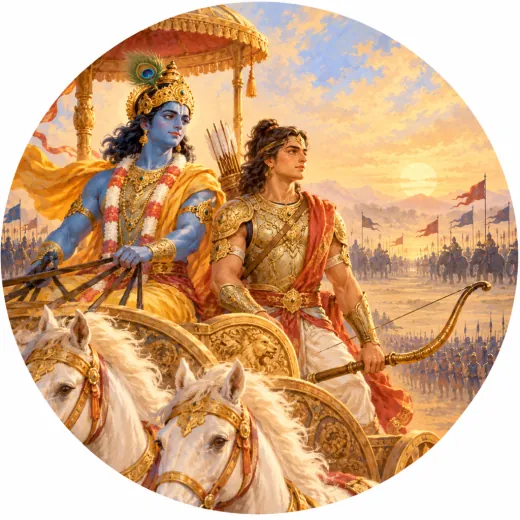
Arjuna
Arjuna, “the shining one”
a little scary
Arjuna is the greatest archer of the Mahabharata, one of the five Pandava brothers. To marry the princess Draupadi he passed an impossible test: hitting the eye of a fish spinning high up, while looking only at its reflection in water. The most famous story comes before the great battle of Kurukshetra: Arjuna sees his relatives and teachers among the enemy, and no longer wants to fight. His friend and charioteer, Krishna, speaks to him at length about duty and the meaning of life. That dialogue is the Bhagavad Gita.
Did you know? The Mahabharata has about a hundred thousand verses: it is one of the longest poems ever composed.
The story
To hit the eye of a fish, Arjuna did not look at the fish.
The fish was made of metal and spun high up, on a wheel that never stopped. To take aim you had to turn your back on it and look down, into a basin of water where its reflection trembled. One breath out of time, and the arrow would be lost in the sky of the kingdom of Panchala.
It was the contest for the hand of Draupadi, daughter of King Drupada. Princes from every land had drawn the bow, one after another, and every one had missed. Some could not even bend it. Arjuna stepped forward last, dressed as a brahmin, one poor priest among many, because he and his four brothers, the Pandavas, had to stay hidden from their enemies. He looked into the water. Not at the crowd, not at the kings. He saw only the eye of the fish.
The arrow flew, and the eye fell to the ground.
That is how the Mahabharata introduces its hero: the greatest archer in the world. But that is not why he is still remembered. He is remembered for a day many years later, on a plain called Kurukshetra, when Arjuna no longer wanted to shoot even a single arrow.
The family had been divided for a long time. The five Pandavas and their cousins, the Kauravas, were fighting over a kingdom. There had been tricks, years of exile, failed talks. In the end only war was left, and the two armies stood face to face, enormous, with their chariots, their elephants, their banners.
Arjuna climbed into his chariot, pulled by white horses. At the reins was the friend he loved most, Krishna, who had chosen not to fight in this war and to be only a charioteer. On both sides the battle conches sounded: Krishna's, Arjuna's, his brothers'. The sound filled the plain and made the earth shake.
“Take me between the two armies,” said Arjuna. “I want to see who I must fight.”
Krishna drove on, and the chariot stopped in the empty space between the two hosts. Arjuna looked to the right. He looked to the left.
He saw his uncles. He saw cousins, brothers-in-law, childhood playmates. He saw the teacher who had taught him to draw a bow, and the old grandfather who had held him on his knees as a child. All of them in front of him, ready to die; and almost all of them, if he fought, beneath his arrows.
His legs gave way. His mouth went dry. His hands, which had never shaken before an enemy, began to tremble, and his great bow, the Gandiva, slipped from his fingers.
“Krishna,” he said softly. “I can't. I don't want victory, I don't want the kingdom, I don't even want to live, if to have them I must kill these people.”
He sat down on the floor of the chariot and let his arrows drop. All around him, for a moment, it seemed that even the noise of the battle was waiting.
Krishna looked at him, and did not laugh at him.
“Why this confusion,” he said, “and why now? Stand up.”
Arjuna did not stand up, and Krishna understood that short words were not enough. So he began to speak in earnest, and his voice was as calm as a lake with no wind.
“You grieve for those who should not be grieved for,” he said. “There was never a time when I did not exist, nor you, nor these kings; and there will never be a time when we cease to be. What lives in each of us is not born and does not die. The sword does not cut it, water does not wet it, the wind does not dry it. Just as a person takes off a worn-out garment and puts on a new one, so the one who dwells in a body leaves it and takes another.”
Arjuna listened, without raising his head.
“You are a warrior, and this is your task. Do your duty. But remember: you have a right to the action, not to the fruits of the action. Do what is right, and let go of what comes of it.”
They talked for a long time, in the middle of the still plain. This conversation is the Bhagavad Gita: about seven hundred verses inside a poem of a hundred thousand stanzas. Krishna spoke to him of the mind, which must stay as still as the flame of a lamp where no wind blows. He spoke of action done without attachment. And Arjuna asked his questions, even the hard ones.
At one point Arjuna asked for more.
“I want to see you as you really are.”
“With these eyes you cannot,” Krishna replied. “I will give you others.”
And the chariot, the horses, the sky of Kurukshetra vanished.
Arjuna saw a form without limits. Mouths and eyes beyond counting, countless arms, wonders never seen; a light like a thousand suns blazing together in the sky. He saw all the warriors of both armies pouring into the jaws of that form like rivers rushing to the sea. His hair stood on end. He joined his hands, bowed, and his voice shook.
“Who are you?”
“I am Time,” the voice answered, “that brings the worlds to their end. Even without you, these warriors will not live. Stand up, and be only the instrument.”
Arjuna could not bear it long. “Please,” he said, “show me again the face I know.” And once more he saw the friend with the kind smile, his charioteer, sitting in front of him. His heart grew calm.
“Now that I see your human face,” he whispered, “I have found my mind again.”
Krishna waited. The wind passed over the plain. Far away, somewhere, a horse stamped.
Arjuna rose to his feet. He picked up the Gandiva and gripped it with both hands.
“My confusion is over,” he said. “The doubt is gone. I will do what you tell me.”
On both sides the horns sounded for the second time, and the battle began. It lasted eighteen days, and it was terrible; but the poem does not remember those arrows. It remembers a man sitting on the floor of a chariot, who at a certain moment lifts his head.
For millions of people the Gita is still a sacred text, and each reads it in their own way. But they all start from the same place: the day when the greatest archer in the world was afraid of himself, and someone stayed beside him, in the chariot, long enough to answer.
A living tradition, told with respect: how we tell myths.
Relatives around the world
Listen / Read next
- Music to read by: Cinematic JourneyEpic film-style music, no lyrics, by Ciro Simone IrmiciSpotifyYouTube Music
Sources
- Mahabharata
- Bhagavad Gita
