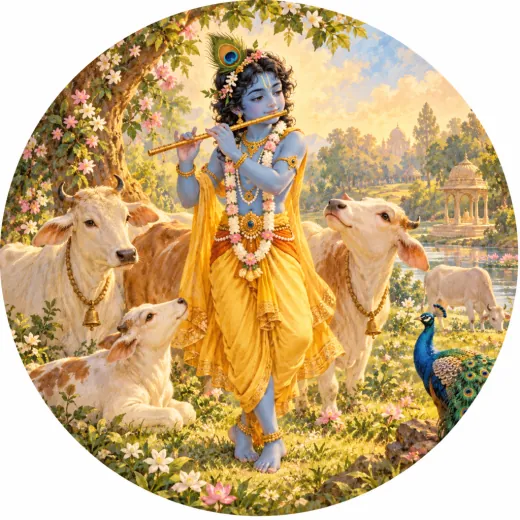
Krishna
Kṛṣṇa, “the dark one”, in Sanskrit
not scary at all
Krishna is one of the best-loved avatars of Vishnu. He was born in a prison, because a wicked king wanted to get rid of him, and his father carried him to safety at night across the river Yamuna. He grew up among the cowherds of Vrindavan: he was a naughty child who stole butter, and a boy who played the flute so well that the cows stopped eating to listen. When the god Indra sent endless rain on the village, Krishna lifted the hill of Govardhan with one finger and held it up like an umbrella for seven days.
Did you know? At his birthday festival, in some cities, teams of young people build human pyramids to break a pot of yoghurt hung up high, as he did as a child.
The story
Once upon a time there was a king who was afraid of a child who had not yet been born.
His name was Kamsa, and he ruled in Mathura. One day, at the wedding of his sister Devaki, a voice from the sky had told him, “The eighth child of this woman will be your end.” From that moment on, Kamsa never slept again. He locked Devaki and her husband Vasudeva in a prison, with iron doors and guards at every corner, and he waited.
The eighth child was born at midnight, on a stormy night.
Outside, the rain was pouring down. Thunder shook the walls. Inside the cell, Devaki heard a little cry and saw a newborn baby as dark as a rain cloud, with shining eyes, who was already smiling. This was Krishna, and it is said that he was Vishnu himself, come down to earth to set things right.
At that moment, everything changed. Vasudeva's chains fell away by themselves. The iron doors opened with a sigh. One by one, the guards fell asleep where they stood, their heads resting on their spears.
“Take me away,” the baby whispered, or so the story goes.
Vasudeva wrapped him in a cloth, laid him in a basket and lifted it onto his head. He walked out of the prison. The wind pushed him, the rain soaked him, and suddenly, in front of him, the river Yamuna spread out, black and swollen as he had never seen it.
Vasudeva did not stop. He waded into the water. It came up to his knees, his waist, his chest, his neck. At that moment, behind him, a great serpent rose out of the current and spread its heads over the basket like an umbrella, to shelter it from the rain.
When the river felt the baby, it drew back. The water parted, and Vasudeva crossed without getting his feet wet.
On the other side was a village of cowherds, Gokula. In the house of Nanda and Yashoda a baby girl had been born that very night. Vasudeva set his basket down beside Yashoda, who was asleep, picked up the little girl and went back in silence. The next morning Yashoda woke up with a dark baby boy in her arms, and she believed he was her own.
And so Krishna grew up among the cows.
He was the naughtiest child in the village, and all the other children followed him in a line, like a little gang. He stole butter. Not because he was hungry, but for fun. He climbed the shelves, stood on his friends' shoulders to reach the pots hanging from the ceiling, knocked the jugs over, and when his mother caught him, with his hands in the bowl and his face all white, he looked up at her with such big, innocent eyes that her anger melted away.
“Was it you who ate the butter?” Yashoda would ask.
“No, Mummy. It was the cat.”
“Cats don't have such little hands.”
One day his friends came running to her: “Krishna has been eating mud!” Yashoda grabbed him. “Open your mouth!” He opened it. And inside that little child's mouth she saw the sky, the stars, the rivers, the mountains, every living creature, and even herself looking in. Her head spun. Then Krishna smiled, and she forgot all about it.
As the years went by he grew into a boy, and he learnt to play the flute.
It was a sound nobody had ever heard before. When Krishna played on the riverbank, the cows stopped chewing and raised their heads. The birds stood still on the branches. The river slowed down. The cowherds working in the fields put down their tools and sat down, even though they did not know why. The women came out of their houses with the thread still in their hands, and stood motionless in the doorway, listening.
One autumn the cowherds got ready, as they did every year, to make offerings to Indra, the god of rain. Krishna, who was only seven, asked, “Why?”
“Because if we don't honour him, he won't send the rain.”
“And where do we get the rain from? From the clouds. And our fields and our cows, where do they get their food? From the hill of Govardhan. Let's hold the festival for the hill.”
The cowherds looked at the hill. It was true. Just in case, they offered it a feast: sweets, milk, rice, flowers. Krishna ate with them.
Up in heaven, Indra noticed that nobody was bringing him anything any more. He flew into a rage. He gathered all the clouds he had, the blackest ones, and hurled them at the village.
The sky closed over. It began to rain as it had not rained for centuries, day and night, harder and harder. The streams burst their banks. The fields disappeared under the water. The cowherds ran about with their cows in their arms, screaming, with nowhere left to go.
“Krishna!” they cried. “Help us!”
Krishna looked at the hill. Then he held out his left hand. With a single finger, the smallest one, he lifted the hill of Govardhan off the ground and held it high above his head, like an umbrella.
“Come, everyone,” he said. “There is room for every person and every cow.”
And they came. The cowherds, the women, the old people, the children, the calves, all of them under the floating mountain, watching the rain beat down on its edge and pour off. A day went by. Then two, three, four, five. Krishna stood there with his finger raised, smiling. After a while the youngest children fell asleep. On the sixth day the rain began to ease. On the seventh, it stopped.
Indra understood. He came down from heaven, bowed, and asked forgiveness. And Krishna, holding no grudge, smiled at him.
Then he set the hill back in its place, gently, the way you put a cup down on a table.
The years went by. Krishna left the village and went back to Mathura, and the prophecy that had kept Kamsa awake came true. Long afterwards, on a battlefield, he spoke to his friend Arjuna and told him things that are written in the Bhagavad Gita.
But in Vrindavan, when the wind stirs the grass, the cowherds say you can still hear a flute out on the plain.
A living tradition, told with respect: how we tell myths.
Relatives around the world
Listen / Read next
- Music to read by: Cinematic JourneyEpic film-style music, no lyrics, by Ciro Simone IrmiciSpotifyYouTube Music
Sources
- Bhagavata Purana, Book X
- Bhagavad Gita
