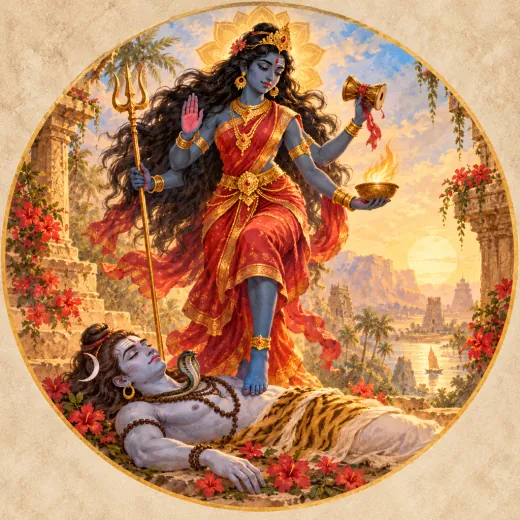
Kali
Kālī, “the black one”, in Sanskrit
scary
Kali is a powerful and fierce form of the Goddess, revered as a protecting mother especially in Bengal. Her name is linked to the colour black and to time, which transforms everything. The Devi Mahatmya tells that she sprang from the forehead of the goddess Durga during a battle against the demons, and later helped to defeat Raktabija, a demon who multiplied every time a drop of his blood touched the ground. She is shown with dark skin and her tongue out: a Bengali tradition says she sticks it out in shame, when she realises she has stepped on Shiva.
Did you know? In Kolkata, whose name according to one tradition comes from the Kalighat temple, her main festival falls on the same night as Diwali.
The story
The battlefield was silent.
It was the hour when everything seemed to be over. The sun was about to set, the dust was settling, and on the mountain stood a woman alone, with a lion crouching at her feet. She was the goddess, Durga, whom the book also calls Ambika. Before her stood an army of demons that had been trying to crush her for days.
The demons were led by two brothers, Shumbha and Nishumbha, who had seized heaven and driven out the gods. That was why the gods had called on her: alone, beautiful, unshakeable, without fear.
The brothers sent two captains. Their names were Chanda and Munda, and they came galloping up with an army of thousands of warriors, spears held high and black banners flying. They looked at the goddess. She did not move.
And little by little, her face grew dark.
Her brows drew together. The air on the mountain grew heavy, as it does before a thunderstorm. The demons, hardened as they were, slowed their pace without knowing why. A horse whinnied and reared.
From the goddess's forehead, right at the point where her eyebrows met, someone came out.
It was a woman. Black as a moonless night, gaunt, very tall. Her hair hung loose, her eyes were sunken and red, and her mouth gaped open, with her tongue hanging out. She held a sword in one hand and a noose in the other, and round her neck hung a long garland of skulls. She made no sound. Then she opened her mouth and gave a single cry.
It was Kali.
That cry filled the whole valley and echoed off the mountains. The demons dropped their weapons. Some ran. Others stood frozen, unable to move, because they could no longer remember how.
Kali hurled herself into their midst. She was faster than the wind. Wherever she went, the ranks opened up and never closed again. War elephants sank to their knees, chariots shattered, the black banners fell one after another, without a sound, like autumn leaves.
When the trumpets fell silent, Chanda and Munda were gone. Kali went back to the goddess and brought her the proof of her victory over both of them. Ambika smiled. “From today,” she said, “you will be known throughout the world by the name of Chamunda.”
But the war was not over. The worst was yet to come.
For a moment the valley was calm. Up above, the gods were hugging each other and some were laughing. Nobody was looking towards the horizon, where the dust was rising again, slowly, from a single direction.
For Shumbha and Nishumbha, to make up for their defeat, had sent a champion. His name was Raktabija, “seed of blood”, and there was no stranger warrior in the world.
He was tall and strong. But his real strength was something else: every drop of his blood that touched the ground became another demon, exactly like him, with the same strength, the same face and the same weapons.
The gods did not know this. They found out straight away.
The goddess struck him, and every drop that fell into the dust stood up. A second Raktabija. Then a third. Then ten. Then a hundred. Each one waved his club, each one laughed, each one had the same face, and as the gods watched, the newborn demons gave birth to still more.
The valley was filling up. Where before there had been one champion, now there were thousands of champions. They pushed and shoved each other, they called to one another in the same voice. The noise of all those weapons and all those footsteps made the ground shake.
A soldier in the demon army, on top of a hill, tried to count the Raktabijas. He got to a hundred, then two hundred. Then he gave up, because he realised he had run out of fingers, and of voice too, and that even he, who was on the demons' side, was afraid.
Up above, the gods held their breath. The more the goddess struck, the more crowded the field became. Every victory was a defeat.
Ambika understood. She turned to Kali, who had stopped, and spoke to her quietly.
“Open your mouth,” she said. “As wide as you can. You must catch every drop before it reaches the ground. And you must devour the demons that are born, one after another. Do not let a single one escape.”
Kali did not answer. But her mouth opened, and it opened so wide, so very wide, that for an instant it seemed to have no bottom.
Then the goddess struck again. With the sword, with the trident, with arrows, with the club. At every blow Kali was there, mouth open, catching every drop before it touched the dust. The new demons, the ones who had already stood up, ran at her, and she seized them and swallowed them. One after another. Without hurrying.
The field emptied. Little by little the identical faces disappeared, one at a time, like candles going out. And in the end only one Raktabija was left, the real one, pale and exhausted, staring at the last drop that had never touched the ground.
He fell.
The gods looked at each other in disbelief. Then one single, long breath came out of all their chests.
Victorious, Kali began to dance. She danced for joy, for fury, for the end of fear, and her dance was so wild that the earth bent beneath her feet. The mountains shook. The seas rose up. The world was about to give way.
They tell in Bengal that Shiva then lay down on the battlefield, among the dead, to stop her. Dancing, Kali did not see him. She put her foot on him. And when she realised who it was, she stopped dead, her eyes went wide and, out of shame, she bit her tongue.
That, they say, is why she is shown with her tongue sticking out.
Her enemies fear her. But those who pray to her call her “Ma”, mother. Because she, they say, is the mother who comes when there is no one else left, and who does not stop until her children are safe.
A living tradition, told with respect: how we tell myths.
Relatives around the world
Listen / Read next
- Music to read by: Cinematic JourneyEpic film-style music, no lyrics, by Ciro Simone IrmiciSpotifyYouTube Music
Sources
- Devi Mahatmya (about 6th century)
- David Kinsley, Hindu Goddesses, University of California Press (1986)
