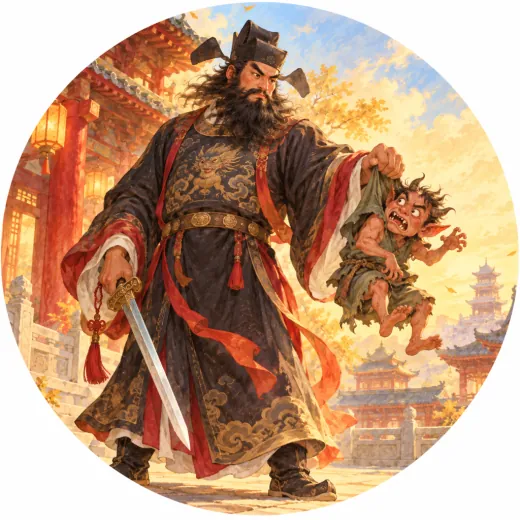
Zhong Kui
鍾馗, in Chinese
a little scary
Zhong Kui was a student who, the legend says, failed the imperial examinations. Later traditions add that he had come first but was turned down because he was very ugly, and that he died of grief and became the king of demon hunters. A legend tells that Emperor Xuanzong, sick with fever, saw him in a dream catching a little demon that had stolen a flute from him. When he woke up he was cured, and he asked the most famous painter in the land to paint Zhong Kui as he had seen him, with a bristly beard and a sword.
Did you know? For centuries in China people hung his picture on their front doors, at New Year or in summer, to keep evil spirits away.
The story
In the winter the emperor fell ill, the palace of Chang'an stopped making any noise.
Servants walked on tiptoe. Doctors came in with their sleeves full of herbs and went out shaking their heads. Emperor Xuanzong, who ruled the greatest empire in the world, lay in bed with a fever that rose in the evening and fell at dawn, and no medicine could beat it. At night he shivered under three blankets. By day he stared at the ceiling.
One night, between one shiver and the next, he fell asleep. And in his dream he heard footsteps.
Small, quick, light as a cat's. Someone was running round the hall, between the lacquered columns, laughing under their breath. The emperor turned his head and saw him: a little demon no taller than a child, dressed in red, with one foot bare and one in a shoe. He was clutching two things the emperor knew well. The scented pouch of Yang Guifei, his favourite. And his own jade flute.
“Stop!” he tried to shout. But in the dream his voice would not come out, or came out as a sigh.
The little demon stopped anyway. He turned, gave a mocking bow and introduced himself. “My name is Xuhao. It means Emptiness and Waste. Wherever I go, larders empty, joys are spoilt and worry settles on the houses. I'm keeping the pouch. The flute too. What use are they to you, anyway?”
Then something changed in the air. The lamps dimmed, as if they had felt a sudden chill. Outside the door came a heavy step, just one, and then another.
A giant walked in.
On his head was a battered hat; he wore a blue robe with one shoulder bare, and leather boots dirty from the road. His beard was bristly as a wild boar's hide. His face was the kind you never forget: broad, dark, with eyes bulging under his eyebrows like two hot coals. The little demon saw him and stopped laughing.
He had no time to run. The giant grabbed him by the neck the way you pick up a kitten, and there he hung in mid-air, kicking at nothing.
Then the man turned towards the bed and bowed.
“Your Majesty, I am Zhong Kui, of the Zhongnan mountains. In the time of Emperor Gaozu I came to Chang'an for the state examinations, and I did not pass. Since then I have sworn an oath: to rid the empire of evil spirits. That is why I am here.”
What happened next, the emperor did not want to watch. He closed his eyes, and when he opened them it was morning.
The room was full of sunlight. The fever was gone. Xuanzong sat up, amazed to be breathing without effort, and asked for something to drink, then something to eat. Then he sent for Wu Daozi, the most famous painter in the realm.
“I'm not asking you to invent,” he told him. “I'm asking you to remember with me.” And he described everything: the hat, the blue robe, the bare shoulder, the beard, the stare, the way the man had gripped the demon.
Wu Daozi worked in silence. When he put down his brush, the emperor said nothing for a long time. Then he said, “It's as if you were in my dream, standing by the bed.” And he rewarded him with gold.
It was the first portrait of Zhong Kui. People have been talking about him ever since.
They wanted to know who that man had been. So, over the centuries, the story grew, as stories grow when they are loved. In the later versions, which are not part of the dream story, they say Zhong Kui had been the most gifted young man of his time, and that in the exams he wrote the finest verses of all and came first. But on the day the prizes were handed out, the officials looked up and saw his face: ugly, scarred, with a bristly beard and bulging eyes. Someone muttered that a face like that could not stand before the emperor. His name was struck out.
Zhong Kui could not bear the pain. He died that day, on the palace steps.
But in China the dead do not end where they end for us. In the afterlife, they say, he was given a job that suited him. The face that had been no use at court would send demons running for their lives. And Zhong Kui became the king of spirit hunters, the one who roams the nights of the empire, sword in hand, and finds whoever is hiding.
That is why, after Xuanzong's dream, a custom was born. In every house that could afford it, at New Year, and in some places in summer too, when sickness walks with the heat, his portrait was hung on the door. The black beard, the blue robe, the wide-open eyes, the sword. A doorkeeper who never sleeps and can never be talked round.
Picture a house, one evening at the end of winter. Outside, the wind is swinging the lanterns. A child in pyjamas stops in front of the door and looks up.
“Grandma, why does he look so angry?”
“Because he has to frighten anyone who wants to come in without being invited.”
“And what if they're not frightened?”
“They always are.” Grandma tucks his scarf in. “Even little red demons with one bare foot. Especially those.”
The child looks at her, suspicious. Then he looks at the portrait again. The bushy eyebrows, the hard mouth, the stare that never gives way. It seems to him that the man on the door is listening.
In that house, that night, nobody gets in.
Meanwhile, somewhere in a dark street, a little demon with one bare foot and one shoe slips out of an alley, sees a door with a big bearded face on it and stops, out of breath. He thinks for a moment. Then he goes another way. That is what all his kind do when they meet Zhong Kui.
When he was alive, all he had wanted was to serve the empire. The empire, according to the later versions, had turned him away because of his face. And now that face was on millions of doors, and his job was exactly that: to be looked at.
Does he ever smile, under that beard? Nobody knows. Nobody has ever dared to look that closely.
Relatives around the world
Listen / Read next
- Music to read by: Cinematic JourneyEpic film-style music, no lyrics, by Ciro Simone IrmiciSpotifyYouTube Music
Sources
- Shen Kuo, Mengxi Bitan (11th century)
- Lihui Yang and Deming An, Handbook of Chinese Mythology, ABC-CLIO (2005)
