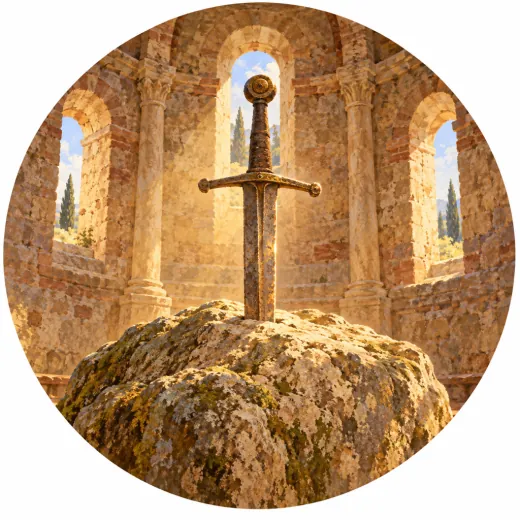
The Sword in the Stone of San Galgano
the sword of Galgano Guidotti
not scary at all
Galgano Guidotti was a young knight from Chiusdino, dissolute and overbearing. Tradition says that after a vision he decided to change his life: on the hill of Montesiepi he thrust his sword into a rock to make a cross of it and say goodbye to war. He lived as a hermit for about a year and died in 1181; after his death he was proclaimed a saint. The incredible thing is that the sword is still there, inside a round chapel, protected by a glass case. A little further down are the ruins of the abbey of San Galgano, which no longer has a roof.
Did you know? Some have linked this sword to King Arthur's, but it is only a theory: the two stories may have nothing in common.
The story
Galgano was born in Chiusdino, in Tuscany, around 1148. His father was called Guidotto, the family was that of the Guidotti, minor country nobility, people who served the bishops of Volterra and followed the trade of arms.
In those days, a boy of good family had one road in front of him: the sword, the horse, the castle. Galgano took it all, head held high.
He was young, and he was not good. The sources, in different words, say so: he lived for amusements and whims, given to abuses, as sure of himself as someone who has never lost anything. When his father died, far too soon, he carried on as before, perhaps harder, perhaps more alone.
Then, one night, the dreams began.
They were not peaceful dreams. Galgano woke with his heart pounding and a sentence in his head: leave everything. A voice, they say, the voice of his own soul. Then, once, an apparition, that of the archangel Michael, who pointed him to another road.
Galgano laughed, the first time. The second time he stopped laughing.
His mother watched him in silence, at the table. She had understood before he did.
"Where are you going?" she asked one morning, seeing him saddle his horse.
"To Civitella."
"And then?"
"I do not know."
She said nothing more. After all he was her boy, and boys like him are not stopped with words. She tried, we know it from those who wrote his story: his mother tried to dissuade him. But Galgano left all the same.
The road to Civitella Marittima ran through hills of woodland and scrub. The horse walked slowly, ears pricked. It was a beautiful day, or perhaps not. The stories do not mention the weather. They say only that at a certain point, for no reason, the horse stopped.
It would not go any further.
Galgano spurred it. He pulled at it. He spoke to it. Nothing. The horse planted its hooves on the ground, as if in front of a wall that only it could see.
In the end the knight let go of the reins. He set it free.
And the horse, slowly, began to climb.
Not along the road, but off the road, through the woods, up a slope. Galgano no longer held command: he let himself be carried. The climb was hard. The trees opened. At the top, among grass and stones, there was a round, quiet hill. It was called Montesiepi.
The horse stopped again, and this time Galgano understood.
He dismounted. He looked around. The silence was full of sky.
He still had his sword, the one that had been with him for years. He looked at it for a long time: it was the thing that told him who he was. Then he gripped it with both hands, and thought of one thing only: how do you give something up, when you have nothing else in your hands?
The answer was there, in front of him. There was no altar. There was a rock.
He raised the sword and drove it in.
The blade went into the stone like butter. It stood upright, still, with the hilt above and the blade within. And, seen from afar, it no longer looked like a sword. It looked like a cross.
That was, they say, his renunciation: not to throw away the weapon, but to make of it a sign. Not to defeat anyone, but to stop fighting.
Galgano stayed there. He withdrew to live as a hermit, beside the iron cross. His retreat lasted about a year. Around him, in time, a group of followers gathered. Many came to ask him for comfort. He did not say much. He prayed, and listened to them.
He died on 3 December 1181.
After his death, the tale did not end. The miracles attributed to him were set down in writing in the process that would make him a saint, and even today they are the most important document on his life. The bishop of Volterra, Ildebrando Pannocchieschi, with the pope's approval, had a small round chapel built on the hill, the Rotonda of Montesiepi, to guard the saint's tomb and his sword.
The sword is still there.
Until 1924 anyone could try to pull it out, and the blade came away. Then someone damaged it, and it was fixed with molten lead in the crack. Today it is protected by a transparent dome, and inside the Rotonda, beneath the dome of brick and travertine, you can still see it: upright, still, the blade in the rock.
Entry to the hermitage is free, and the place is open every day. In 2001 some scholars examined it. It was no ordinary object: the metal dated from the twelfth century, the very age of Galgano.
Lower down, in the valley, stands the abbey, begun in 1218 and consecrated in 1268. It no longer has a roof: it fell in, and now the sky comes in through the naves, and grass grows where the floors once were.
And then there is the other story, the English one: a king, a sword, a rock. Some have thought that Galgano's legend travelled all the way there, and inspired the tales of Arthur; there is also, among the Round Table, a knight called Galgano. Other scholars think that the two stories have nothing in common. Nobody knows.
What we do know is simpler. On the hill of Montesiepi, eight hundred years ago, a knight laid down his sword. And the sword, inside its case, is still there to remember him.
Relatives around the world
Listen / Read next
- Music to read by: Cinematic JourneyEpic film-style music, no lyrics, by Ciro Simone IrmiciSpotifyYouTube Music
- The words of the dialect: FlorentineNonnese, the dictionary of Italian dialects
