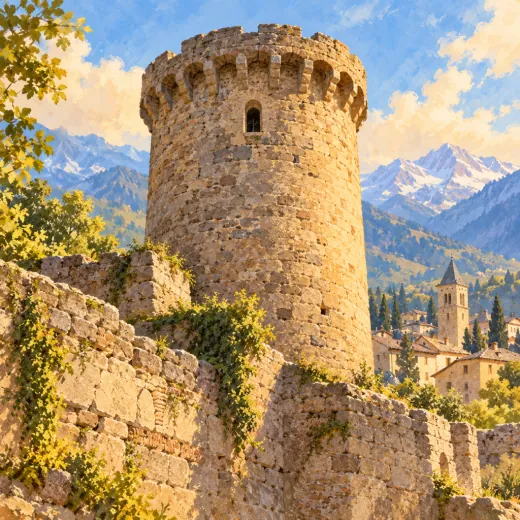
The Torre di Bramafam
“Brama fam”, meaning “cries of hunger”
scary
In Aosta, on top of the ancient Roman walls, stands a medieval tower with a strange name: the Torre di Bramafam (the Bramafam Tower). The legend says that a jealous lord of the Challant family locked his wife inside, and that she died of hunger lamenting her sufferings. Another tradition gives the name a calmer explanation: the tower was a granary, and during a famine people gathered beneath it to beg for bread. Nobody knows which story is true, but the tower is real and really did belong to the Challant family.
Did you know? The tower stands on a Roman base, next to the Porta Principalis Dextera of the ancient walls of Aosta.
The story
In Aosta, when the mountains turn black and the sky stays a little light, it is worth walking along the old walls.
They are Roman walls. Those who built them were thinking of a city that would last for ever, and indeed they are still there, large, grey, with the stones cut straight. At a certain point, where via Bramafam meets viale Carducci, the stones change. They become smaller, rougher. And on them rises a round tower, massive, without a light.
It is the Torre di Bramafam, the Tower of Bramafam.
You cannot go in. The door is shut and there has been nobody inside for centuries. And yet, in the silence of the evening, people passing by slow down.
You hear the traffic of the avenue fading little by little. The voices of the young people heading home move away. What is left is the sound of your own shoes on the asphalt, and above your head that round wall which seems higher than it did a minute ago.
The tower is truly very old. Its base is Roman: it rests on a piece of the tower that stood beside the Porta Principalis Dextera, one of the gates of the ancient city. Higher up it is medieval: it was built between the twelfth and thirteenth centuries. And its first owner was a family: the Challant.
The Challant were powerful. They were viscounts of Aosta, and in 1295 they received the fief of Challand. Then the tower passed to the counts of Savoy, changed hands several times, gradually lost its importance, and in the sixteenth century was abandoned for good.
Up to here these are facts. But there is the name. Bramafam.
It reads in two parts, "brama" and "fam": desire, longing, hunger. It is not a name for a tower. It is a name for a groan.
And so, in Aosta, there are those who tell this.
It is said that one of the Challant was a jealous man. Jealous in a way that left no room to breathe. One day, for fear of losing her, or of being betrayed, he shut his wife in the tower. He closed the door and kept the key.
Nobody in the city had the courage to ask. Or perhaps nobody knew at once.
The woman stayed up there. The mountain wind passed over the walls, and inside the tower there was a stone darkness that never warmed. The days up there were all alike: the light that came in through a slit, moving slowly across the floor, and then vanishing. It is said that nobody brought her anything to eat. It is said that, in the silence, passers-by stopped to listen to something that sounded like a voice. A thin voice, ever weaker, lamenting its sorrow.
From the street, on winter evenings, someone swore to have heard it. Then they pulled their cloak tight and quickened their step without turning round. The voice did not speak of revenge. It called nobody by name.
It said only that it was hungry.
When the voice went silent, the city understood. Nobody said it aloud. But from that day, for everyone, the tower had the name it still has: the tower of longed-for hunger, Bramafam.
If you are there, in front of those stones, and the wind rises just at that moment, you may feel a bit foolish. That is normal. The wind makes noise in every tower.
But wait a minute before you go.
Because there is another story, and when you look closely it is less terrible and sadder. It says that the tower, for a long period, was a granary. A public granary, where the city's grain was set aside. Then a famine came, the kind that empties houses one after another. And the people, starving, gathered right there, at the foot of the tower, looking up at the walls where the grain was stored, and asking for bread.
A thousand voices. Every day. All with the same word.
Imagine that noise beneath the walls: the children crying, the mothers hushing them, the old people sitting on the ground with their backs against the cold stone. And above them the tower, round and silent, which did not answer.
Yet another explanation speaks of a gate called Biatrix and of a certain Beatrice, wife of a Challant. But, scholars say, no serious proof supports it.
Which of the three is the true one, nobody knows. The records do not say, and the stones do not speak.
Two images remain. A woman alone in a stone room. A square full of people raising their faces towards a wall. In both, someone is hungry, and nobody opens.
It grows dark. The street lamps come on along the avenue. Before you go, turn one last time to look at the tower.
It is motionless. Tall, round, with empty windows. There is no light.
But someone, at the highest window, perhaps is still waiting.
Listen / Read next
- Music to read by: Cinematic JourneyEpic film-style music, no lyrics, by Ciro Simone IrmiciSpotifyYouTube Music
