The maize people of the Popol Vuh
Popol Wuj, in K'iche'
not scary at all
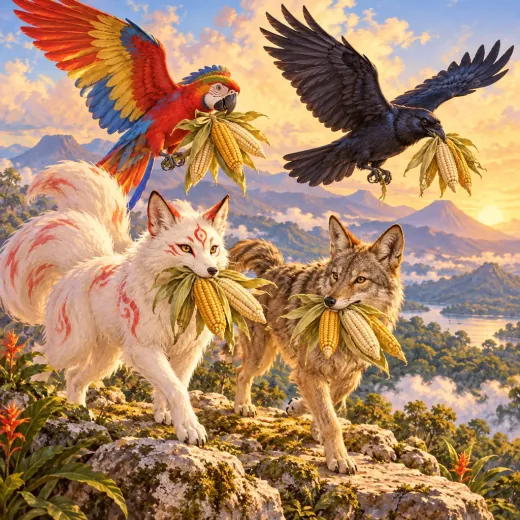
The Popol Vuh tells that the creator gods tried several times to make human beings. The animals could not name their creators, and so they made them of mud, but they melted and could not stand up. Then they made them of wood: they walked and talked, but they had no hearts and forgot their creators; they were swept away, and those who were left became monkeys. In the end four animals, the fox, the coyote, the parrot and the crow, showed the gods a place full of yellow and white maize. From that maize dough the true people were born.
Did you know? The only old copy of the Popol Vuh was written out around 1701 by a friar in Chichicastenango, and it is now kept in a library in Chicago.
The story
In the beginning there was nothing of what you see now.
There were no mountains, no trees, no rivers. There was nobody breathing. The Popol Vuh, the sacred book of the K'iche' of Guatemala, says that everything was still, calm, silent. The sky was empty. And under the sky there was only water, motionless as a mirror.
In the water were the creators. Their names were Tepeu and Gucumatz, and they talked together in the dark, and their voices had the power to make things. They said, “Earth!” And the earth rose from the sea like a mist growing thicker. They said, “Mountains!” And the mountains sprang up, one after another, as if someone were pulling them up from below.
Then came the animals. Deer, birds, jaguars, snakes: each one got its home, a ravine or a branch, a den or a pool. The creators told them, “Speak. Say our names. Worship us.”
The animals opened their mouths. Out came grunts, whistles, roars, squawks. Not a single name came out.
The creators were patient. They repeated their names once, twice, three times, slowly, the way you do with a child just learning to talk. The deer answered with one call, the birds with another, and the jaguar, by way of reply, yawned.
The creators looked at each other. “This won't do,” they said. “We need someone who can speak.”
So they tried mud.
They kneaded the wet earth and shaped it like a man. He was a soft man who could not stand up and could not turn his head. He talked, but his words made no sense. When water touched him, he melted. The creators watched him crumble and understood that this would not do either.
So they called two wise old ones: Grandmother Xmucané and Grandfather Xpiyacoc, who could read the future by casting grains of maize and the red seeds of a tree. “What should we do?” the creators asked. The two old ones cast the seeds, studied them for a long time, and answered, “Make them of wood.”
So they made men and women of wood.
These ones, yes, could stand. They walked, they talked, they multiplied, they filled the earth with children. But something was wrong. They had no heart, no soul. They did not remember their creators. They went on all fours, never looking up at the sky.
So the gods sent the flood. A rain of resin fell, thick and sticky. And that was when things began to rebel. The pots said, “You burnt us every day, now it's your turn.” The grinding stones said, “You crushed us every morning.” The dogs and the turkeys had their say too. The wooden people fled onto the roofs, up the trees, into the caves, but wherever they went, something chased them out. They say that the ones who survived, leaping from branch to branch, became the monkeys that still live in the forest today.
The world was empty again. Two attempts, two failures.
The creators no longer knew what to try. That was when the four animals arrived.
A fox, a coyote, a parrot and a crow. They had come from far away, feathers and fur all ruffled, and they brought news. “We've found a place,” they said. “It's called Paxil, and it's called Cayalá. It's full of maize. Yellow maize and white maize. Anyone who wants to eat can eat there.”
Grandmother Xmucané looked at the grains. Then she took the cobs and carried them home. She ground them on the stone nine times, nine long times, her hands white with flour. Then she mixed the flour with water, and little by little, out of the dough, came arms, legs, shoulders, hands. A body that moved. The most beautiful they had ever made. The grandmother looked at it, took a step back, and for the first time in a long while she smiled.
There were four men. Their names were Balam Quitzé, Balam Acab, Mahucutah and Iqui Balam.
They were the first who could truly speak. As soon as they opened their eyes, the first thing they said was: “Thank you, thank you twice, thank you three times. We have been made. We have a mouth, we have a face, we speak, we listen, we think, we walk. We see well.”
And they really did see well. They saw everything. They saw the shape of the sky and the bottom of the earth, they saw what was near and what was very, very far, without taking a step or turning their heads.
The creators stopped to think. “This is not good. If they see everything, they will be like us. And we do not want people to be gods.”
So the Heart of Sky breathed on their eyes. It was a light breath, like the one that settles on a mirror and fogs it. From that day on, people saw only what was close by. They lost the sight of the infinite, but they gained something: the time to look at what was in front of them.
Then, while the four slept, the creators gave each of them a wife. When they woke and saw her beside them, their hearts were full of joy.
From those four came children, and from the children came the children's children, and the world began to fill up again. This time nobody melted in the water. Nobody forgot who had made them.
The Popol Vuh was written in the K'iche' language around the middle of the 16th century, in the letters of the Latin alphabet, because the old painted books were gone. The original manuscript has been lost. What we have is the copy made around 1701 by a friar, Francisco Ximénez, at Chichicastenango, in the mountains of Guatemala. Today it is kept in Chicago, at the Newberry Library, very far from the mountains where it was written.
That is how great stories are saved: someone writes them down before they vanish, and someone else, a long time later, copies them out.
As for maize, in Guatemala they still grow it. And in that countryside, when the cob is ripe and golden, anyone who knows the book knows perfectly well what the tortilla they are eating is made of.
Relatives around the world
Listen / Read next
- Music to read by: Cinematic JourneyEpic film-style music, no lyrics, by Ciro Simone IrmiciSpotifyYouTube Music
Sources
- Popol Vuh, translated by Dennis Tedlock, Simon & Schuster (1985)
- Newberry Library, Chicago, manuscript Ayer MS 1515
