The Lost Valley of the Walser
“Das verlorene Tal”, in the Walser language
not scary at all
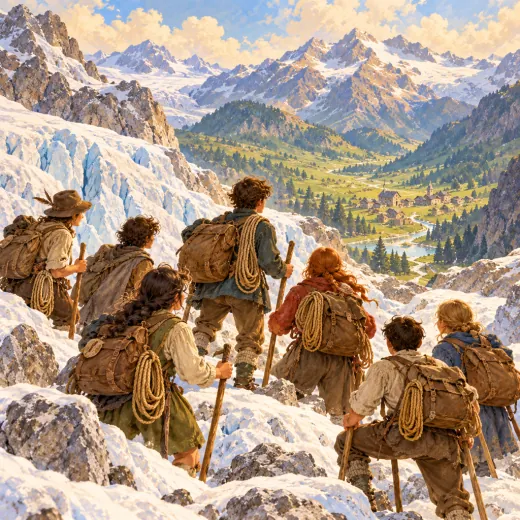
The Walser, mountain people who settled in Gressoney centuries ago, told of a green and happy valley hidden beyond the glaciers of Monte Rosa: the homeland of their ancestors. In 1778 seven young men from the village decided to go and see it. They climbed the glaciers, driven by curiosity more than by glory, until they passed 4,000 metres. From a spur of rock they finally saw below them the green pastures of the Riffelberg and the Riffelalp and the Zmutt valley. The expedition is true history; the lost valley was a dream.
Did you know? That rock is now called the “Rock of Discovery”, and the seven young men are remembered among the first climbers of Monte Rosa.
The story
In winter, at Gressoney, the dark comes early and the evenings never end. People sit in the stable, for the warmth of the cows, and the women spin and the men mend tools. The children sit on the floor and listen.
The grandmothers, on those evenings, told of a valley.
Not just any valley. Grandmother said that, behind Monte Rosa, beyond the glaciers, there was a place green as no other. Wide pastures. Tall grass. Fat cows, solid houses, people who did not have to toil. Once, they said, their ancestors had lived there. Then the glaciers had begun to grow, to cover the passes, to close the roads. And the valley had stayed there, untouched, on the other side of the white.
They called it the Verluoretal, "the lost valley".
The children listened open-mouthed. Many of them, as they grew up, forgot it. One did not.
Joseph Beck was eighteen and in the winter of 1777 he was at Alagna, the Walser village on the other side of Monte Rosa. There he heard something that made him lift his head: the people of Alagna wanted to go and look for the lost valley. That summer they would climb the glaciers to see whether it really existed.
Joseph came back to Gressoney for Easter with that news inside him. He told his brother Valentino.
"Why are we waiting for them to arrive?" said Valentino.
Neither of them could sleep that night. Then, one at a time, they looked for other boys: Franz Castel, Jean Etienne Litschgi, Joseph Zumstein, Sebastian Linty. Last of all Nicolaus Vincent joined them. There were seven.
They told nobody. They met in secret, in the evening, and discussed how to walk on ice, in what order they would march, what to put in the sacks. In those days the techniques of mountaineering were not yet known, nor the iron tools used today. Nobody had ever done anything of the kind. But they had something stronger: the wish to know what the world on the other side was like.
They were not seeking glory. They wanted the truth.
For months they had to pretend nothing was happening. With their parents, at work in the fields, at Mass: always with that thing hidden under the tongue. Joseph looked at Monte Rosa from the window, and Monte Rosa, large and white, seemed to look back at him.
At last the end of the summer of 1778 came. They gathered in secret at the Lavetz alp, and there they spent the night, without much sleep. At midnight they rose. They tied their shoes, loaded their sacks, and set out in the dark, one behind the other, without speaking.
The air was so cold that their teeth chattered. They passed the place they call Hoches Licht, and when they were beyond it, it was four o'clock. Then they began to climb the Garstelet glacier.
The ice creaked under their boots. Here and there were crevasses, cracks dark as mouths, which had to be skirted. Every now and then one stopped and the others waited. Nobody said "let us go back".
Dawn caught them on the glacier. The snow went from blue to pink, then to gold. Their breath had grown short. Every step cost effort, but nobody noticed. Behind them the valley of home grew small, then a dot, then nothing. Ahead there was only the climb, and every time they thought they had arrived another piece of slope appeared.
At noon they reached a point of black rock planted in the ice, in the middle of the pass they call the Lysjoch, at more than four thousand metres. They climbed onto the last stone, and there they stopped.
The wind had dropped. In front of them, below, lay the world.
And there was a valley. Green. Wide pastures, meadows, soft slopes. The Riffelberg, the Riffelalp, far below the Zmutt valley. Just as grandmother had told it.
Nobody spoke for a long while. Joseph thought of his grandmother's voice, and how many times, as a child, he had imagined just that green.
Then Valentino laughed, or perhaps wept, and after a while they were all laughing. They stayed there for two hours looking, sitting on the rock, eating what they had. To the rock on which they stood they gave the name Entdeckungsfels, "the rock of discovery".
"It is real," said someone. "It is not just a story."
"No," replied another. "But grandmother will not believe us."
Coming down took them the rest of the day. They returned to the Lavetz alp, where they slept, and only the next morning did they take the road home.
They did not stop at that single time. They went back in 1779, and again in 1780.
Each time the valley was there, the same, waiting for them. And each time, in the stables of Gressoney, one more child listened to the story of the lost valley and then, in secret, raised their eyes towards the glacier. Somehow, after that summer, the story had one more ending.
Almost two hundred and fifty years ago, seven boys from Gressoney, the local story says, got there first, without knowing what they would see. That is why they are remembered as the first mountaineers of Monte Rosa. But, from that day, the lost valley was no longer lost. It was only far away, and very beautiful.
Listen / Read next
- Music to read by: Cinematic JourneyEpic film-style music, no lyrics, by Ciro Simone IrmiciSpotifyYouTube Music
Sources
- Henri Armand, «Le notaire Bastrenta, Walser et citoyen du monde», Nouvelles du Centre d'études francoprovençales n. 49 (2004), con il racconto di Umberto Monterin sulla salita del 1778
- Walser Kulturzentrum / Centro Culturale Walser, «Walser Kulturzeitung» n. 8 (2018)
- Regione Autonoma Valle d'Aosta, turismo, «I Walser»
